


I've spent nearly a decade working with dogs across every temperament imaginable, from reactive rescues to perfectly polished show poodles. In that time, I've watched training methods evolve—and few tools spark more debate than e-collars. Understanding how top rated dog training collars actually work isn't just academic curiosity; it's essential knowledge if you're considering one for your dog. The science behind these devices helps explain both their effectiveness and their risks.
What Is an E-Collar?
An electronic training collar (commonly called an e-collar, remote training collar, or stimulation collar) is a device worn around a dog's neck that delivers controlled stimulation through contact points touching the skin. Despite what many people assume, top rated dog training collars aren't just "shock collars"—modern versions offer multiple stimulation types including vibration, tone, and various levels of static stimulation.

The basic setup includes a collar unit with contact probes and a handheld remote transmitter. When the handler presses a button on the remote, it sends a signal to the collar receiver, which then delivers the programmed stimulation. Most quality e-collars designed for training—not containment systems—offer adjustable intensity levels ranging from barely perceptible sensations up to higher levels meant for emergency recall.
I've handled dogs wearing these collars during grooming sessions, and the physical design matters more than most people realize. The contact points (usually metal prongs) need to sit flush against the skin, which means proper fit is critical. On double-coated breeds like my senior shepherd mix, that can be tricky—too loose and it won't make contact, too tight and you're creating pressure points that cause discomfort independent of any stimulation.
The technology has changed significantly even in the time I've been grooming. Early models offered limited control and crude on/off switches. Current top rated dog training collars feature precise intensity adjustment, multiple stimulation modes, and safety features like automatic shutoff timers. If you're exploring these tools, the dog training collar landscape includes far more nuance than the polarized online debates might suggest.
How It Works: The Physiology and Psychology

The science behind e-collar function operates on two levels: the physical sensation delivered to the dog and the behavioral conditioning that results. Let's start with what actually happens when you press that remote button.
The Physical Mechanism
When activated, the collar's contact points deliver electrical stimulation through the skin to underlying nerve receptors. At low levels, this creates a tingling or tickling sensation—think of the muscle stimulators physical therapists use, not a wall socket. Higher levels produce increasingly uncomfortable sensations that dogs instinctively want to avoid.
The intensity depends on several factors: the collar's power output, the contact point size and placement, the dog's coat thickness, skin sensitivity, and even moisture levels (wet skin conducts better). A level 3 on one collar isn't the same as level 3 on another—there's no standardized measurement across manufacturers. This variability is exactly why I recommend anyone considering these tools check out detailed guidance on dog training collar safety before putting one on their dog.
From what I've seen with my own high-energy terrier mix, the sensation needs to be noticeable enough to interrupt unwanted behavior but not so intense that it creates fear or panic. Finding that sweet spot requires careful calibration for each individual dog.
The Behavioral Science
E-collars work through operant conditioning, specifically positive punishment (adding an aversive to decrease a behavior) and negative reinforcement (removing an aversive when the dog complies). Here's how that plays out in practice:
When a dog begins an unwanted behavior—say, lunging toward a squirrel—the handler delivers stimulation. The dog experiences discomfort and stops the behavior. The stimulation ends. Over repeated exposures, the dog learns that ceasing the unwanted behavior makes the discomfort stop (negative reinforcement) and that starting the behavior causes discomfort (positive punishment).
The timing is absolutely critical. The stimulation must occur within one to two seconds of the behavior—the same timing window that makes treat-based training effective. Miss that window and the dog can't form the association between their action and the consequence.
What many people don't realize is that effective e-collar training also incorporates classical conditioning. Dogs learn to associate the sensation with specific cues or contexts. A well-trained e-collar dog might respond to a low-level vibration or even just the sound of the remote beep because those stimuli predict the possibility of static correction—the actual correction becomes unnecessary over time.
I've watched professional trainers use these collars with precision that borders on artistry. But I've also groomed dogs who were clearly confused or anxious because their owners applied stimulation inconsistently or at inappropriate intensities. The science works, but only when applied with consistent, informed technique.
Why It Matters: Practical Applications and Considerations
Understanding the mechanics of e-collars matters because these are powerful tools with real consequences—both positive and negative—for your dog's behavior and emotional wellbeing.
When They Can Be Useful
For certain training challenges and specific dogs, e-collars offer advantages that other methods struggle to match. Off-leash reliability is the big one. When my clients ask about recall training for dogs who'll be hiking or hunting off-leash, I understand why trainers sometimes recommend these tools. The remote gives you the ability to communicate consequences across distances where your voice won't reach and treats can't compete with the environment.
They can also help with high-drive behaviors that are self-reinforcing—chasing wildlife, fence fighting, or prey-driven aggression. When the behavior itself provides massive internal reward, you need a pretty compelling reason for the dog to stop. A well-timed, appropriately calibrated correction can interrupt the behavior long enough for redirection.
Some working dogs—hunting retrievers, livestock guardians, or protection dogs—are trained with e-collars as part of industry-standard protocols. The best dog training collars for these purposes often include features like longer range and waterproof construction.
The Risks and Downsides
But here's what keeps me cautious: I've personally seen the fallout when these collars are misused. One of my regular grooming clients, a sweet golden retriever, developed noise sensitivity and anxiety after inconsistent e-collar application. The owner was trying to stop barking but couldn't figure out the right timing or intensity. The dog just learned that unpredictable bad things happened when he was excited.
Potential negative outcomes include:
- Fear and anxiety: Especially if stimulation is too intense or poorly timed
- Aggression: Some dogs redirect frustration from the correction onto nearby people or animals
- Learned helplessness: When dogs can't figure out how to avoid the stimulation
- Suppressed communication: Dogs may stop warning signals (like growling) before aggressive behavior, making them more dangerous
- Physical harm: Rare but possible with prolonged contact or excessive intensity
The behavioral science research is pretty clear that training methods emphasizing positive reinforcement create better long-term outcomes for most dogs and most training goals. E-collars aren't necessary for the majority of training challenges—patient, consistent positive reinforcement training works for everything from basic obedience to complex behaviors.
Types & Variations of E-Collar Systems
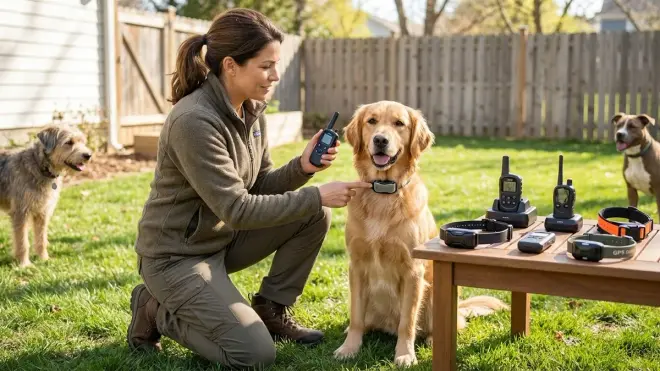
Not all electronic training collars function the same way. Understanding the variations helps you recognize what you're actually looking at when evaluating top rated dog training collars.
By Stimulation Type
Static stimulation collars deliver electrical pulses through contact points. These range from ultra-low "tickle" sensations to higher corrections. Quality models offer 50-100+ adjustable levels.
Vibration collars use a motor to create buzzing rather than electrical stimulation. Some dogs find vibration more aversive than low-level static; others barely notice it. My terrier mix thinks vibration is hilarious and will trigger it deliberately.
Spray collars release a burst of citronella or unscented air near the dog's face. These fall under the broader category of correction collars but use a completely different mechanism.
For a detailed comparison of how these different approaches stack up in training effectiveness, check out shock collars vs vibration collars vs spray collars.
By Function
Containment/boundary systems trigger automatically when the dog approaches a buried wire perimeter. These are fundamentally different from training collars—the dog controls when correction happens based on location, not behavior.
Anti-bark collars activate automatically in response to vocalization, using sensors that detect vibration or sound. I'm personally skeptical of these because they can't distinguish between nuisance barking and legitimate alert barking. For alternatives, consider other bark-reduction methods that address the underlying cause.
Remote training collars are handler-activated, giving you control over timing and intensity. These are what most people mean when discussing e-collar training.
By Size and Power
Small dog training collars use lighter receivers and lower maximum intensities appropriate for dogs under 20 pounds. Using a standard collar on a small breed risks delivering disproportionate stimulation.
Standard collars work for medium to large dogs (roughly 30-120 pounds), while heavy-duty models exist for working dogs over 100 pounds with thick coats.
Feature Variations
Modern top rated dog training collars might include waterproofing, multiple-dog capacity (one remote controlling several collars), GPS tracking, smartphone app integration, and safety features like automatic timeout after continuous stimulation. The bells and whistles matter less than core functionality, but a truly waterproof collar makes sense if your dog swims.
Frequently Asked Questions

Are e-collars safe for all dogs?
No, e-collars are not appropriate for all dogs. Puppies under six months shouldn't use them because their developing brains are more vulnerable to stress and fear associations. Dogs with heart conditions, seizure disorders, or significant anxiety may have adverse reactions to stimulation. Fearful or reactive dogs often worsen with aversive methods. Senior dogs with cognitive decline may become confused by corrections they can't connect to behavior. Always consult a veterinary behaviorist before using an e-collar on any dog with health or behavioral issues.
What's the difference between top rated dog training collars and cheap ones?
Quality e-collars offer precise, consistent stimulation levels with clear gradations between intensities, while cheap models often have poorly calibrated outputs that jump erratically between levels. Top rated dog training collars feature better build quality with waterproof seals, durable contact points that won't corrode, and reliable wireless range. They typically include safety features like automatic shutoff and low-battery warnings. Cheap collars may deliver unintended intensity spikes or fail when wet. Given that you're using this on a living being you care about, the price difference isn't worth the risk.
Can you use an e-collar without professional training help?
Technically yes, but I wouldn't recommend it for most people. The mechanics seem simple—press button, dog stops behavior—but the timing, intensity selection, and integration with positive reinforcement require more skill than most owners realize. Poor technique can damage your relationship with your dog and create behavioral problems worse than what you started with. At minimum, work with a qualified trainer for initial setup and introduction. For guidance on proper introduction methods, see how to introduce a training collar without causing fear.
How do I know what intensity level to use on my dog?
Start at the absolute lowest setting and gradually increase until you see the smallest perceptible response—maybe an ear flick, a pause, or slight head turn. That's your working level for training. You should never need to go high enough to cause yelping, cowering, or panic. Test on yourself first (yes, really) to understand what each level feels like. Adjust for context: you might need slightly higher intensity outdoors with distractions than in a quiet room. Reassess regularly because dogs can become sensitized or desensitized over time.
Are there alternatives to e-collars for off-leash training?
Yes, though they require more time and higher skill from the handler. Long-line training uses a 20-50 foot leash to give freedom while maintaining physical control during recall practice. High-value reward training builds intrinsic motivation to return—think real chicken or cheese, not dry kibble. Treat-based puppy training establishes foundation skills that transfer to off-leash work. Some dogs achieve reliable recall through these methods alone, though it typically takes months of consistent practice rather than the weeks often claimed for e-collar training.
Summary

E-collars deliver controlled electrical, vibrational, or spray stimulation through a remote-activated collar unit. The science behind them relies on operant conditioning—specifically punishment and negative reinforcement—to decrease unwanted behaviors and increase compliance. Modern top rated dog training collars offer adjustable intensities and safety features their predecessors lacked, but the fundamental mechanism hasn't changed: they create an aversive experience the dog learns to avoid by modifying behavior.
From my grooming table perspective, I see the results of both skillful and careless e-collar use. The dogs trained by knowledgeable professionals show reliable responsiveness without fear. The dogs trained by owners who bought a collar without proper education often show stress responses that make my work harder—and break my heart a little.
These tools work through well-established behavioral science, but "works" doesn't automatically mean "best choice." For many dogs and many training goals, positive reinforcement methods achieve the same outcomes without the risks. If you're considering an e-collar, invest in professional guidance and understand the physiology you're manipulating. Your dog's trust is worth getting this right the first time.