
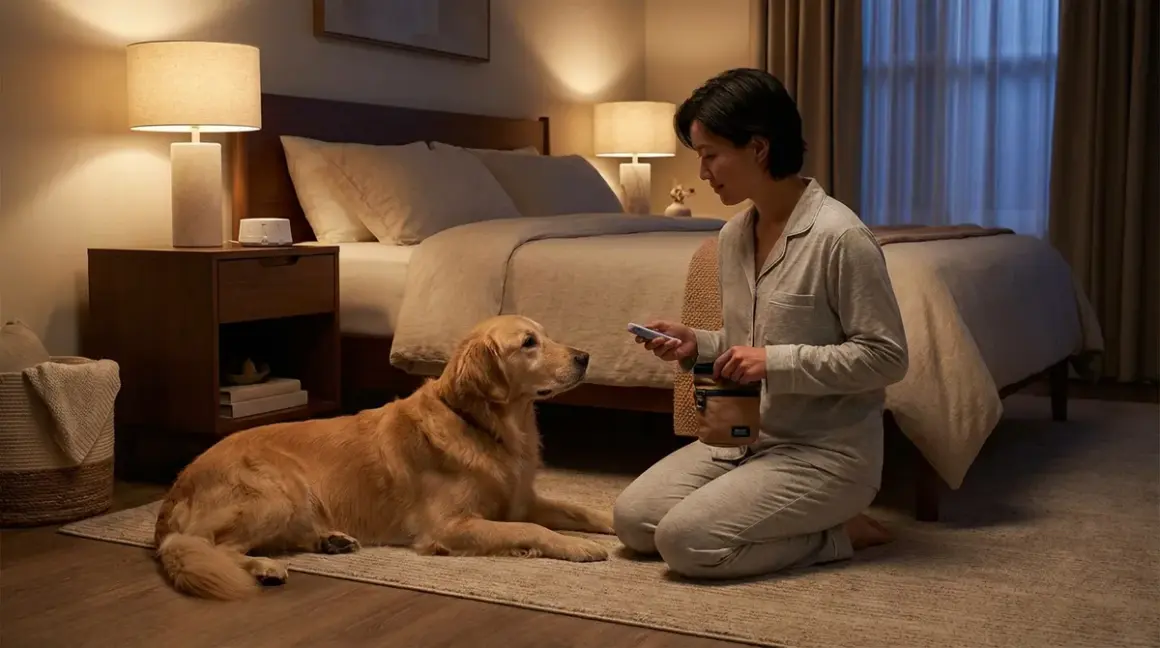

Nothing wrecks your sleep quite like a dog barking at 2 a.m. I've worked with hundreds of families dealing with nighttime barking, and I can tell you this: figuring out how to stop dog barking at night isn't about finding one magic fix. It's about understanding why your dog's doing it and then applying the right combination of techniques that actually work for your specific situation. The good news? Once you nail down the cause, most dogs can learn to sleep quietly through the night within a couple of weeks.
What Is Nighttime Dog Barking?
Nighttime barking is exactly what it sounds like—your dog vocalizing during the hours you're trying to sleep, typically between bedtime and morning. But here's what matters: not all nighttime barking is the same thing.

Some dogs bark sporadically in response to outside noises—cars passing, wildlife moving through the yard, neighbors coming home late. Other dogs bark persistently for minutes or even hours, often due to anxiety, attention-seeking, or unmet needs. I've seen this a hundred times: a puppy who hasn't learned to self-soothe yet, an adult dog dealing with separation anxiety, or a senior dog experiencing cognitive changes that disrupt their sleep cycle.
The barking can happen in different contexts too. Your dog might bark from their crate, from your bedroom, from another room, or even from outside if they sleep in a covered area. Each scenario tells you something different about what's driving the behavior.
Age plays a huge role here. Puppies under six months often bark at night because they're adjusting to being alone, need bathroom breaks, or haven't developed the emotional regulation to settle down independently. Adult dogs (1-7 years) typically bark due to environmental triggers, insufficient exercise, or reinforced attention-seeking patterns. Senior dogs (7+ years, depending on breed size) may develop nighttime vocalization due to cognitive dysfunction syndrome, pain from arthritis or other conditions, or changes in their sensory perception like hearing loss that makes them more reactive to unexpected stimuli.
The intensity and pattern of barking matters too. A few alert barks when someone walks past your house is different from continuous demand barking that only stops when you appear. That distinction shapes how you'll approach the solution.
How Nighttime Barking Works (And Why Dogs Do It)
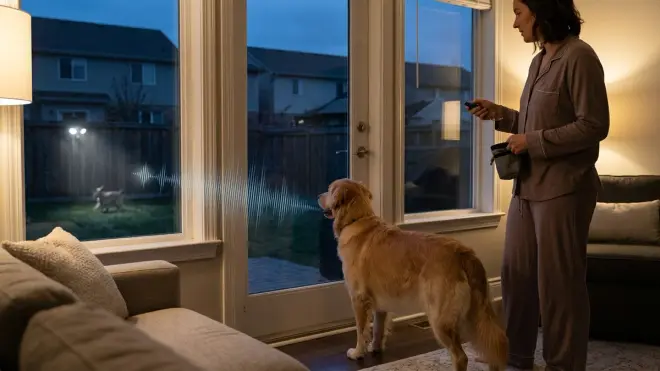
To figure out how to stop dog barking at night, you need to understand what's actually happening in your dog's head. Dogs bark at night for the same reasons they bark during the day—communication, alerting, anxiety, or learned behavior—but nighttime amplifies certain triggers while removing others.
Here's what usually happens: Your home gets quieter at night, which means your dog's hearing becomes more sensitive to environmental sounds. That raccoon rummaging through trash bins two houses down? Your dog hears it crystal clear. The neighbor's cat crossing the yard? Your dog knows it's there. During the day, these sounds get drowned out by normal household activity. At night, they stand out.
Then there's the anxiety component. When you're asleep or in another room, your dog might experience what behaviorists call separation distress. This is especially common in dogs who haven't been taught to feel comfortable being alone. The barking is their way of saying "Hey, where is everyone? I need someone here with me." For these dogs, silence and darkness create uncertainty that triggers vocalization.
I've also seen the reinforcement cycle play out countless times. It works like this: Dog barks at night. You get up to check on them, tell them to be quiet, or let them out of their crate. Your dog just learned that barking gets your attention and potentially gets them what they want. Even negative attention—you yelling "Quiet!"—is still attention. It doesn't take long before your dog develops a habit of barking because the behavior has been consistently rewarded.
Physical discomfort drives nighttime barking too, particularly in puppies and senior dogs. A puppy with a full bladder will bark because they're trying to avoid eliminating in their sleeping area. A senior dog with arthritis might bark because they're stiff and sore from lying in one position. These are legitimate need-based vocalizations, not behavioral issues.
Breed characteristics influence nighttime barking patterns as well. Guard breeds like German Shepherds, Rottweilers, and Dobermans were literally bred to be alert to environmental changes and announce potential threats. Hound breeds like Beagles and Coonhounds have strong vocalization instincts. Terriers can be reactive and persistent. That doesn't mean these dogs can't learn quiet nighttime behavior—they absolutely can—but you're working with their genetic predisposition, not against it.
The biological reality is that dogs are crepuscular animals, meaning they're naturally more active during dawn and dusk. Their wild ancestors did most of their hunting and moving around during these low-light periods. Your domestic dog still carries some of that programming, which is why many dogs get a burst of energy in the evening and can be alert during early morning hours.
One more piece that matters: dogs have shorter sleep cycles than humans. While you might sleep for seven or eight hours straight, your dog cycles between sleep stages every 30-45 minutes. During their lighter sleep phases or when they wake up briefly, they're more likely to notice and react to stimuli that you'd sleep right through.
Why Solving Nighttime Barking Matters

Let's be direct here: chronic sleep deprivation affects every part of your life. When your dog barks at night repeatedly, you're not just dealing with a training problem—you're dealing with compounding stress that impacts your health, your relationships, your work performance, and your patience with your dog during the day.
I've worked with clients who were genuinely at their breaking point. They'd tried "just ignoring it" for weeks, losing hours of sleep every night, becoming increasingly short-tempered with their partner, their kids, and their dog. Some were considering rehoming a dog they otherwise loved because the nighttime barking was unsustainable. That's not an exaggeration—chronic nighttime disruption is one of the most common behavioral complaints that leads to dogs being surrendered.
Your dog's wellbeing matters too. A dog who barks excessively at night is telling you something's wrong. They might be anxious, scared, in pain, or confused. Addressing nighttime barking isn't about suppressing a behavior—it's about identifying and resolving whatever's causing your dog distress. A dog who sleeps peacefully through the night is a dog who feels secure, comfortable, and confident in their environment.
There's also the neighbor factor. Depending on where you live, persistent nighttime barking can strain relationships with neighbors or even result in noise complaints. I've seen situations escalate to the point where homeowners associations or local animal control got involved. Solving the problem protects your living situation and your relationship with the people around you.
Beyond the immediate disruption, nighttime barking often signals other training gaps that affect your daily life too. A dog who barks at night due to separation anxiety probably shows anxiety when you leave for work. A dog who barks for attention at 3 a.m. likely demands attention inappropriately during the day. When you address the nighttime issue properly, you're often improving your dog's overall behavior and emotional regulation.
11 Proven Methods to Stop Dog Barking at Night
Here's what actually works. Not every method will apply to your situation, but once you identify why your dog's barking, you'll know which ones to focus on.
1. Increase Daytime Physical Exercise
A tired dog is a quiet dog. I can't count how many nighttime barking problems I've seen resolve simply because the dog started getting adequate physical activity during the day.
Most adult dogs need 30-90 minutes of genuine exercise daily, depending on their breed, age, and energy level. A Border Collie or Australian Shepherd needs way more than a Bulldog or senior Pug. Here's what matters: walking around the block a couple times doesn't cut it for high-energy breeds. You need activities that get their heart rate up—running, fetch, swimming, dog park play sessions, or walks with intervals of jogging.
The timing matters too. Exercise your dog in the late afternoon or early evening, a few hours before bedtime. This gives them time to physically tire out, mentally wind down, and enter the evening already depleted of excess energy. A dog who's been lying around the house all day still has plenty of gas in the tank at midnight.
For puppies, be careful not to over-exercise developing joints. The general rule is five minutes of exercise per month of age, twice daily. A four-month-old puppy should get about 20 minutes of exercise twice a day. But even young puppies need appropriate activity to sleep well at night.
2. Add Mental Stimulation and Enrichment
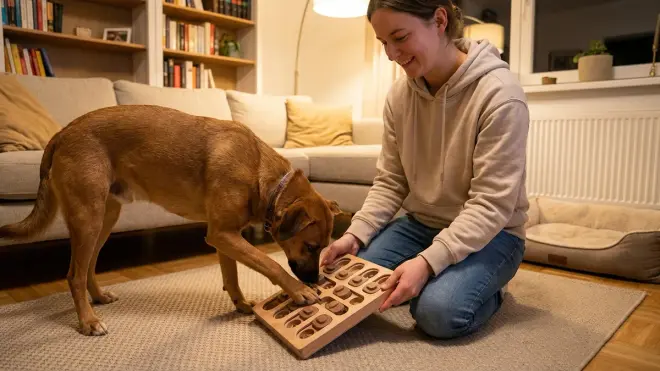
Physical exercise tires the body. Mental work tires the brain. And a mentally exhausted dog sleeps more soundly than one who's just physically worn out.
Mental enrichment includes puzzle feeders, snuffle mats, training sessions, scent work, and any activity that makes your dog think and problem-solve. I usually recommend a 15-20 minute training session in the evening—teaching new tricks, practicing commands with high-value training treats, or working on impulse control exercises.
Food puzzles at dinner time work great. Instead of feeding from a bowl, make your dog work for their meal using a Kong Wobbler, a snuffle mat, or even just scattering kibble in the grass for them to find. This engages their natural foraging instincts and provides mental stimulation that carries over into calmer evening behavior.
For dogs who bark at environmental triggers, scent work is particularly effective. Teaching your dog to identify and indicate specific scents gives them a job that channels their alertness into a focused activity rather than reactive barking.
3. Establish a Consistent Bedtime Routine
Dogs thrive on predictability. When bedtime follows the same sequence every night, your dog learns to anticipate sleep and begins to relax before you even turn off the lights.
Create a routine that happens in the same order at roughly the same time each night. Here's what works for most families: final meal at least 2-3 hours before bed, last bathroom break right before bedtime, a few minutes of calm interaction (gentle petting, quiet talking), then settling into their sleep space with a cue like "bedtime" or "settle."
The predictability itself becomes a cue. After a week or two of consistent routine, your dog's body starts preparing for sleep when the sequence begins. Their stress hormones lower, their heart rate decreases, and they mentally shift into rest mode.
Avoid high-energy play right before bed. I've seen owners who think they're tiring their dog out with a late-night play session, but what they're actually doing is amping up their dog's arousal level right when they need them to wind down. Active play triggers adrenaline and cortisol that take time to clear the system.
4. Address Bathroom Needs Properly
This one's straightforward but critical: if your dog needs to eliminate during the night, they're going to vocalize about it, especially puppies and senior dogs.
Puppies under four months typically can't hold their bladder through the night. They need a middle-of-the-night bathroom break. Set an alarm, take them out quietly and calmly, no play or excitement, then right back to bed. As they mature, gradually extend the time between breaks until they can make it through the night.
Senior dogs may develop reduced bladder control due to aging, medications, or health conditions. If your older dog suddenly starts barking at night after years of quiet sleeping, consider a late-evening bathroom break right before you go to bed and potentially limiting water intake in the hour or two before bedtime (but always ensure adequate hydration throughout the day).
Watch for signs of medical issues. Excessive nighttime urination or difficulty holding their bladder can indicate urinary tract infections, diabetes, kidney problems, or other health conditions that need veterinary attention. If bathroom-related nighttime barking appears suddenly or worsens despite appropriate breaks, schedule a vet visit.
5. Use White Noise to Mask Environmental Triggers

Here's a simple fix that works surprisingly well for dogs who bark at outside sounds: consistent background noise that masks the triggers without being intrusive.
A white noise machine designed for sound-sensitive dogs or even a box fan creates a consistent sound blanket that makes it harder for your dog to hear (and react to) cars, wildlife, and other nighttime noises. This works particularly well for alert breeds and dogs who sleep in rooms facing the street.
The key is consistency. Turn it on every night as part of the bedtime routine so your dog learns to associate the sound with sleep time. Place it between your dog's sleeping area and the most common source of trigger sounds—usually a window or exterior wall.
Some dogs respond better to calming music or nature sounds. I've had clients use apps specifically designed for anxious dogs with frequencies and rhythms that promote relaxation. Experiment with what works for your dog, but once you find something effective, stick with it consistently.
6. Optimize Their Sleeping Environment
Where and how your dog sleeps directly impacts their nighttime behavior. An uncomfortable or anxiety-inducing sleep space sets you up for barking problems.
For crated dogs, make sure the crate is appropriately sized—large enough for them to stand, turn around, and lie down comfortably, but not so large that they have room to eliminate in one corner and sleep in another. Cover three sides of the crate with a breathable blanket to create a den-like environment that feels secure. Place comfortable bedding inside appropriate for the temperature—cooling mats in summer, warmer bedding in winter.
Crate location matters too. Dogs are social animals. For many dogs, especially puppies and anxious dogs, placing the crate in your bedroom or just outside your bedroom door significantly reduces nighttime anxiety and barking. They can smell and hear you, which provides reassurance without requiring your active attention. If you'd prefer they eventually sleep elsewhere, you can gradually move the crate farther from your bedroom over several weeks once the barking is resolved. You can learn more about crate training specifically for nighttime quiet.
For dogs who sleep outside a crate, provide a comfortable bed in a quiet, low-traffic area where they won't be disturbed by household activity or outside stimuli. Some dogs sleep better with slight elevation (a bed on a low platform or couch they're allowed on) because it gives them better visual awareness of their environment.
Temperature control is crucial. Dogs generally sleep best in slightly cooler environments—around 65-70°F for most breeds. Overheating causes restlessness and can trigger vocalization.
7. Teach the "Quiet" Command

This is a fundamental training tool that gives you a way to interrupt barking and reward silence. But here's the catch: this only works if you've trained it properly during the day first. You can't introduce a new command in the middle of the night and expect results.
Here's how to teach it: During the day, when your dog barks (at the doorbell, during play, whatever), say "quiet" in a calm, firm voice. The instant they stop barking—even for just a second—immediately mark it with "yes!" or a click if you use a clicker, then give them a treat. Repeat this dozens of times over multiple days until your dog consistently stops barking when you say "quiet."
The key is you're rewarding the silence, not just stopping the bark. Wait for them to be genuinely quiet for at least 2-3 seconds before rewarding. Gradually extend the duration of quiet before the reward.
Once your dog reliably responds to "quiet" during the day, you can use it at night. When they bark, calmly say "quiet," and reward immediately when they comply. Don't yell it, don't repeat it multiple times—one calm command, then wait for the response.
If your dog barks persistently at night despite the "quiet" command working during the day, it usually means you haven't addressed the underlying cause. The command becomes useful for minor interruptions but won't solve anxiety-driven or need-based barking.
8. Address Separation Anxiety and Fear
If your dog's nighttime barking stems from anxiety about being alone, you need to address the emotional issue, not just suppress the behavior. This takes time and patience but creates lasting change.
Start by building confidence during the day. Practice short separations—leave the room for 30 seconds, come back, no big deal. Gradually extend the duration. The goal is teaching your dog that you always come back and that being alone briefly is completely safe.
For nighttime, this might mean temporarily sleeping closer to your dog's sleeping area, then gradually increasing distance over several weeks. I know that sounds like going backward, but you're building a foundation of security that allows your dog to eventually sleep independently without distress.
Calming aids can help during this process. Products containing L-theanine, chamomile, or melatonin may take the edge off mild anxiety. Some dogs respond well to pheromone diffusers that mimic the calming signals mother dogs release to their puppies. Anxiety wraps or weighted vests create gentle pressure that some dogs find soothing. These aren't magic fixes, but they can support behavioral training.
For severe separation anxiety, work with a certified professional dog trainer or veterinary behaviorist. Some cases benefit from prescription anti-anxiety medication alongside behavior modification.
9. Eliminate Reinforcement of the Barking
This is tough because it requires you to change your behavior: stop responding to nighttime barking in ways that reward it. Every time you get up, talk to your dog, let them out of their crate for comfort, or give them attention when they bark at night, you're teaching them that barking works.
Here's what usually happens: Dog barks. You ignore it for five minutes. Dog keeps barking. You ignore it for another ten minutes. Finally, you can't take it anymore, so you get up and tell them to be quiet. You just taught your dog that persistent barking for 15 minutes gets your attention. Next time, they'll probably bark for 20 minutes because they learned the threshold.
The solution isn't easy, but it's straightforward: once you've ruled out legitimate needs (bathroom, water, discomfort), you have to consistently not respond to demand barking. This means earplugs, white noise for you, and commitment to riding it out. Most dogs will escalate briefly (called an "extinction burst") before the behavior diminishes.
Important exception: never ignore sudden, unusual barking from a dog who normally sleeps quietly. That could indicate a genuine emergency—pain, illness, or a real threat. I'm talking about eliminating reinforcement for chronic, pattern-based barking that you've identified as attention-seeking or anxiety-driven.
10. Consider Strategic Feeding Times
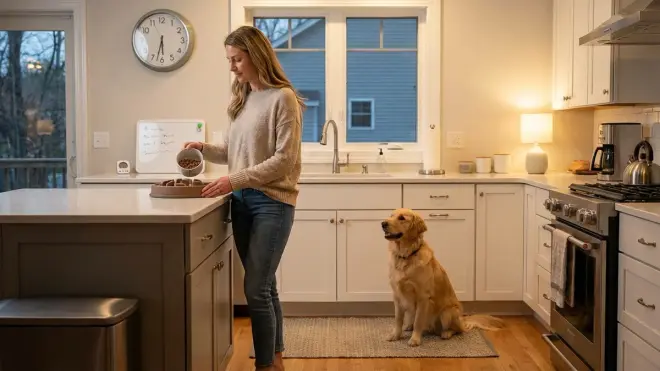
When and what you feed your dog affects their nighttime behavior more than most people realize. Feeding too close to bedtime can cause nighttime bathroom urgency. Feeding too early might mean your dog's genuinely hungry at 4 a.m.
For most adult dogs, I recommend the last meal at least 3-4 hours before bedtime. This gives them time to digest and eliminate before settling down for the night. Pick up water about an hour before bed (but make sure they've had adequate hydration throughout the day—don't restrict water as a general rule).
What you feed matters too. High-quality, digestible dog foods that meet AAFCO nutritional standards are less likely to cause digestive upset that could disrupt sleep. Some dogs do better with certain food types depending on their individual digestion.
If your dog seems restless at night, try a small training-treat-sized snack right before bed—something with a bit of protein that satisfies without creating a full stomach. Some people use a frozen Kong with a small amount of wet food that their dog can work on as they settle down for the evening.
For puppies who still need multiple meals, time the last feeding 2-3 hours before bed and take them out immediately before crating them for the night.
11. Rule Out Medical Issues
If you've tried multiple behavioral approaches and your dog's nighttime barking persists or appears suddenly after a period of normal sleeping, you need to rule out underlying health problems.
Pain is a major cause of nighttime vocalization, especially in senior dogs. Arthritis, dental disease, gastrointestinal discomfort, or injuries that worsen when lying down can trigger barking. Dogs often seem fine during the day when they're moving around, then vocalize at night when they're still and the discomfort becomes more noticeable.
Cognitive dysfunction syndrome (CDS) in senior dogs causes confusion, disorientation, and sleep-wake cycle disruption. Dogs with CDS may bark at night because they're genuinely confused about where they are or what's happening. This condition is similar to dementia in humans and affects a significant percentage of dogs over 10 years old.
Hearing loss in senior dogs can lead to increased barking because they can't hear themselves and because unexpected stimuli (vibrations, visual changes) startle them more easily without auditory warning. Vision loss creates similar issues.
Hypothyroidism, pain from internal organs, urinary issues, and numerous other conditions can manifest as behavior changes including nighttime barking. If your dog shows other symptoms—changes in appetite, water consumption, energy level, mobility, or bathroom habits—get to your vet promptly.
Even for dogs where behavioral causes seem obvious, I always recommend a veterinary checkup before implementing a training plan. You want to make sure you're not trying to train away a symptom of illness.
Types of Nighttime Barking and What They Mean

Alert barking happens when your dog hears something outside—animals, people, vehicles. It's usually sharp, repetitive, and clearly directed toward a specific trigger. Dogs bred for guarding or alerting are more prone to this type. The barking typically stops once the trigger passes or you've acknowledged it.
Attention-seeking barking is persistent and often escalates if ignored initially. Your dog has learned that barking gets you to appear, even if you're telling them to stop. This type usually follows a predictable pattern—same time each night, similar intensity, clear response when you engage.
Anxiety-driven barking often includes other stress signals: whining, pacing (if not crated), panting, destructive behavior. It may start as soon as you leave the room or shortly after. The barking typically has a higher, more distressed quality compared to alert barking.
Need-based barking happens when your dog genuinely needs something—bathroom break, water, or they're uncomfortable. It's usually intermittent initially, then becomes more insistent. This type often resolves immediately once the need is met.
Age-related confusion barking in senior dogs may seem random, happen at odd hours, and not follow a clear pattern. The dog might seem disoriented when you check on them. This type requires a different approach focused on environmental management and veterinary support rather than traditional training.
Understanding which type you're dealing with determines how to stop dog barking at night effectively. Alert barking needs environmental modification and desensitization. Attention-seeking requires consistent non-reinforcement. Anxiety needs confidence-building and possibly calming aids. Needs-based barking requires schedule adjustments. Confusion-related vocalization needs medical intervention and environmental support.
Frequently Asked Questions

How long does it take to stop a dog from barking at night? Most cases of nighttime barking improve significantly within 7-14 days if you consistently apply appropriate methods targeting the specific cause, though attention-seeking behavior may take 3-4 weeks of strict non-reinforcement to fully resolve. Anxiety-based barking typically requires 4-8 weeks of systematic confidence-building work, while medical issues show improvement once the underlying condition receives proper veterinary treatment.
Should I let my puppy bark it out at night in their crate? For puppies under four months, never ignore persistent nighttime barking without first checking whether they need a bathroom break—they genuinely can't hold their bladder all night yet. Once you've confirmed their physical needs are met, short periods of self-soothing (5-10 minutes of intermittent fussing) help them develop independence, but prolonged distress barking requires reassessment of your crate training approach, placement, or bedtime routine.
Will an anti-bark collar stop nighttime barking? Anti-bark collars suppress the symptom without addressing the underlying cause, which means they may temporarily reduce barking but often create additional stress, especially for dogs barking due to anxiety, fear, or legitimate needs. Humane anti-bark options for small dogs exist, but I only recommend considering them after you've exhausted behavioral training approaches and confirmed with your vet that no medical issues are present—they're a tool of last resort, not a first-line solution.
Why does my dog only bark at night when I'm trying to sleep? Dogs don't specifically target your sleep time—nighttime barking happens because your home is quieter (making environmental sounds more noticeable to your dog), you're unavailable (triggering separation distress in anxious dogs), darkness amplifies fear responses in some dogs, and previously reinforced attention-seeking behavior has taught them that nighttime barking successfully gets you to respond even when daytime barking doesn't.
Can certain dog foods cause more nighttime barking? While food doesn't directly cause barking, low-quality diets with difficult-to-digest fillers or inappropriate ingredient ratios can create digestive discomfort, excessive hunger, or energy spikes that contribute to restlessness and nighttime vocalization. Dogs with undiagnosed food sensitivities may experience discomfort that worsens at night when they're still, and feeding times that don't align with your dog's digestive rhythm can create bathroom urgency that triggers barking.
Summary
Learning how to stop dog barking at night comes down to three things: identifying the real cause behind your dog's barking, addressing that specific cause with appropriate methods, and staying consistent long enough for new patterns to form. I've seen this work countless times—the dog who kept an entire household awake for months learns to sleep peacefully once their owner figures out whether it's about anxiety, environmental triggers, insufficient exercise, or unmet needs.
Start with the basics: make sure your dog gets adequate physical exercise and mental stimulation during the day, establish a consistent bedtime routine, and create a comfortable sleeping environment. Rule out medical issues if the barking appeared suddenly or your dog shows other concerning symptoms. Then layer in targeted solutions—white noise for alert barkers, confidence-building for anxious dogs, schedule adjustments for puppies and seniors.
The key is patience and consistency. Most nighttime barking doesn't resolve overnight, but you should see improvement within the first week if you're addressing the right cause. And once your dog (and you) start getting solid, uninterrupted sleep again, you'll remember why you wanted a dog in the first place.