
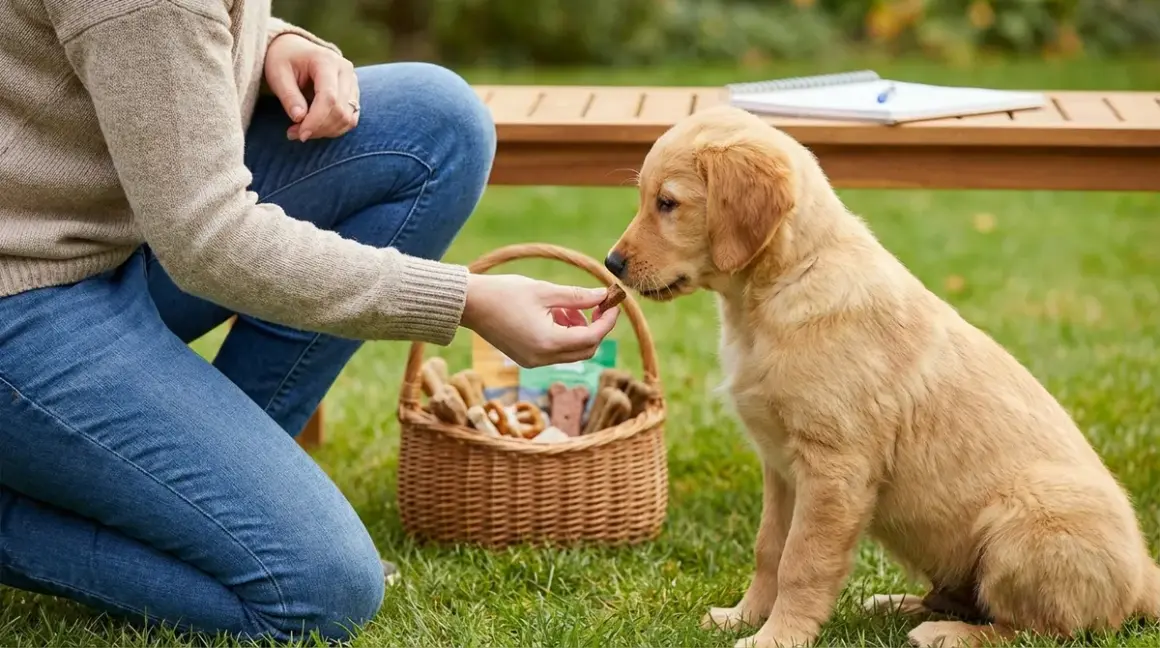

If you're wondering how many treats can I give my puppy during training, you're not alone. I've seen this question come up hundreds of times over the years, and for good reason—treats are the most powerful tool in your training toolkit, but too many can lead to upset stomachs, picky eating, and weight problems down the road.
Here's what you'll learn in this guide: the exact formula for calculating your puppy's daily treat allowance, how to distribute those treats throughout training sessions, and practical strategies to maximize your training effectiveness without overdoing the snacks. This isn't complicated stuff, but getting it right makes a massive difference in both your training results and your puppy's long-term health.

Skill level: Beginner-friendly
Time to implement: Immediate (once you understand the calculation)
Whether you're working with an 8-week-old Golden Retriever puppy or a 5-month-old Terrier mix, these guidelines apply across all breeds and sizes. Let's get into the specifics.
What You'll Need
Before we dive into how many treats can I give my puppy during training, gather these items:
- Your puppy's current weight (use a bathroom scale for larger breeds, a kitchen scale for toy breeds)
- Your puppy food bag (to check calorie content per cup)
- Your chosen training treats (check the calorie information on the package)
- A kitchen scale or measuring cups (for portion accuracy)
- A small treat pouch (to carry treats during training sessions)
- Your puppy's daily feeding schedule (to know how much regular food they're getting)
- Calculator or smartphone (for quick calorie math)
Optional but helpful:
- Multiple types of training treats in different value levels (low, medium, high)
- Small containers for pre-portioning daily treat allowances
- A notebook to track training sessions and treat usage
Step 1: Calculate Your Puppy's Total Daily Calorie Needs
The foundation of figuring out how many treats can I give my puppy during training starts with knowing their baseline calorie requirements. Puppies need significantly more calories per pound than adult dogs because they're growing rapidly—sometimes gaining several pounds per week during their fastest growth phases.
Here's the practical approach I use: Puppies generally need about twice the calories of an adult dog of the same weight. For a quick baseline, multiply your puppy's current weight in pounds by 50-60 calories. So a 20-pound puppy needs roughly 1,000-1,200 calories daily. That said, this varies based on breed size, activity level, and growth rate.
Small and toy breed puppies (under 20 pounds at maturity) tend to burn calories faster and may need up to 60-70 calories per pound. Large and giant breed puppies actually need fewer calories per pound—around 40-50—because we want to control their growth rate to protect developing joints. A Great Dane puppy growing too fast faces serious orthopedic risks.
The most reliable number comes from your puppy food packaging. Most quality puppy foods include feeding charts that account for age, current weight, and expected adult weight. Use those recommendations as your starting point, then calculate the total calories they're getting from their regular meals.
For example, if your puppy food contains 400 calories per cup and you're feeding 2.5 cups daily, that's 1,000 calories from regular food. Keep this number handy—you'll need it for the next calculation.
Step 2: Apply the 10% Treat Rule
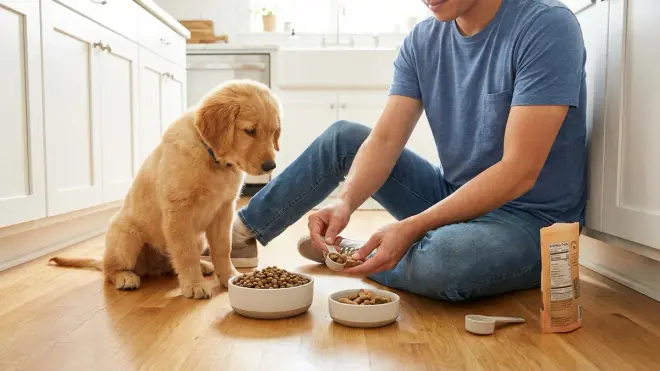
Here's the golden rule I've followed for two decades: treats should never exceed 10% of your puppy's total daily calorie intake. This is the standard recommendation from veterinary nutritionists, and it's the guideline I share with every client.
Why 10%? Because your puppy's regular food is formulated to provide complete and balanced nutrition—the right ratios of protein, fat, vitamins, and minerals for growth. When treats start replacing too much of that balanced diet, nutritional gaps appear. I've seen puppies develop dull coats, digestive issues, and even growth problems when treats consistently made up 20-30% of their diet.
Using our 1,000-calorie example from Step 1, your puppy's daily treat allowance would be 100 calories maximum. That's it. Not a huge number when you're doing multiple training sessions throughout the day.
Some trainers push this to 15% during intensive training periods, and I'll occasionally go there myself for a week or two when we're working on something challenging. But I never recommend staying above 10% long-term, especially with puppies under 6 months who are in their critical growth windows.
For puppies prone to weight gain (like Labrador Retrievers, Beagles, or Cocker Spaniels), I actually keep it closer to 5-8%. I'd rather see slower training progress than a chubby puppy with stressed joints.
Document this number somewhere accessible. Write it on a sticky note on your treat jar. Put it in your phone. You need this figure in your head when you're reaching for training treats throughout the day.
Step 3: Choose Training Treats by Calorie Density
Not all training treats are created equal, and this is where most new puppy owners get tripped up. The size of the treat matters way less than the calories it contains.
I've watched people hand their puppy a single large biscuit that contained 50 calories—half their entire daily treat allowance—for one simple sit. Meanwhile, the Zuke's Mini Naturals Training Dog Treats that I frequently recommend contain only 3-4 calories each, meaning you could give 25-30 of them within that same 100-calorie budget.
Look for treats with these characteristics:
- 3-5 calories per piece maximum (smaller is better for frequent training)
- Soft texture (so your puppy doesn't stop training to crunch)
- Pea-sized or smaller (you want them swallowed quickly)
- Strong aroma (motivation matters more than size)
High-value treats like freeze-dried liver or small pieces of cheese can run 8-12 calories per piece. I still use these, but I reserve them for the hardest training challenges—recalls around distractions, for example—and I use them sparingly.
Here's my everyday breakdown: I use low-calorie commercial treats (3-4 calories) for basic obedience repetitions, tiny pieces of cooked chicken breast (about 5-6 calories per pea-sized piece) for moderate challenges, and small cubes of cheese or hot dog (10-12 calories) for breakthrough moments only.
Do the math before your training session. If you're using 4-calorie treats and have a 100-calorie daily budget, you can give roughly 25 treats throughout the entire day. If you're planning 3-4 training sessions, that's only 6-8 treats per session. Suddenly the limits become very real.
You can learn more specific treat selection strategies in our guide on how to use treats for puppy training, which covers timing and delivery methods in detail.
Step 4: Subtract Treat Calories From Regular Meals
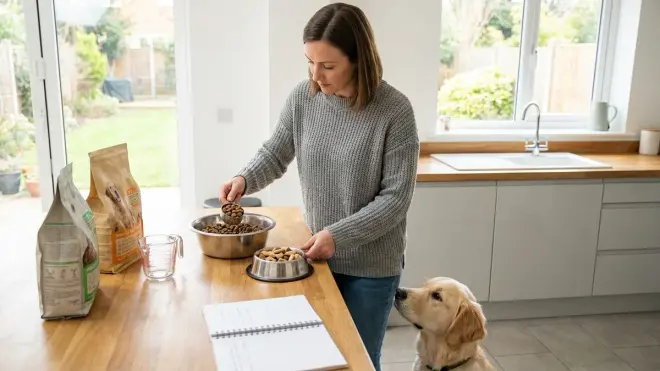
This step is crucial, and it's where a lot of puppy owners create problems without realizing it. When you use training treats throughout the day, you must reduce your puppy's regular food by an equivalent number of calories.
Going back to our 1,000-calorie puppy: if you use 100 calories of treats during training, you should only feed 900 calories of regular food. Otherwise, you're feeding 1,100 total calories—a 10% surplus that adds up to excess weight surprisingly fast.
I know this feels fussy, especially during busy training periods. Here's the practical approach I use: Pre-portion your puppy's daily food in the morning, then set aside about 10% in a separate container. Use this reserved portion throughout the day as training treats when possible, supplementing with commercial treats only when you need higher-value motivation.
For example, if your puppy gets 2.5 cups of kibble daily, measure out 2.25 cups into their regular feeding bowls and put the remaining 0.25 cups in a training pouch. Kibble works great for low-distraction training—practicing sits in your quiet living room, for instance. Save the really tasty stuff for harder scenarios.
On heavy training days, when you know you'll use more treats than usual, reduce the morning and evening meals by an extra 10-15%. It's better to slightly underfeed on a training-intensive day than to consistently overfeed. Your puppy won't starve missing a few kibbles, but consistent overfeeding creates weight problems that are hard to reverse.
If you're working with a puppy who's already at a healthy weight and very active, you might have a little more flexibility. But for most puppies, especially those 3-6 months old who are still establishing eating patterns, strict portion control prevents problems.
Step 5: Distribute Treats Strategically Throughout Training Sessions
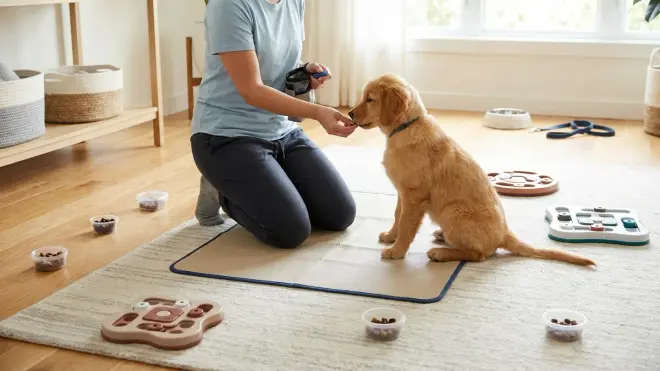
Knowing how many treats can I give my puppy during training isn't just about the total number—it's about when and how you use them. I've seen people blow through their entire daily treat allowance in one 15-minute session, then have nothing left for the rest of the day.
Here's the distribution strategy that works best: Plan your training sessions in advance and allocate treats accordingly.
If you're doing 4-5 short training sessions daily (which is ideal for puppies with short attention spans), divide your treat budget evenly. With our 25-treat example (100 calories ÷ 4-calorie treats), you might plan:
- Morning session (8 AM): 5 treats for basic commands (sit, down, come)
- Midday session (12 PM): 6 treats for leash walking practice
- Afternoon session (4 PM): 5 treats for crate training or stay practice
- Evening session (7 PM): 6 treats for recall and impulse control
- Reserve treats: 3 treats held back for unexpected teaching moments
That last point is important. Puppies create spontaneous training opportunities throughout the day—they come to you voluntarily, they stop barking on their own, they choose their bed instead of jumping on the couch. I always keep 10-15% of my treat budget in reserve to capture and reinforce these moments.
During each session, use treats variably. Don't reward every single repetition, especially once your puppy understands the behavior. In the beginning, yes—reward every successful sit. But within a few days, start rewarding 3 out of 4 attempts, then 2 out of 3, eventually becoming unpredictable. This variable reinforcement actually makes the behavior stronger and stretches your treat budget further.
For more specific guidance on treat timing and delivery, check out our recommendations for best puppy training treats, which includes options organized by training scenario.
Step 6: Use Treat Alternatives and Non-Food Rewards
One of the best ways to extend your training effectiveness without exceeding the treat limit is to incorporate non-food rewards into your rotation. This is something I emphasize with every client, especially those with food-motivated puppies who'd happily eat themselves into a stomachache.
Effective non-food rewards include:
- Play with a favorite toy (a quick 10-second tug session can be as rewarding as a treat)
- Access to something they want (opening the door to the yard, releasing them to greet a person)
- Praise and petting (more effective than most people realize, especially once a relationship is established)
- Life rewards (they sit before meals, before going outside, before getting their leash on)
I use a technique called "reward randomization" where I mix food treats, toys, and praise unpredictably. My puppy doesn't know whether the next correct behavior will earn a treat, a ball toss, or enthusiastic praise. This unpredictability keeps them engaged and reduces total treat consumption.
For example: When teaching recall, I might reward with a treat 50% of the time, a brief game of tug 30% of the time, and excited praise with petting 20% of the time. My puppy still responds enthusiastically because something good always happens—it's just not always edible.
You can also make individual treats go further by breaking them into smaller pieces. Most commercial training treats can be split in half or even quarters. Your puppy doesn't care about the size—they care about the frequency and the flavor. I've run entire training sessions using quarter-pieces of treats, turning my 25-treat budget into 100 individual rewards.
Another strategy: use your puppy's regular kibble for easy behaviors in low-distraction environments, saving high-value treats exclusively for challenging scenarios or new behaviors. Your puppy will happily sit for kibble in your living room. Save that piece of chicken for sits near the dog park entrance.
Step 7: Monitor Your Puppy's Body Condition and Adjust
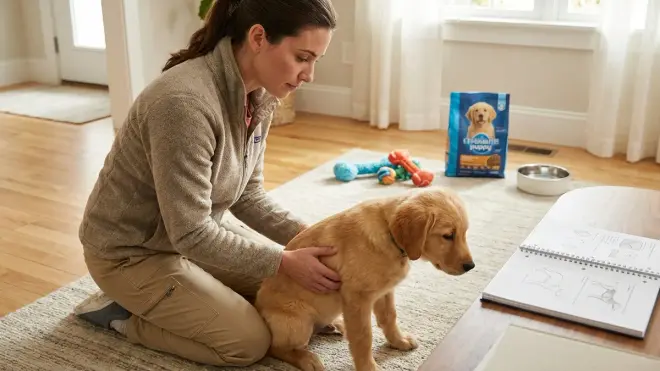
Even with perfect calculations, real-world results vary. Metabolism, activity level, and growth rate all affect how your puppy processes calories. That's why regular body condition monitoring is essential.
Every week, I have my clients perform a simple assessment: Run your hands along your puppy's ribcage. You should be able to feel the ribs easily without pressing, but you shouldn't see them prominently. There should be a visible waist when viewed from above, and a slight tuck when viewed from the side.
If you're seeing or feeling too much weight gain (ribs hard to feel, no waist definition), reduce treat calories to 5-7% of total intake instead of 10%. If your puppy seems too thin (ribs very prominent, pronounced waist), you can slightly increase treat allowance or, better yet, increase regular meal portions.
Growth rate matters especially for large and giant breeds. According to the American Veterinary Medical Association, rapid growth in large-breed puppies increases the risk of developmental orthopedic diseases. For breeds expected to exceed 50 pounds at maturity—think German Shepherds, Golden Retrievers, or Rottweilers—I'm extra conservative with treat calories and growth rate.
Track your puppy's weight weekly for the first six months. Most veterinary offices will let you stop by to use their scale without an appointment. Plot the weights on a growth chart (your vet can provide one specific to your breed) and make sure you're following the middle of the expected range, not the high end.
Signs you're giving too many treats:
- Loose stools or digestive upset
- Refusing regular meals or becoming picky
- Weight gain above expected growth curve
- Begging behavior intensifying
- Low energy after training sessions (blood sugar spikes and crashes)
If you notice any of these, pull back immediately. Drop to 5% treat calories for a few days and see if things normalize.
Step 8: Adjust for Age, Activity, and Training Intensity
How many treats can I give my puppy during training changes as your puppy matures and your training evolves. What works for an 8-week-old puppy in early socialization differs from what a 6-month-old adolescent needs during distraction training.
8-12 weeks old: Training sessions should be very short (3-5 minutes) but frequent (6-8 times daily). You'll use fewer treats per session, but more sessions means your total daily treat count might approach that 10% maximum. Focus on soft, tiny treats that don't require much chewing. At this age, digestion is still developing, so monitor stools closely.
3-6 months old: This is peak training time. Sessions can extend to 10-15 minutes, and you might do 4-6 daily. This is when people most commonly overfeed treats because they're so motivated to train. Stay disciplined about that 10% limit. Consider incorporating low calorie training treats for puppies to maximize your training repetitions without exceeding calorie limits.
6-12 months old: Training becomes more about real-world application—walks, dog parks, distractions. You'll likely use fewer total treats per day but higher-value ones. A 10-month-old puppy might get only 15 treats daily, but each one is a high-value reward for something genuinely difficult like maintaining a heel past another dog.
Activity level adjustment: A highly active puppy enrolled in agility classes or running regularly might handle 12-15% treat calories without weight gain. A lower-energy puppy or one on restricted exercise (like a large-breed puppy protecting growing joints) should stay at 8% or below.
During intensive training periods—maybe you're preparing for a competition or working through a specific behavioral challenge—you can temporarily increase to 15% for 1-2 weeks maximum, then return to 10%. Think of it like a training camp rather than a permanent lifestyle.
Pro Tips & Common Mistakes
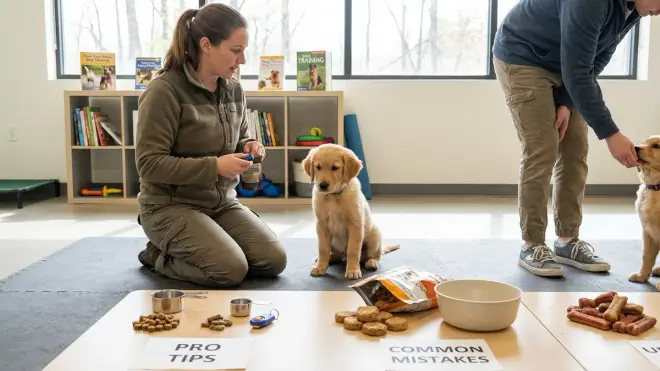
Here's what I've learned actually works after twenty years of doing this:
Keep a treat journal for the first month. Write down every treat your puppy gets and from whom. You'd be amazed how many "just one treat" moments happen throughout the day from family members, visitors, and even well-meaning neighbors. I've had clients discover their puppy was getting 30-40 extra treats daily from kids sneaking snacks.
Use the smallest effective treat size. There's no training benefit to a larger treat—none. I've seen puppies respond just as enthusiastically to a piece of kibble the size of a lentil as they do to a whole biscuit. Your puppy cares about frequency and taste, not volume.
Pre-portion daily treats every morning. Put the exact allotment in a container. When it's empty, treats are done for the day. This prevents the "just a few more" creep that happens when you're grabbing from a full bag.
Common mistake: Using human food liberally without accounting for calories. A small piece of cheese might seem tiny, but at 10-15 calories, three pieces consumed half your treat budget. If you use human food, measure it, calculate it, and count it.
Common mistake: Forgetting to account for dental chews, bully sticks, and other "extras." A 6-inch bully stick can contain 50-100 calories—that's your entire treat budget or more. On days when your puppy gets a dental chew, reduce training treats to near zero and slightly cut regular meals.
Pro tip: Make or buy treats you can break apart. Soft-baked treats work better than hard biscuits for this. I often use homemade puppy training treats that I can portion exactly to my needs—usually in 2-3 calorie pieces.
The biggest mistake I see: Starting with high-value treats for easy behaviors. If your puppy will sit for kibble, use kibble. Reserve chicken, cheese, and freeze-dried liver for the genuinely hard stuff. Otherwise, you create an inflation problem where your puppy stops responding to normal treats and you're stuck constantly escalating.
Frequently Asked Questions
Can I give my puppy more treats on some days and fewer on others?
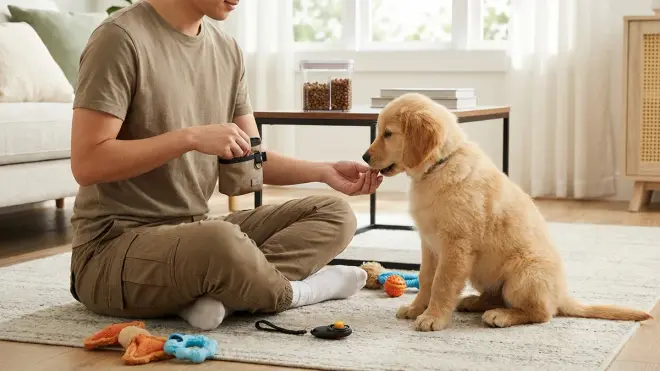
Yes, you can vary daily treat amounts as long as your weekly average stays around 10% of total calorie intake. If you have an intensive training day and use 15% treats, balance it with a lighter day at 5% the next day. Just avoid consistently exceeding 10% over multiple days, as this can create nutritional imbalances and weight gain. I do this myself—training-heavy Saturdays might hit 12-13% treats, but Sunday is usually minimal training with mostly kibble rewards.
What if my puppy isn't food motivated enough for training?
Some puppies genuinely care less about food than others, but I've found that most "non-food-motivated" puppies are actually just constantly full from free-feeding or getting too many treats throughout the day. Try scheduled meals instead of free-feeding, and create some food anticipation by training right before mealtimes when hunger peaks. Also experiment with different treat types—some puppies ignore commercial treats but go crazy for tiny pieces of cooked meat or cheese. If food truly doesn't work, shift to toy rewards and play-based training methods.
Should I count calories from chew toys like bully sticks or rawhide alternatives?
Absolutely yes—chew items often contain significant calories that many puppy owners overlook. A typical 6-inch bully stick contains 50-90 calories, which can represent 50-90% of your puppy's entire daily treat budget depending on their size. On days when your puppy gets a substantial chew item, reduce training treats proportionally or slightly decrease their regular meal. I typically skip training treats entirely on days my puppies get bully sticks, or I'll use only their regular kibble for training.
How do I handle training when multiple family members are involved?
Establish a central treat-tracking system that everyone uses—this could be a daily container that gets filled each morning with the exact treat allotment, or a simple chart on the refrigerator where people mark each treat given. Communication is essential. I've worked with families where the kids were training before school, parents during the day, and everyone in the evening, and the puppy was getting triple or quadruple the intended treats. One person should measure and distribute the daily treat allowance, and everyone draws from that same pool.
Summary
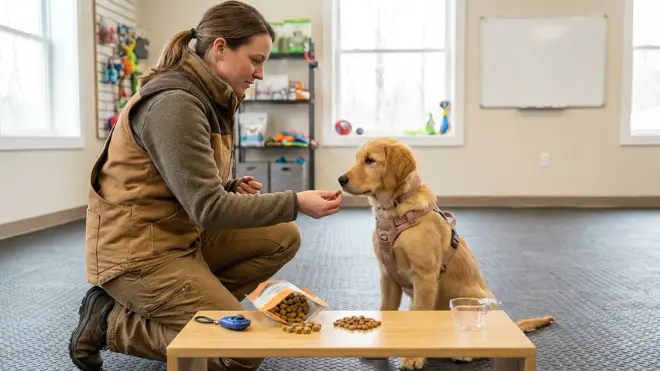
So, how many treats can I give my puppy during training? The safe limit is 10% of your puppy's total daily calorie intake, which you calculate by knowing their baseline calorie needs and reducing their regular food by an equivalent amount when using treats.
For most puppies, this translates to somewhere between 15-30 small training treats daily, depending on size, age, and the calorie density of your chosen treats. The key is planning ahead—know your numbers, choose calorie-efficient treats, distribute them strategically across training sessions, and supplement with non-food rewards whenever possible.
I've seen puppies make incredible training progress within these limits. You don't need hundreds of treats to build reliable behaviors. You need consistency, good timing, and thoughtful reward distribution. Stay within that 10% guideline, monitor your puppy's body condition weekly, and adjust based on what you're seeing. Your puppy will learn just as effectively—actually, more effectively with variable reinforcement—and they'll maintain a healthy weight while developing those critical skills.
Training your puppy is one of the most rewarding experiences you'll have together. Just remember that those training treats are tools, not meals, and a little discipline with portions now prevents bigger problems down the road.