
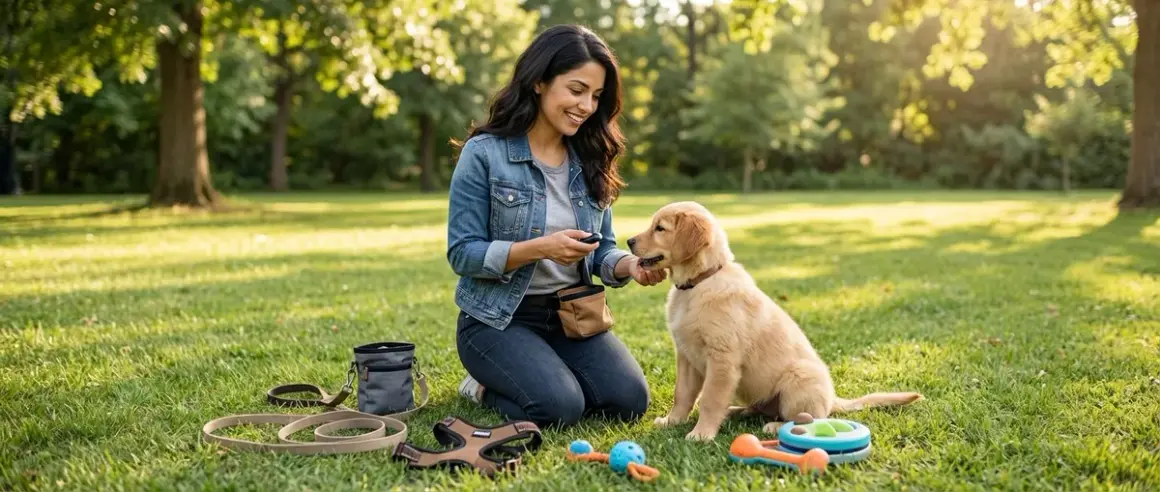

I'll be honest—when my friend Sarah brought home her first puppy last spring, she called me in a panic after two days. Not because her golden retriever puppy was untrainable, but because she'd bought literally everything the pet store recommended and had no idea what she actually needed. Sound familiar? If you're standing in the training aisle feeling overwhelmed by clickers, leashes, treat pouches, and mysterious devices you can't quite name, you're not alone. The right puppy training tools make the difference between a frustrating first month and a confident start to your journey together. Quick verdict: You don't need everything, but you do need the essentials done right—a properly fitted harness or collar, a sturdy training leash, a reliable clicker or marker, high-value treats, and something to carry it all during those critical first 90 days.
What to Look For in Puppy Training Tools
Age-Appropriate Design and Safety Features
Puppies aren't just small dogs—their bodies are still developing, which means training tools designed for adult dogs can cause real harm. For puppies 8-16 weeks old, you need equipment that accounts for their fragile tracheas, developing joints, and rapid growth spurts. Look for harnesses with multiple adjustment points (at least 4-5 points is ideal) so you're not buying a new one every three weeks as your pup shoots up.

Collars should sit snugly enough that your puppy can't back out (the two-finger rule: you should be able to fit two fingers between collar and neck), but never so tight they restrict breathing. Avoid choke chains, prong collars, or any aversive tools for puppies under six months—the American Veterinary Society of Animal Behavior has clear position statements against punishment-based methods during critical developmental periods. Your puppy's learning windows are wide open right now; harsh corrections create fear associations that can last a lifetime.
Positive Reinforcement Compatibility
The puppy training tools you choose should support reward-based learning, not undermine it. Clickers need a distinct, consistent sound that cuts through household noise but doesn't startle a sensitive puppy. I learned this the hard way when I borrowed a friend's clicker for her lab puppy—the thing was so loud the poor pup flinched every time I used it. We switched to a softer-toned clicker and suddenly he was all in.
Treat pouches should open silently (no Velcro ripping that distracts mid-training session) and allow one-handed access so you can mark and reward within the critical 0.5-second window that solidifies the behavior connection. Training leashes need to be lightweight enough that they're not dragging your 8-pound puppy around, but durable enough to handle teenage zoomies in a few months. The goal is tools that fade into the background, letting your puppy focus on learning—not on the weird thing you just strapped to them.
Durability for the Puppy Destruction Phase
Let me paint you a picture: puppies between 3-7 months old are teething tornados. They will chew anything. My neighbor's beagle puppy destroyed three fabric treat pouches before she switched to a canvas-and-leather model that could survive the wash-drool-chew cycle. When evaluating puppy training tools, check materials like reinforced nylon webbing (1-inch width minimum for medium to large breeds), marine-grade hardware that won't rust when covered in drool, and stitching that can handle regular washing.
For toys used as training rewards, look for rubber compounds rated for aggressive chewers even if your puppy seems gentle now—trust me, that changes. Natural rubber or FDA-grade thermoplastic elastomer (TPE) holds up better than vinyl or cheap plastic. If it's going in your puppy's mouth regularly (like tug toys used during impulse control training), it should be non-toxic and easy to sanitize. You'll be cleaning these things constantly.
Size and Breed Considerations
A Chihuahua puppy and a Great Dane puppy need completely different equipment, even at the same age. For toy breeds (under 10 pounds as adults), you'll want narrow 3/8-inch width leashes and harnesses with chest padding to distribute pressure. Large and giant breed puppies (those destined to hit 60+ pounds) need wider 1-inch leashes with cushioned handles to protect your hands during leash training, plus harnesses that won't dig into their developing chest structure.
Brachycephalic breeds (bulldogs, pugs, Boston terriers) already have compromised airways, so collars should never be your primary training attachment point—always use a well-fitted harness during training sessions. Working and sporting breeds often need longer training leashes (15-30 feet) earlier in development because they're bred for distance work and need controlled practice with recall across larger spaces. Check the manufacturer's breed-specific sizing charts; generic "small/medium/large" categories rarely account for the massive variation in puppy body types.
Multi-Stage Usability
Here's something nobody tells new puppy parents: you're going to progress through training phases faster than you think, and buying tools that grow with your pup saves money and reduces confusion. Look for puppy training tools with extended usability. Training leashes with multiple clip points let you shorten them for heel training and lengthen them for recall practice without buying separate equipment.
Treat pouches with dividers let you separate high-value rewards (chicken, cheese) from everyday kibble as you work on generalization and reward fading. Some harnesses convert from front-clip (for leash training and pulling management) to back-clip (for casual walks once your pup has mastered loose-leash walking) with a simple hardware adjustment. Think about the skills you'll be teaching across the first 6-12 months—if you're following our puppy training aids checklist, you'll want tools that serve multiple functions as you move from basic commands to more complex behaviors.
Our Top Picks
PetSafe Gentle Leader Headcollar for Puppies
The PetSafe Gentle Leader Headcollar🛒 Amazon works on a completely different principle than standard collars—it guides your puppy's head, and where the head goes, the body follows. This head halter fits puppies as young as 8 weeks and is particularly brilliant for large-breed pups who will eventually outweigh you but haven't learned impulse control yet. The padded nose loop prevents chafing during those early "what is this thing on my face" adjustment sessions, and the quick-snap buckle means you're not wrestling with complicated straps while your puppy wriggles.
I recommended this to a friend with a German Shepherd puppy who was already pulling at 12 weeks, and the difference was immediate—not because it's punishing, but because it gives you directional control that a collar or harness simply can't provide during those critical early walking lessons.
Pros:
- Immediate reduction in pulling without neck strain or aversive corrections
- Adjustable nose loop and neck strap accommodate rapid puppy growth for 3-4 months
- Training DVD included with force-free introduction protocols
- Redirects jumping behavior naturally by lowering the head position
- Works for all breed types once properly fitted
Cons:
- Requires 3-7 day acclimation period with treat association before functional use—not a quick fix
- Looks like a muzzle to unfamiliar people, which can prompt uncomfortable questions during walks
- Can rub the nose bridge if fitted too tightly or if your puppy constantly paws at it
Kurgo Tru-Fit Smart Dog Harness with Steel Nesting Buckles
The Kurgo Tru-Fit Smart Dog Harness🛒 Amazon is the harness I actually wish I'd found sooner. It has five adjustment points, which means it genuinely grows from 10-pound puppy to 80-pound adolescent (depending on which size you start with), and the chest and shoulder straps are padded with ripstop material that won't dig in during training sessions. The front D-ring attachment is clutch for teaching loose-leash walking—when your puppy pulls, they naturally turn back toward you rather than getting reinforced for dragging you forward.
But here's what really sold me: the steel nesting buckles auto-lock, so there's no fumbling with plastic clips when you're trying to load a squirmy puppy into the car. It's also crash-tested for vehicle restraint (important if you're crate training in the car), though you'll need the separate tether attachment for that function.
Pros:
- Five adjustment points accommodate 4-6 months of growth in most breeds
- Front-clip and top-clip options let you progress through training stages
- Padded chest plate prevents rubbing on short-coated breeds
- Reflective stitching improves visibility during early morning potty breaks
- Machine washable without hardware deterioration
Cons:
- The buckle system is sturdy but adds bulk—not ideal for toy breeds under 8 pounds
- Takes longer to put on than slip-on harnesses (trade-off for security)
- Runs slightly small in the chest measurement—size up if your puppy is between sizes
PetSafe Clik-R Training Clicker with Volume Control
The PetSafe Clik-R Training Clicker🛒 Amazon solved a problem I didn't know existed until I tried it: sound-sensitive puppies who shut down at the sharp crack of traditional clickers. This one has a raised button that's easy to press quickly (critical during rapid-fire repetitions) and the internal mechanism produces a softer, more muted click that still registers clearly but doesn't startle nervous pups. The attached wrist coil means it's always accessible during training sessions—I cannot tell you how many times I've lost a clicker in my pocket during heel work.
If you're planning to use clicker training for basic obedience and trick training (which, if you're not, you should consider—it's how most modern trainers work), this tool gives you precise timing without the intimidation factor. It's particularly good for herding breeds and other sensitive puppies who are hyper-aware of environmental changes.
Pros:
- Ergonomic design prevents hand fatigue during long training sessions
- Softer click works for noise-sensitive breeds without losing clarity
- Wrist coil keeps it accessible and prevents mid-session searches
- Large button surface area makes it usable with gloves during winter training
- Inexpensive enough to keep spares in your treat pouch, car, and training bag
Cons:
- The softer click can get lost in high-distraction environments like dog parks
- Wrist coil tangles if you toss the clicker in a bag rather than hanging it
- Slightly larger than minimalist clickers—won't fit in very small pockets
Mighty Paw Training Treat Pouch 2.0 with Built-In Waste Bag Dispenser
The Mighty Paw Training Treat Pouch 2.0🛒 Amazon is what happened when someone actually asked trainers what they needed instead of just slapping pockets on fabric. The magnetic closure is completely silent (no Velcro rip to distract your puppy right before a reward), and it snaps open with one hand so you can mark and treat within that critical half-second window. The main compartment easily holds 2-3 cups of treats, which is about what you'll go through during early training sessions if you're following treat-based training protocols.
But the game-changer is the built-in waste bag dispenser and small accessory pocket for your clicker or keys. I used to clip waste bags to my belt loop like some kind of dog-training janitor—this integrates everything into one washable pouch that doesn't look ridiculous. The adjustable waist strap fits over winter coats or summer shorts equally well.
Pros:
- Silent magnetic closure doesn't telegraph treat delivery
- Lined interior wipes clean and can handle moist treats without leaking
- Integrated waste bag dispenser eliminates the need for separate holders
- Adjustable strap fits waists from 26-52 inches comfortably
- Reflective trim adds visibility during early morning training walks
Cons:
- The magnetic closure is strong enough that arthritic hands might find it difficult to open quickly
- Only one main compartment—no dividers for separating high-value vs. regular treats
- Sits slightly loose when empty, which can bounce during jogging if you're doing fitness training with your pup
Frisco Solid Nylon Leash with Padded Handle
The Frisco Solid Nylon Leash🛒 Amazon is proof that you don't need to spend a fortune on effective puppy training tools. This 6-foot nylon leash has reinforced stitching at stress points (where the handle attaches and at the clip), a genuinely padded handle that doesn't cut into your palm during those early pulling phases, and marine-grade hardware that won't rust despite being drooled on, rained on, and occasionally used as a chew toy when you're not looking fast enough.
The 6-foot length is the sweet spot for training—long enough for your puppy to sniff and explore during potty breaks, short enough to maintain control during heel work and urban walking. I particularly like that it comes in 5/8-inch width for small/medium puppies and 1-inch width for large breeds, so you're matching the tool to your dog's size rather than using one-size-fits-all equipment.
Pros:
- Multiple color options help you grab the right leash if you're training multiple dogs
- Padded handle genuinely cushions during unexpected pulls
- Affordable enough to keep spares in your car and with dog-sitters
- Available in widths appropriate for different puppy sizes
- Weather-resistant materials hold up to rain, snow, and mud
Cons:
- No traffic handle near the clip for close control in crowded situations—you'll need to choke up on the leash
- The padding adds bulk to the handle, which makes it harder to fit in small treat pouches
- Nylon can develop a stiff texture after repeated washing—needs occasional fabric softener
Outward Hound Hide-A-Squirrel Puzzle Toy for Mental Stimulation
The Outward Hound Hide-A-Squirrel Puzzle Toy🛒 Amazon isn't a traditional training tool, but it's essential for puppies who need mental exercise when physical training sessions end. This plush puzzle has three squeaky squirrels hidden inside a soft tree trunk, and your puppy has to figure out how to extract them. It's brilliant for teaching problem-solving, building focus, and burning mental energy during those "I've trained for 10 minutes and my puppy is still bouncing off walls" moments.
For training purposes, you can use it as a high-value reward after successful training sessions or incorporate it into impulse control exercises (leave it/take it with the squirrels). Puppies between 8 weeks and 6 months need about 5 minutes of training for every month of age, so a 12-week-old puppy maxes out around 15 minutes—but they still have hours of energy to burn. This channels it productively.
Pros:
- Combines play and mental stimulation in a low-impact activity
- Squeakers engage prey drive in a controlled, non-destructive way
- Machine washable when it inevitably gets covered in drool and dirt
- Available in multiple sizes for different breed types
- Can be stuffed with treats instead of squirrels for scent work training
Cons:
- Not durable enough for aggressive chewers—this is a supervised play toy, not a leave-alone chew
- The squirrels are small and present choking hazards if your puppy shreds toys
- Some puppies solve it in 30 seconds and lose interest—better for puzzle-oriented breeds
Frequently Asked Questions
What puppy training tools do I actually need in the first week?
You need five things in the first week: a properly fitted collar or harness with ID tags, a 6-foot training leash, high-value training treats in thumb-nail sized pieces, a treat pouch or pocket system to carry them, and either a clicker or a consistent verbal marker word like "yes." Everything else—puzzle toys, long lines for recall training, specialty harnesses—can wait until you've established basic communication and your puppy understands that good things happen when they pay attention to you. Many new puppy parents overbuy in the first week and then realize their specific puppy learns better with different tools, so start minimal and add based on your individual dog's learning style and your training goals.
Are clickers necessary for puppy training or can I just use verbal praise?
Clickers aren't strictly necessary, but they're incredibly helpful because they provide a consistent, emotionally neutral sound that marks the exact moment your puppy does something right. Your voice changes with your mood, energy level, and context—you don't sound the same praising your puppy at 6 AM versus 6 PM, or when you're frustrated versus delighted. The clicker always sounds identical, which creates crystal-clear communication during the learning phase. That said, if you have mobility issues that make clicker use difficult, or you're training a sound-sensitive puppy, a consistent verbal marker like "yes" or "good" said in the same tone every time works fine—you just need to be more disciplined about your timing and delivery consistency than you would with a mechanical marker.
Can I use the same training tools for small breed puppies and large breed puppies?
No, and this is important for safety and effectiveness. Small breed puppies (Chihuahuas, Yorkies, toy poodles) need narrower 3/8 to 1/2-inch width leashes and harnesses to prevent the equipment from overwhelming their tiny frames, while large and giant breed puppies need 1-inch width equipment to distribute pressure appropriately and give you actual control as they grow. The hardware weight matters too—a heavy metal clip that's fine on a Lab puppy's harness will drag down a Maltese puppy's neck. Treat sizes should scale with mouth size; a training treat for a Newfoundland puppy can be a full meal for a Pomeranian puppy, which throws off your training treat calculations. Buy tools sized for your puppy's adult weight projection, not their current 8-week-old size, and adjust as they grow.
How do I choose between a collar and a harness for puppy training?
For most puppies, a harness is the safer choice during active training sessions because it distributes pressure across the chest and shoulders rather than concentrating it on the developing trachea. This is especially critical for brachycephalic breeds (pugs, French bulldogs, Boston terriers) who already have breathing challenges, toy breeds prone to collapsing trachea, and any puppy who pulls or lunges during leash training. Use a collar for ID tags and short potty breaks, but clip your training leash to a harness during actual training sessions. The exception is if you're working with a professional trainer who specifically recommends collar-based training for your individual puppy's needs—but even then, it should be a flat buckle collar, never a choke chain or prong collar on a puppy under six months old.
When should I introduce different training tools as my puppy grows?
Introduce tools progressively based on skill development, not age alone. Start with basics (collar/harness, short leash, clicker, treats) in weeks 8-12 during initial socialization and name recognition work. Add a longer 15-20 foot training line around 14-16 weeks when you begin recall training in controlled outdoor environments—but only after your puppy has mastered recall in lower-distraction settings. Introduce puzzle toys and interactive feeders around 12-16 weeks to build problem-solving skills and provide mental stimulation between training sessions. Wait until your puppy is at least 5-6 months old before introducing any specialized equipment like agility foundations tools or advanced obedience gear, and always consult with a certified professional trainer if you're considering tool-assisted training methods. The key is building a foundation with simple, clear tools before adding complexity that might confuse the learning process.
The Verdict
Your puppy doesn't need every gadget in the pet store—they need a few well-chosen, properly fitted puppy training tools that support their learning and keep them safe during these critical first months. Start with the essentials: a comfortable harness or collar that fits their current size with room to grow, a sturdy 6-foot leash, a reliable clicker or marker system, and a treat delivery system that keeps you quick and consistent. As your puppy masters basic skills and you identify their specific learning style, you can add specialized tools that address your unique training challenges. The best puppy training tools are the ones you'll actually use consistently, that fit your puppy's size and temperament, and that make positive reinforcement training easier rather than more complicated. Choose tools that grow with your pup, invest in durability where it matters, and remember that your consistency and patience matter far more than expensive equipment.