
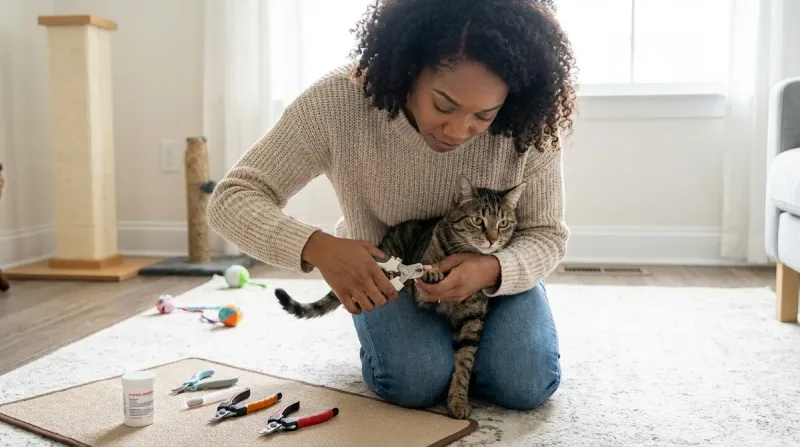

I'll be honest—the first time a client asked me to recommend best cat nail clippers for beginners, I had to pause. I've spent nearly a decade at the grooming table working with dogs of every size and temperament, but cats? They're a different beast entirely, and their nail care demands a specific touch. After watching too many cat owners struggle with oversized, awkward clippers meant for dogs, I started paying closer attention to what actually works for felines. The best cat nail clippers for beginners need to be precision tools that give you control and confidence, not clunky gadgets that turn a quick trim into a wrestling match.
Quick verdict: Scissor-style clippers with safety guards win for most first-timers, but the right choice depends on your cat's size, your hand strength, and how much visual feedback you need to avoid the quick.
What to Look For in Cat Nail Clippers
Clipper Style That Matches Your Confidence Level
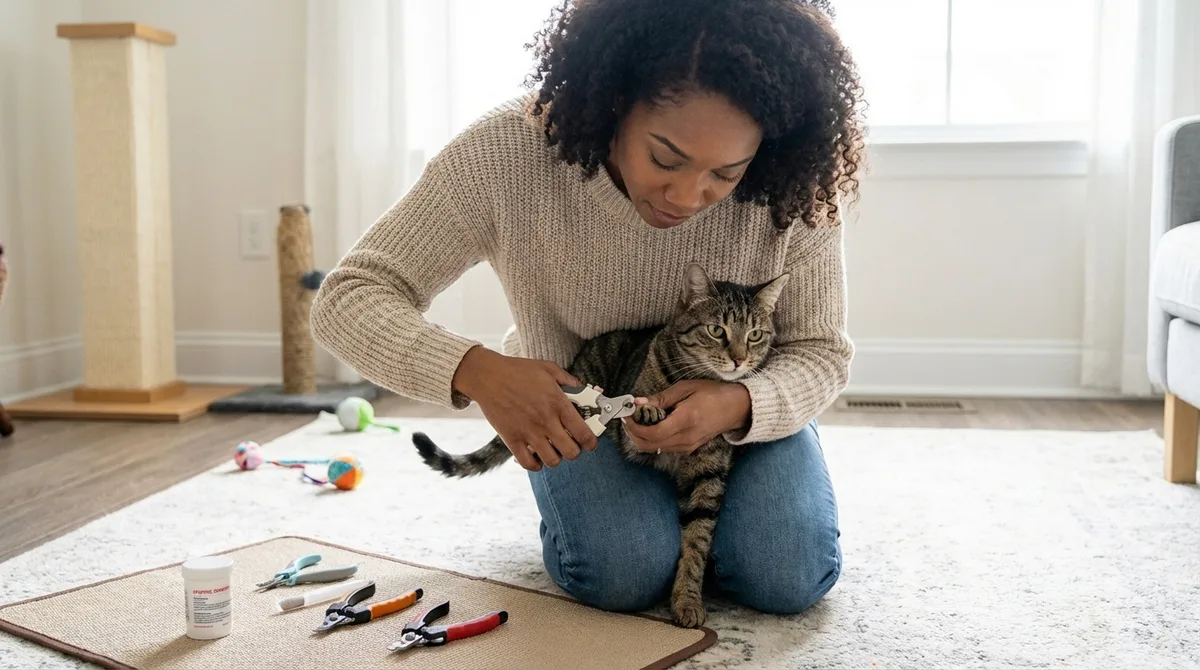
You've got three main styles to choose from, and each serves a different skill set. Scissor-style clippers look like small pruning shears with curved blades—they're what I recommend to most beginners because they mimic the motion of regular scissors, which feels intuitive. You can see exactly where the blade sits before you squeeze. Guillotine clippers have a hole you slide the nail through, then a blade slides across to make the cut. They work well for small to medium cats, but you need to position the nail correctly or you'll get a ragged cut. Plier-style clippers (also called miller's forge style) give you more cutting power, but they're usually overkill for cat nails and can feel bulky if you have smaller hands.
I've watched dozens of first-time nail trimmers fumble with guillotine clippers because they can't see the blade position clearly. Scissor-style eliminates that guesswork—you can literally watch the blade approach the nail.
Blade Material and Sharpness
Stainless steel blades are non-negotiable. They hold an edge longer, resist rust from sanitizing, and cut cleanly instead of crushing the nail. A dull blade—whether it's cheap metal or just old—will splinter the nail and can actually crack it vertically into the quick, which bleeds and hurts. I replace my own clippers every 12-18 months depending on use, and I sharpen them midway through if I'm using them frequently.
Some premium clippers use surgical-grade steel or include replaceable blade cartridges. For most cat owners trimming once or twice a month, mid-range stainless steel does the job. Just test the blades before you buy if you're shopping in-store—they should meet evenly with no light gap when closed.
Safety Features for Mistake Prevention
Safety guards are the training wheels of nail trimming. They're small metal stops that limit how much nail you can remove in one cut, which helps prevent you from cutting into the quick (the blood vessel inside the nail). On cats with clear or light-colored nails, you can usually see the pink quick, but on dark nails, it's invisible. A guard gives you a buffer zone.
That said, guards can be limiting once you get comfortable. My senior shepherd has black nails, and I often take off the guard after the first cautious cut so I can fine-tune the length. For absolute beginners working with an uncooperative cat, though, guards are worth the slight inconvenience. Some clippers also include LED lights that illuminate the nail to help you see the quick on dark claws—gimmicky on some models, genuinely helpful on others.
Handle Comfort and Grip Control
You're probably going to be working with a squirmy, unhappy cat, so your clippers need to feel secure in your hand. Non-slip rubber grips or textured handles give you control even if your palms are sweaty (which they will be the first few times). The handle length matters too—too short and you can't get leverage; too long and they're unwieldy for precision work on small paws.
I have pretty average-sized hands, and I've struggled with clippers designed for larger groomers. Test the squeeze resistance before you commit. If you have arthritis or weaker grip strength, look for spring-loaded handles that open automatically after each cut—it reduces hand fatigue significantly.
Size Appropriate for Feline Claws
This seems obvious, but I've seen people use heavy-duty dog clippers on a 9-pound domestic shorthair. Cat nails are thin and delicate compared to most dog breeds. Small to medium clippers with blades around 2-4mm wide are ideal. Anything larger risks crushing the nail or cutting more than you intended because you can't see what you're doing around the bulk of the tool.
If you have a Maine Coon or Norwegian Forest Cat—basically a cat built like a small dog—you might need slightly larger clippers, but even then, precision beats power. The how to groom a cat at home guide covers more about tailoring tools to your cat's size and coat type.
Ease of Cleaning and Maintenance
Cat nails carry bacteria and fungi, especially if your cat uses a litter box (so, all cats). You need to be able to sanitize your clippers between uses, which means smooth metal surfaces without crevices where gunk hides. Some clippers have covers or cases that keep the blades clean in storage—helpful if you're tossing them in a drawer with other grooming tools.
Oil the hinge point every few months with clipper oil or even mineral oil. It keeps the action smooth and prevents rust. I learned this the hard way when a pair of clippers I left in a damp bathroom cabinet seized up mid-cut.
Our Top Picks
Safari Professional Nail Trimmer for Cats
The Safari Professional Nail Trimmer for Cats🛒 Amazon has been my go-to recommendation for nervous first-timers since I started paying attention to feline grooming tools. It's a scissor-style clipper with a safety guard that stops you from taking too much nail in one pass, and the handles have a soft rubber coating that doesn't slip even when you're wrestling with a cranky tabby. The blades are sharp straight out of the package—I've used these on my grooming table when clients bring in cats alongside their dogs, and they make clean cuts on both fine and thicker nails. The safety guard is removable once you build confidence, which gives this tool a longer learning curve.
The spring-loaded mechanism opens the blades automatically after each cut, which matters more than you'd think when you're trying to hold a paw, position the nail, and squeeze the handles all at once.
Pros:
- Sharp stainless steel blades cut cleanly without crushing
- Removable safety guard grows with your skill level
- Comfortable rubber-grip handles reduce hand fatigue
- Spring action makes repeated cuts less tiring
- Compact size works for kittens through average adult cats
Cons:
- The safety guard placement can block your view on very small kittens
- Spring tension weakens after 12-18 months of frequent use
- Not large enough for giant breed cats like Maine Coons
Millers Forge Professional Nail Clip
The Millers Forge Professional Nail Clip🛒 Amazon is a plier-style clipper that gives you more cutting power than most scissor models, which makes it a good fit if you have a senior cat with thicker, harder nails or if you're trimming multiple cats and need something durable. I know I said plier-style can be overkill, but Millers Forge sizes theirs appropriately for cats—the blades are small and precise, not the massive guillotine plates you see on dog versions. The handles are coated in a grippy vinyl that's held up through hundreds of grooming sessions in my experience.
This is the clipper I reach for when I'm working with older cats whose nails have gotten tough and brittle. The extra leverage means less hand strain and cleaner cuts in one squeeze.
Pros:
- High cutting power for thick or overgrown nails
- Extremely durable—these last for years with basic maintenance
- Precise blade alignment prevents crushing or splitting
- Works well for groomers handling multiple cats daily
- Comfortable grip even during extended use
Cons:
- Heavier and bulkier than scissor-style clippers
- No safety guard, so you need to be confident about nail anatomy
- The wider jaw can make it harder to see tiny kitten nails clearly
Boshel Cat Nail Clippers and Trimmer
The Boshel Cat Nail Clippers and Trimmer🛒 Amazon includes both a scissor-style clipper and a small nail file in one package, which is genuinely useful if your cat tolerates a quick smoothing after the cut. The blades are angled at 25 degrees—Boshel claims this reduces the chance of splitting, and in practice, I've noticed cleaner cuts with less post-trim splintering compared to straight-blade designs. The safety guard is built into the blade housing, so you can't remove it, which is limiting if you want to graduate to freehand trimming.
The handle design is where this one shines for beginners. It's got deep finger grooves that guide your hand into the right grip position, which helps if you've never held clippers before.
Pros:
- Angled blade design produces exceptionally clean cuts
- Built-in safety guard prevents over-cutting
- Included file smooths rough edges immediately
- Ergonomic finger grooves make proper grip obvious
- Sharp out of the box with smooth cutting action
Cons:
- Non-removable safety guard limits advanced use
- Finger grooves feel awkward if you have very small or very large hands
- The file is basic—it works, but it's not high-grit professional quality
Epica Professional Cat Nail Clipper
The Epica Professional Cat Nail Clipper🛒 Amazon is a guillotine-style clipper with a unique twist—the blade opening is smaller and more oval-shaped than standard round guillotine models, which matches the natural shape of cat claws. I was skeptical about recommending guillotine clippers for beginners, but this design actually makes it easier to position the nail correctly. The blade is sharp stainless steel, and the handle has a rubber coating with raised texture that gives you grip even with one hand.
I've used this on my own grooming table when I need a compact clipper that fits in my apron pocket. It's light enough that it doesn't fatigue your hand, which matters if you're trimming all four paws in one session.
Pros:
- Oval blade opening fits cat nail shape naturally
- Compact and lightweight for easy maneuvering
- Replaceable blade extends tool lifespan
- Non-slip textured handle works for single-handed operation
- Cuts through tough nails with minimal pressure
Cons:
- Guillotine style requires more precise nail positioning
- No safety guard, so it's easy to over-cut if you're nervous
- The blade replacement mechanism is finicky—you need small fingers or tweezers
Zen Clipper Cat Nail Clipper
The Zen Clipper Cat Nail Clipper🛒 Amazon looks like a small orange flashlight, which is exactly what threw me off the first time I saw it. Instead of scissor or guillotine action, this is a rotary clipper—you slide the nail into a slot and turn a dial that lowers the blade. It's the slowest cutting method I've tested, but that's actually the point. For genuinely anxious beginners or cats that panic at the sound of traditional clippers, this nearly-silent tool reduces the sensory triggers.
The trade-off is speed. If you have multiple cats or a squirmy animal, the extra time per nail adds up. But if you're working with a senior cat that's patient or a kitten you're desensitizing to grooming, this is a remarkably low-stress option.
Pros:
- Nearly silent operation doesn't startle nervous cats
- Impossible to cut too fast or too much at once
- No moving handles means less hand fatigue
- Works well for cats with severe grooming anxiety
- Easy to control nail positioning before cutting
Cons:
- Extremely slow—each nail takes 15-20 seconds
- Awkward to use if your cat won't hold still
- The slot can get clogged with nail dust after several uses
- Not intuitive at first—there's a learning curve to the dial mechanism
Shiny Pet Cat Nail Clippers with LED Light
The Shiny Pet Cat Nail Clippers with LED Light🛒 Amazon has an integrated LED light that illuminates the nail from below, making it easier to see the quick on black or dark-colored nails. I was ready to dismiss this as a gimmick, but after testing it on a black cat with zero quick visibility, I'm a convert. The light is bright enough to show the internal structure without being blinding, and it's positioned right where you need it—at the cutting edge.
The clipper itself is scissor-style with a safety guard, and the blades are reasonably sharp stainless steel. The LED runs on a watch battery that's replaceable, though I haven't needed to change mine yet after six months of occasional use.
Pros:
- LED light genuinely helps identify the quick on dark nails
- Scissor-style design with removable safety guard
- Lightweight and balanced for one-handed use
- Battery lasts months with regular use
- Comfortable non-slip handles
Cons:
- The LED button is placed where you might accidentally press it while cutting
- More expensive than non-LED options
- Battery replacement requires a tiny screwdriver
- The light adds slight bulk to the handle
Pet Republique Professional Cat Nail Clippers
The Pet Republique Professional Cat Nail Clippers🛒 Amazon are scissor-style clippers with an unusually long handle that gives you extra leverage—helpful if you have arthritis or weaker grip strength. The blades are made from hardened stainless steel that stays sharp longer than softer metals, and the cutting angle is slightly curved to match the natural shape of cat claws. This is one of the sharper clippers I've tested—it cuts through thick senior cat nails without that crunching sound that cheaper blades make.
The safety guard is removable, and the package includes a small nail file and a guide booklet with diagrams of feline nail anatomy. It's a thoughtful touch for beginners who don't know where the quick is.
Pros:
- Extra-long handles provide excellent leverage
- Extremely sharp blades cut cleanly even on thick nails
- Removable safety guard with clear stop positioning
- Includes educational materials and nail file
- Heavy-duty construction feels professional-grade
Cons:
- Longer handles make the clipper less compact for storage
- Heavier than most cat clippers—you'll notice it after 20+ nails
- The sharp blades require careful handling when not in use
- Pricier than basic models
Hertzko Electric Pet Nail Grinder
The Hertzko Electric Pet Nail Grinder🛒 Amazon isn't a clipper—it's a rotary grinding tool that files down the nail gradually instead of cutting it. I'm including it because for some cats (and some owners), grinding is genuinely easier than clipping. There's no quick cut, no risk of splitting the nail, and the process is so gradual that you can't accidentally take too much. The grinder has three speed settings and comes with different grinding stone sizes for kittens through large cats.
The downside is noise and vibration. Some cats tolerate the buzzing motor just fine; others act like you've brought a chainsaw into the room. It also takes longer per nail than clipping, and you need to be careful about heat—grinding generates friction, so you work in short bursts to avoid discomfort.
Pros:
- Gradual filing eliminates risk of cutting the quick
- No sharp edges or splitting after trimming
- Works well for cats that panic at clipper sounds
- Adjustable speeds for different nail thicknesses
- USB rechargeable with long battery life
Cons:
- Motor noise and vibration scare many cats
- Much slower than traditional clipping
- Generates nail dust that you need to clean up
- Requires regular maintenance and stone replacement
- Learning curve to avoid over-grinding or creating heat
Frequently Asked Questions
How often should I trim my cat's nails?
Most indoor cats need nail trims every 3-4 weeks, though the exact timing depends on your cat's activity level and scratching habits. Outdoor cats who climb trees and scratch on rough surfaces naturally wear down their nails and might only need trimming every 6-8 weeks, or sometimes not at all. Senior cats with reduced activity and kittens growing rapidly may need more frequent trims—check every two weeks and trim when the nails start to curve into hooks or catch on fabric.
I've noticed that my higher-energy dogs wear their nails down through daily activity, but cats don't typically move in ways that file their claws naturally, especially on indoor carpeting and furniture. If you can hear your cat's nails clicking on hard floors, it's time for a trim. For more context on general feline grooming timing, the how often should you bathe a cat guide covers seasonal and activity-based care schedules.
What's the safest way to hold a cat while trimming their nails?
The safest hold depends on your cat's temperament, but for most beginners, the burrito wrap works best—wrap your cat snugly in a towel with only one paw exposed at a time, which limits their movement without requiring you to physically restrain them. Sit with the wrapped cat in your lap or on a table at waist height, gently press on the paw pad to extend the nail, and make your cut quickly and calmly.
For more cooperative cats, you can skip the towel and simply hold them in your lap facing away from you, securing their body against your torso with one arm while you work on the paws with your dominant hand. Never hold a cat down forcefully or trap them on their back—it triggers panic and you'll both end up scratched. The how to trim cat nails without getting scratched guide goes deeper into positioning techniques and desensitization methods.
Can I use dog nail clippers on my cat?
You can use dog clippers on a cat if the blades are small enough, but it's not ideal and increases your risk of mistakes. Dog clippers designed for small breeds—like Chihuahuas or Yorkshire Terriers—are sometimes appropriately sized for large cats, but most dog clippers are too bulky for precise work on delicate feline nails. The blade width is the critical factor: cat nails are thin and need blades around 2-4mm wide, while most dog clippers have 5-8mm blades that obscure your view and make it easy to over-cut.
I keep separate tools for cats and dogs in my grooming kit specifically because the precision requirements are different. If you're in a pinch and only have dog clippers, use them on just the very tip of the nail and make multiple small cuts rather than one deep cut. But if you're buying new tools, get cat-specific clippers—they're not expensive, and they make the job significantly easier.
How do I know where the quick is on my cat's nail?
On clear or light-colored nails, the quick appears as a pink or red line running through the center of the nail—it's the blood vessel and nerve that keeps the nail alive. You want to cut 2-3mm in front of where the pink ends, staying in the clear white or translucent portion of the nail. On black or dark nails, you can't see the quick at all, so you need to work more conservatively.
Look at the nail from the side—you'll see it curves downward into a hook at the tip. Make your first cut just at the point where the curve begins, taking off only the hooked portion. If you see a small black dot appear in the center of the cut surface, stop—that's the start of the quick. For dark-nailed cats, I make two or three small cuts rather than one big one, checking the cut surface after each snip. LED clippers help here by illuminating the internal structure, but careful, gradual cutting works just as well.
What should I do if I accidentally cut the quick?
First, stay calm—cutting the quick hurts and bleeds, but it's not a medical emergency for your cat, though it will make them more resistant to future trims. Apply styptic powder (or cornstarch in a pinch) directly to the bleeding nail tip with firm pressure for 30-60 seconds until the bleeding stops. Keep your cat calm and confined so they don't run around and restart the bleeding—a small bathroom or carrier works well.
The nail will be tender for a few days, so don't attempt another trim until it's fully healed. Make a note of which nail you cut so you can be extra cautious with it next time. If bleeding doesn't stop after five minutes of pressure, or if you've cut deeply into the quick, contact your vet. I've quick'd dogs dozens of times over the years—it happens to every groomer and most pet owners eventually. The key is learning from it and adjusting your cutting depth for next time. According to the American Veterinary Medical Association, minor quick cuts heal completely within a week with basic first aid.
The Verdict
After working with cats of every temperament on the grooming table, I keep coming back to scissor-style clippers with removable safety guards as the best cat nail clippers for beginners. They give you visual feedback, intuitive cutting motion, and room to grow as your confidence builds. The Safari Professional hits that sweet spot for most first-timers, but if you're dealing with a genuinely anxious cat, the Zen Clipper's slow, silent approach might save you both significant stress.
Remember that the relationship you build during nail trims matters more than getting perfect results the first time. Go slow, use treats, and don't try to do all four paws in one session if your cat's tolerance is low. Even after nearly a decade of grooming, I still talk to every animal through the process, building trust one nail at a time.