
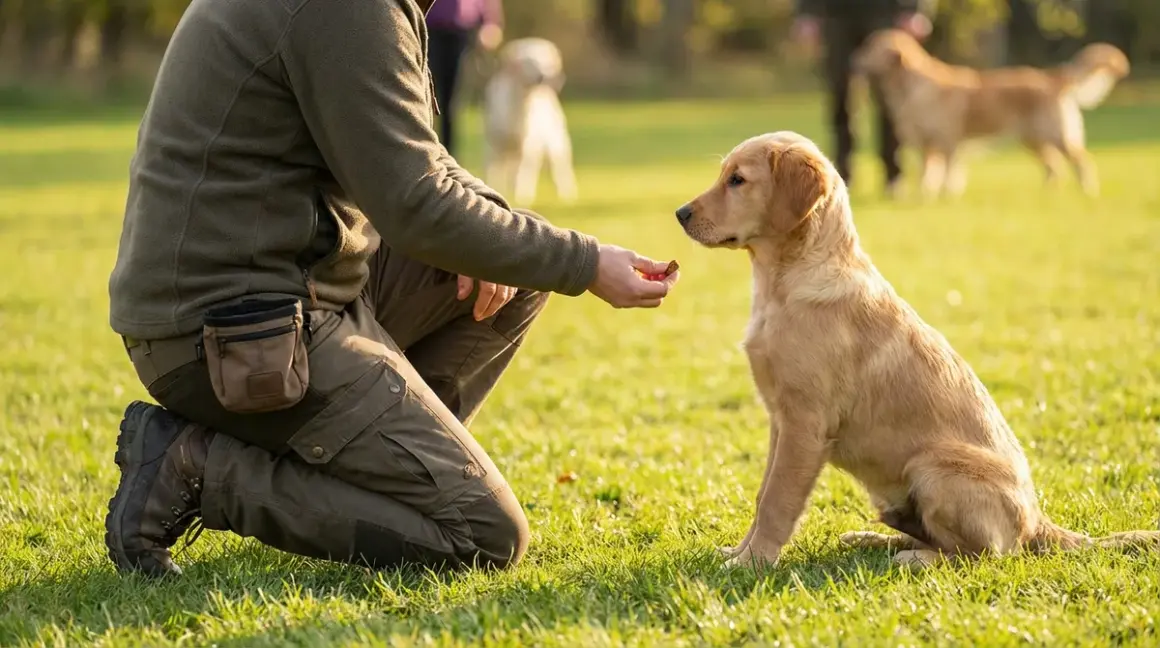

I've spent twenty years watching puppies learn, and here's what I know for sure: how to use treats for puppy training isn't just about tossing food at your dog. It's about timing, consistency, and understanding what actually motivates that little bundle of energy bouncing around your living room. This guide will show you exactly how to use treats for puppy training the right way—no fancy jargon, no complicated protocols, just practical techniques that work with puppies of all breeds and sizes. You'll learn when to reward, which treats work best, how to fade them out eventually, and how to avoid the most common mistakes I see new puppy owners make. Most people can start seeing results within the first training session, typically 5-10 minutes. By the end of this guide, you'll have a clear system that makes training feel less like work and more like building a real connection with your pup.
What You'll Need
Before you start your first training session, gather these essentials:
- High-value training treats (soft, pea-sized pieces that your puppy can eat quickly—look for options with single-source proteins like chicken, beef, or salmon)
- A treat pouch or pocket (keeps rewards accessible and your hands free)
- A quiet training space (especially for the first few sessions—minimize distractions)
- Your puppy's regular meal portions (you'll deduct training treats from daily food intake to prevent overfeeding)
- Patience and realistic expectations (puppies have attention spans of just 5-10 minutes at 8-12 weeks old)
- A water bowl nearby (small treats can make puppies thirsty)
- Optional: a clicker (helps mark exact moments of good behavior, though your voice works too)
Step 1: Choose the Right Treats for Your Puppy's Age and Size
Not all treats work equally well for training, and this is where I see a lot of new puppy owners struggle right out of the gate. Your puppy needs treats that are small enough to eat in one second flat—we're talking pea-sized or smaller. If your puppy spends fifteen seconds chewing, the connection between the behavior and the reward gets fuzzy.
For puppies 8-16 weeks old, stick with soft, moist treats made from limited ingredients. I've seen great results with freeze-dried liver, small training treats specifically formulated for puppies, or even tiny pieces of cooked chicken breast. The Zuke's Mini Naturals Training Dog Treats are a solid example—they're small, soft, and break apart easily for even tinier rewards.
Avoid hard, crunchy treats during early training sessions. They take too long to chew and can actually interrupt the learning flow. Also skip anything with artificial colors, excessive fillers like corn or wheat (especially if your puppy shows any digestive sensitivity), or treats larger than your pinky fingernail.
The treat needs to be more exciting than whatever else is happening around your puppy. That's what trainers call "high value." For some puppies, regular kibble works fine. For others—especially in distracting environments—you need the good stuff. Cheese, hot dogs cut into tiny pieces, or freeze-dried meat usually win the motivation game. Just remember to adjust meal portions accordingly, because training treats should make up no more than 10% of your puppy's daily caloric intake. You can learn more about safe daily limits in our guide on how many treats you can give your puppy during training.
Step 2: Master the Timing—Reward Within One Second
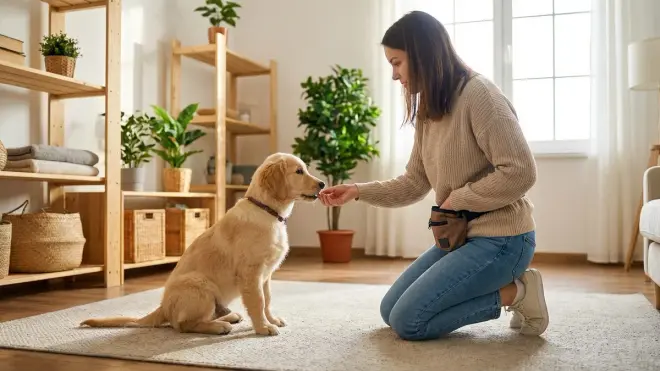
Here's the thing about how to use treats for puppy training that most people don't realize: timing matters more than the treat itself. I've seen this a hundred times—someone asks their puppy to sit, the puppy sits, then the owner fumbles around in their pocket for twenty seconds before finally delivering the treat. By that point, the puppy has stood up, sniffed the floor, and looked out the window. What did you just reward? Not the sit.
You need to deliver that treat within one second of the behavior you want. One second. That's it. This is why keeping treats in an accessible pouch or pocket matters so much.
Here's what the timeline should look like: Your puppy performs the desired behavior (sits, makes eye contact, comes when called), you immediately say "yes!" or click your clicker, then you deliver the treat within that one-second window. The verbal marker or click tells your puppy exactly which behavior earned the reward, and the treat confirms it.
Practice your timing without your puppy first. Seriously. Drop a pen on the floor and practice saying "yes!" the instant it hits the ground, then reach for a treat. It sounds silly, but this simple exercise will make you faster and more consistent when your puppy is actually in front of you.
Your puppy's brain is making connections constantly, and those connections get weaker with every passing second after the behavior. Fast timing creates clear communication. Slow timing creates confusion.
Step 3: Start With Simple Behaviors in Low-Distraction Environments
Don't make the rookie mistake of trying to teach your puppy to come when called at the dog park on day one. Start simple, start boring, start successful.
Pick one basic behavior—sit is usually the easiest. Find a quiet room in your house where your puppy isn't overwhelmed by sounds, smells, or the neighbor's cat walking past the window. You want your puppy's full attention, and that's nearly impossible when there's too much competing stimulation.
Hold a treat close to your puppy's nose, then slowly move it up and slightly back over their head. Most puppies will naturally sit as they follow the treat with their eyes. The second their bottom touches the floor, say "yes!" and give them the treat. Repeat this 5-7 times, then take a break.
Keep training sessions incredibly short at first—we're talking 3-5 minutes for young puppies. Their attention spans are tiny, and pushing past that creates frustration for both of you. I'd rather you do three 3-minute sessions throughout the day than one exhausting 20-minute marathon.
Once your puppy is consistently performing the behavior in that quiet room, gradually add small distractions. Maybe move to a different room. Then try it in the backyard. Then with another family member nearby. This process, called generalization, helps your puppy understand that "sit" means the same thing everywhere, not just in the living room where you first taught it.
You're building a foundation here. If you rush this step, everything that comes later gets shakier.
Step 4: Use Variable Reward Schedules to Strengthen Behaviors
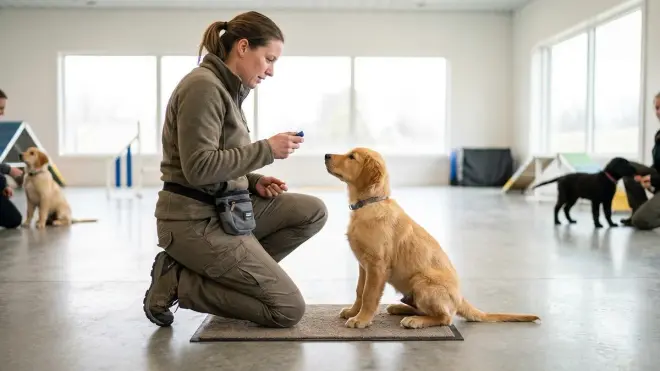
Here's where the training gets more sophisticated, but I'll keep it simple. Once your puppy reliably performs a behavior—let's say they sit every single time you ask in that quiet room—you need to start mixing up the rewards.
At first, you reward every single correct response. That's called continuous reinforcement, and it's perfect for teaching new behaviors. But if you keep rewarding every single sit forever, your puppy will only perform when they know you have treats. I've seen plenty of dogs who won't listen unless they can literally see food in their owner's hand.
The solution is something called a variable reward schedule, which sounds complicated but really isn't. It just means you don't reward every single behavior anymore. Instead, you reward randomly—sometimes the first sit, sometimes the third, sometimes two in a row, then skip the next one.
This unpredictability actually makes the behavior stronger. It's the same psychological principle that makes slot machines so addictive—you don't know when the reward is coming, so you keep trying. Your puppy keeps performing the behavior because they know the reward might be coming, but they're not sure when.
Start by rewarding every other successful behavior, then every third, then randomly. You'll notice your puppy actually becomes more attentive and tries harder when they're not getting a treat every time. But here's the critical part: even when you're not giving food, you still need to praise. A happy "good dog!" or a quick pet keeps them engaged even without the treat.
This transition usually happens after your puppy has been performing a behavior consistently for about a week. Don't rush it, but don't skip it either.
Step 5: Fade Treats Gradually While Increasing Life Rewards
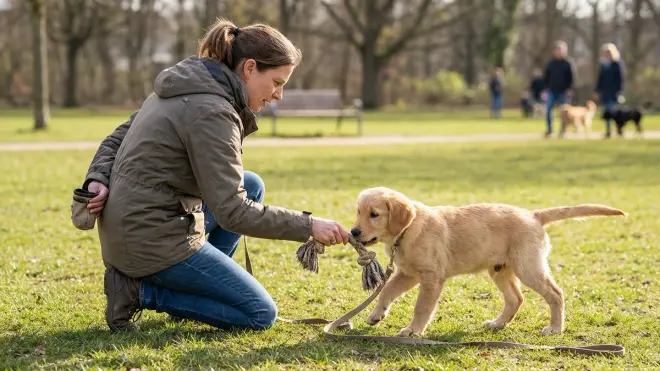
Eventually, you want a puppy who listens because they understand what you're asking and want to cooperate—not because they're staring at the treat in your hand. Fading treats is one of the most misunderstood parts of how to use treats for puppy training.
Here's what doesn't work: training with treats for two months, then suddenly stopping cold turkey and expecting the same level of responsiveness. Your puppy will be confused and likely stop performing the behaviors as reliably.
Here's what does work: gradually replacing food treats with what I call "life rewards"—things your puppy already wants anyway. Does your puppy go crazy when you reach for the leash because walk time is the best part of their day? Make them sit before you clip it on. Does your puppy lose their mind when you open the back door? Make them wait calmly before you let them outside.
Every single thing your puppy wants can become a reward. Access to the yard, permission to greet another dog, throwing their favorite ball, scratching that spot behind their ears they love—these are all powerful reinforcers that don't involve food.
As you make this transition over several weeks or months (yes, months—training isn't a race), you'll use food treats less and less frequently, but you'll still use them occasionally, especially when asking for more challenging behaviors or training in difficult environments. I still carry treats for my own dogs, and the oldest one is seven. They don't always get them, but the possibility is there.
The goal isn't to eliminate treats entirely. The goal is to create a puppy who responds reliably whether food is present or not, because they've learned that good things happen when they cooperate with you.
Step 6: Train in Multiple Environments to Build Reliability
Your puppy might be a superstar in your kitchen, but the moment you step outside, it's like they've never heard the word "sit" in their entire life. Sound familiar? This happens because puppies don't automatically generalize learned behaviors to new environments.
You need to deliberately practice every behavior in multiple locations with varying levels of distraction. Start in that quiet room where you initially taught the skill, then progress through increasingly challenging environments:
- Different rooms in your house (the bedroom, bathroom, hallway)
- Your backyard (new smells, sounds, maybe some birds or squirrels)
- The front yard (more stimulation, possible street noise)
- Quiet neighborhood streets (cars, people walking by)
- Busier areas (near parks, pet stores, or downtown areas)
Each time you move to a new environment, expect your puppy's performance to drop a bit. That's completely normal. You might need to go back to rewarding every single correct response for a few repetitions until they understand that the rules haven't changed—sit still means sit, even at the pet store.
Here's a trick I use constantly: when you're in a new, distracting environment, ask for behaviors your puppy already knows really well before introducing anything new. This builds confidence and gets them into "working mode" even with all the excitement around them. A few quick sits or downs that earn treats help them focus on you instead of the fascinating squirrel across the street.
For most puppies, you'll need to practice each behavior in 5-10 different locations before it becomes truly reliable everywhere. That might sound like a lot, but you can work through environments pretty quickly—a few repetitions in each spot is often enough.
Step 7: Combine Treats With Other Motivators for Well-Rounded Training
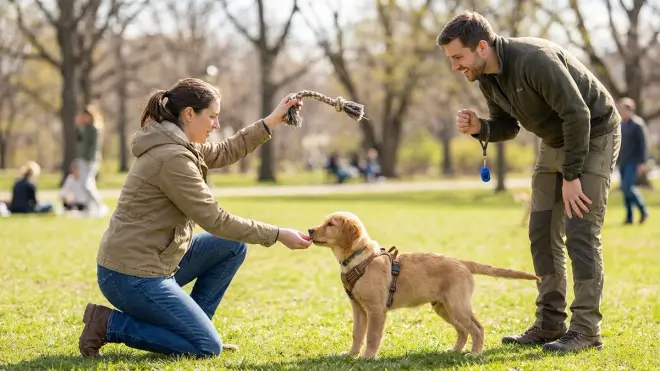
Food isn't the only thing your puppy cares about, and the most effective training programs use multiple types of rewards. I've trained puppies who would work twice as hard for a game of tug as they would for the tastiest treat. Others lose their minds for verbal praise delivered in that high-pitched, excited voice. Some just want to be near you and will work for physical affection.
Pay attention to what makes your specific puppy light up. Then use it.
When your puppy nails a behavior, especially a challenging one, mix up your rewards. Sometimes it's a treat. Sometimes it's "good dog!" said with genuine enthusiasm. Sometimes you immediately produce their favorite toy and play for thirty seconds. Sometimes it's just scratching their chest the way they love.
This variety keeps training interesting for your puppy and prevents them from becoming too fixated on food as the only reason to cooperate. It also prepares you for situations where you don't have treats available—your puppy has already learned that good things come in different forms.
I particularly like combining treats with play for high-energy breeds like Border Collies, Australian Shepherds, or Terriers. You might reward a perfect recall with a treat followed immediately by throwing a ball. The treat satisfies their immediate "I did it!" response, and the play channels their energy into something fun.
For lower-energy or more food-motivated breeds like Basset Hounds, Bulldogs, or many Retrievers, treats might remain your primary reward for longer, but you should still incorporate praise and petting so they don't become only food-motivated.
Understanding your individual puppy's personality and preferences makes training so much easier. There's no one-size-fits-all approach, which is why cookie-cutter training programs often fail. You can also explore homemade puppy training treats if your puppy has specific dietary needs or preferences that commercial treats don't meet.
Pro Tips & Common Mistakes
After two decades of training, I've seen the same mistakes pop up again and again. The biggest one? Using treats that are too large. Your puppy doesn't need a whole biscuit every time they sit. A piece the size of a pea works just as well and won't fill them up after five repetitions. Cut those treats smaller than you think you need to.
Another common issue: boring treats in exciting environments. Your puppy's regular kibble might work great in the kitchen, but at the park surrounded by other dogs? You need to bring the good stuff. Match your reward value to the difficulty of the environment. Our guide to the best puppy training treats can help you identify high-value options.
Here's a pro tip that makes a huge difference: keep your treat hand at your side or behind your back until after your puppy performs the behavior. If your hand is extended in front of you holding a treat, your puppy is just following the food—they're not really learning the behavior. The treat should appear after the action, not before.
Also, don't underestimate the power of your voice. Your tone and energy matter as much as the food. A flat, monotone "good dog" doesn't communicate much enthusiasm. A genuine, excited "YES! Good sit!" delivered with a smile tells your puppy they just did something amazing.
One more thing: never use treats to bribe or lure a puppy out of unwanted behavior. If your puppy is jumping on guests and you offer a treat to get them to stop, you just rewarded jumping. Instead, ask for an incompatible behavior like sit, then reward that.
Frequently Asked Questions
What kind of treats should I use for puppy training?
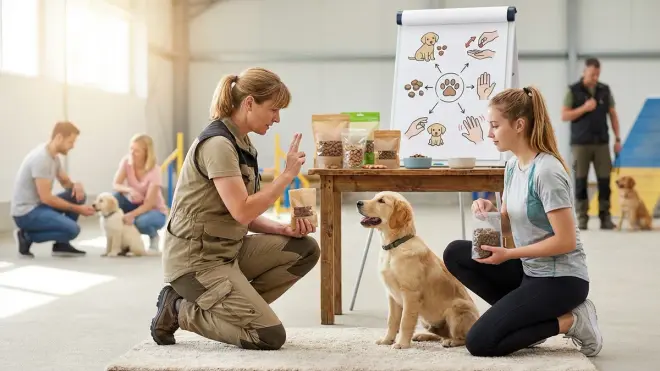
You should use soft, small treats (pea-sized or smaller) made from simple ingredients that your puppy can swallow quickly without much chewing. High-value options include freeze-dried liver, small training-specific treats, tiny pieces of cooked chicken, cheese, or turkey. Avoid hard biscuits, large treats, or anything with artificial additives during training sessions because they take too long to eat and can interrupt the learning process.
How many treats can I give my puppy during a training session?
You can give as many treats as needed during training sessions as long as the total from all sessions doesn't exceed 10% of your puppy's daily caloric intake. For most puppies, this means deducting training treats from their regular meals to prevent overfeeding and weight gain. If you're doing multiple short sessions throughout the day (which works best for young puppies), count all those treats together and reduce dinner portions accordingly.
When should I stop using treats for training?
You should start gradually reducing treat frequency once your puppy reliably performs a behavior, typically after about one week of consistent success, by switching to a variable reward schedule where you reward randomly rather than every time. However, you never completely eliminate treats—even well-trained adult dogs benefit from occasional food rewards, especially when learning new behaviors or working in challenging environments. The goal is making your puppy respond reliably whether treats are present or not.
Can I use my puppy's regular kibble as training treats?
You can use regular kibble as training treats for low-distraction environments and with highly food-motivated puppies, and it's actually a smart way to prevent overfeeding since you're just using their regular meal portions throughout the day. However, kibble usually isn't exciting enough for more challenging training situations or high-distraction environments, where you'll need higher-value treats like meat, cheese, or commercial training treats to maintain your puppy's attention and motivation.
Summary
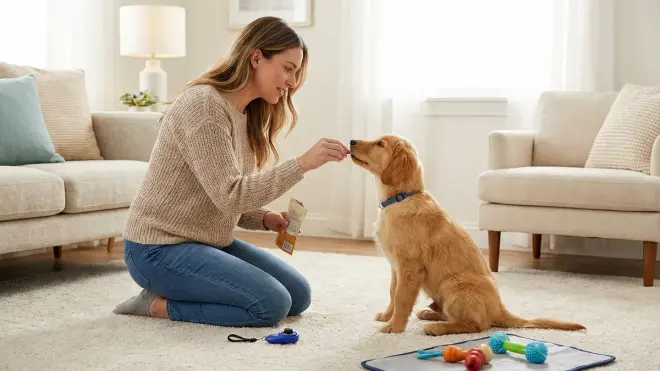
Learning how to use treats for puppy training effectively comes down to timing, consistency, and understanding what motivates your specific puppy. Start with the right treats—small, soft, and high-value—delivered within one second of the desired behavior. Begin in quiet environments with simple commands, then gradually increase difficulty while transitioning from continuous to variable reward schedules. As your puppy becomes more reliable, fade food treats by incorporating life rewards like play, praise, and access to things they already want. Practice in multiple locations to build real-world reliability, and remember that the goal isn't to create a puppy who only works for food—it's to build clear communication and a cooperative relationship.
Your puppy wants to understand you. Treats are just the tool that makes the conversation clearer while you're both learning the language. Keep sessions short, celebrate small victories, and stay patient with the process. The foundation you're building now will shape your relationship for years to come.