


For most first-time owners, an adult dog (1-5 years old) is the better choice because you'll skip the intense housebreaking phase, destructive chewing, and round-the-clock supervision that puppies demand. This guide breaks down the puppy vs adult dog for first time owner decision across time commitment, training challenges, health costs, behavioral predictability, and lifestyle fit—so you can choose the dog that'll actually work with your real life, not the idealized version of it.
Quick Comparison: Puppy vs Adult Dog for First-Time Owners
| Criterion | Puppy (8 weeks - 6 months) | Adult Dog (1-5 years) |
|---|---|---|
| Daily time commitment | 4-6 hours of active supervision, potty breaks every 2 hours | 1-2 hours of exercise and interaction |
| Training difficulty | Starting from scratch; 4-6 months for basic housebreaking | Often knows basic commands; 2-4 weeks to adjust to your routine |
| First-year costs | $2,500-$4,000 (vaccines, spay/neuter, supplies, potential damage) | $1,200-$2,000 (fewer vet visits, existing training) |
| Behavioral predictability | Personality still developing; temperament emerges at 12-18 months | Established personality; what you see is what you get |
| Best for | Flexible schedules, patient temperaments, families with older kids | Working professionals, first-time owners, quieter households |
Time Commitment: The Reality Check Nobody Mentions
Here's what usually happens: people picture playing fetch in the backyard and cuddling on the couch. Then they bring home an 8-week-old puppy and realize they can't leave the house for more than an hour without coming home to accidents or chewed baseboards.

Puppies require constant supervision for the first 4-6 months. I'm talking about setting alarms for 2 a.m. potty breaks, rushing home during lunch, and watching them like a hawk whenever they're out of the crate. Young puppies physically cannot hold their bladder longer than their age in months plus one—so a 3-month-old pup needs to go out every four hours, maximum. That includes overnight. If you're working full-time without the option to come home midday, you'll need to hire a dog walker or use doggy daycare, which adds $15-30 per day to your budget.
The destruction phase hits around 12-16 weeks when teething ramps up. I've seen puppies chew through drywall corners, destroy leather sofas, and gnaw table legs down to splinters—all in the span of a single afternoon. You'll need to puppy-proof your home thoroughly, which means removing or securing anything within three feet of the floor.
Adult dogs settle into your routine within 2-4 weeks. Most can hold their bladder for 6-8 hours during the workday (though I wouldn't push it past six regularly). They've outgrown the manic chewing phase, and if they're from a reputable rescue or foster program, you'll know whether they're crate-trained and housebroken before you sign the paperwork. You can leave the house without a military-level exit strategy. You can sleep through the night on day one.
The time difference isn't trivial—it's the difference between rearranging your entire life for six months and making moderate adjustments for a few weeks. For anyone working a standard schedule, the puppy vs adult dog for first time owner decision usually comes down to this single factor more than any other.
Training Challenges: Starting From Scratch vs Building on a Foundation
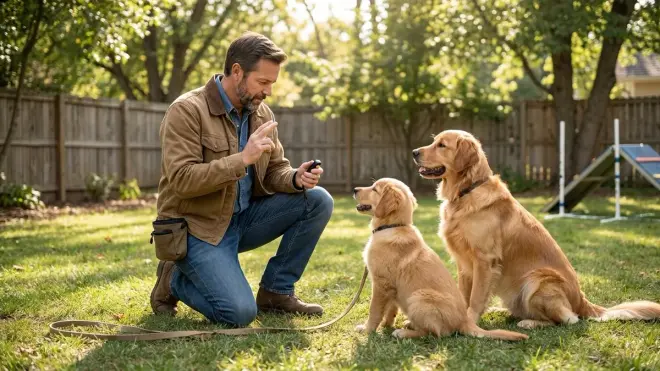
I've trained hundreds of puppies, and here's the truth: basic obedience takes 4-6 months of consistent daily work before you have a dog that reliably responds to sit, stay, come, and leave it. Housebreaking alone can stretch to six months depending on the breed and your consistency. Puppies don't come with an off switch—they're learning machines, but they're also chaos engines with the attention span of a goldfish.
You're starting with zero skills and maximum energy. Every behavior you want—loose-leash walking, not jumping on guests, settling calmly when you're working—has to be taught from the ground up. Puppies need multiple short training sessions daily (5-10 minutes each), and you'll burn through training treats faster than you'd believe. You'll also need to invest in proper puppy training tools like a crate, exercise pen, and leash, plus potentially potty training aids if you're struggling with housebreaking.
The upside? You control the entire learning experience. If you do it right from the start, you won't have to undo bad habits someone else taught. The downside? You're going to mess some things up. Every first-time owner does. And those mistakes become ingrained behaviors you'll spend months correcting later.
Adult dogs often come with basic training already installed. I've worked with plenty of 2-3 year old shelter dogs that knew sit, down, and come within the first session. They've lived with humans before. They understand that inside is for sleeping and outside is for peeing. They've (usually) figured out that biting hands during play is not acceptable. The learning curve is about adapting what they already know to your household rules, not building everything from nothing.
That said, adult dogs sometimes come with baggage—fear-based reactivity, leash pulling, separation anxiety, or resource guarding. But here's the key difference: you can identify these issues during the meet-and-greet period. Reputable rescues will tell you upfront if a dog is nervous around men, reactive to other dogs, or needs a home without cats. With puppies, you're gambling. That sweet, calm 10-week-old might turn into a 60-pound adolescent with serious barrier frustration at 14 months. You won't know until you're already two years deep.
For first-time owners, the predictability of an adult dog's training needs beats the blank-slate fantasy of puppies almost every time. Check out how to train a new dog in the first week for a solid foundation approach that works for adult adoptions.
Health Costs and Veterinary Care: The First-Year Reality
The first year with a puppy is expensive, and most of that expense is non-negotiable. You're looking at $2,500-$4,000 minimum when you add up everything: three rounds of combination vaccines (DHPP) at $75-100 each, rabies vaccine at $20-30, spay or neuter surgery at $200-500, heartworm and flea prevention starting at $15-25 per month, and multiple vet visits for wellness checks and potential issues like intestinal parasites (incredibly common in puppies).
Then there's the stuff you didn't budget for. Puppies eat inappropriate things—rocks, socks, sticks, entire tennis balls. Emergency vet visits for intestinal blockages start around $1,500 and climb from there. They get diarrhea from sudden diet changes, which means more vet visits. They injure themselves doing stupid puppy things like launching off furniture or misjudging a jump. And if you're feeding a large-breed puppy, you'll need specialized nutrition that costs 20-30% more than standard puppy food to ensure proper bone development.
Adult dogs cost substantially less in year one, typically $1,200-$2,000. They've already been spayed or neutered (most rescues include this before adoption). They've finished their core vaccine series—they just need annual boosters at $50-100. They're less likely to eat foreign objects because they've developed some sense of what's food and what's a choking hazard. And crucially, you're not paying for growth—you can buy quality adult dog food in larger quantities without worrying about transitioning to new formulas every few months.
The long-term costs eventually even out. A well-cared-for dog will need senior-specific care after age 7-8 regardless of when you adopted them. But the first-year difference is significant enough to impact the puppy vs adult dog for first time owner decision, especially if you're on a tight budget or don't have $1,500 sitting in savings for emergency vet care.
Behavioral Predictability: Gambling vs Knowing What You're Getting
This is where adult dogs have the clearest advantage. Personality is fully formed by 18-24 months, and what you see during the adoption meet-and-greet is what you'll live with. Is the dog calm and gentle? Energetic and playful? Nervous around strangers? Confident and outgoing? That's your dog. Behavior can be modified with training, but core temperament is set.
I've watched too many first-time owners adopt an 8-week-old puppy from a "calm, laid-back breed" only to end up with a neurotic, high-energy adolescent at 14 months because genetics are unpredictable and early socialization went sideways. Breed tendencies are real—herding breeds tend to be smart and driven, retrievers tend to be mouthy and social—but individual variation is enormous. That sweet, cuddly Golden Retriever puppy might mature into a 75-pound tornado with separation anxiety and zero off-switch.
With puppies, you're making a 15-year commitment based on 30 minutes of observation at the breeder's house or shelter. You don't know if they'll be dog-aggressive, cat-aggressive, child-friendly, or comfortable in the car. You don't know if they'll develop noise phobias or barrier frustration. You're hoping that with proper socialization and training, they'll turn into the dog you imagined. Sometimes it works perfectly. Sometimes it doesn't, and you're stuck managing a behavioral problem you never signed up for.
Adult dogs remove most of that guesswork. Spend an hour with a 3-year-old dog and you'll learn whether they pull on leash, come when called, get along with other dogs, and handle new situations with confidence or anxiety. Foster-based rescues are especially valuable here—the foster family has lived with the dog for weeks or months and can tell you exactly what they're like in a home environment. Does the dog counter-surf? Destroy furniture when left alone? Bark at every passing car? You'll know before you commit.
The behavioral predictability of adult dogs makes them dramatically easier for first-time owners to manage. You can match the dog's actual personality to your actual lifestyle instead of gambling on what a puppy might become. The 3-3-3 rule for rescue dogs explains the typical adjustment timeline beautifully—three days to decompress, three weeks to settle into routine, three months to fully trust you.
Lifestyle Fit: Matching Energy Levels and Household Dynamics
Let's talk about real-world scenarios. You work 9-5, Monday through Friday. You want a dog for companionship and weekend hikes, but you're not home during the day. A puppy doesn't fit that life without expensive interventions like doggy daycare ($300-600/month) or a midday dog walker ($15-30/day). Even with those supports, you're missing the critical socialization window (8-16 weeks) when puppies need exposure to new people, places, sounds, and experiences to develop into confident adults.
Adult dogs fit into working-professional schedules with minimal adjustment. They can handle 6-8 hours alone (with a midday break if possible), and many shelter dogs have already lived in similar situations. You can maintain your normal routine and still provide excellent care.
Family dynamics matter too. Puppies and young children (under age 6) are a difficult combination unless at least one adult is home full-time to supervise. Puppies play rough—they bite, jump, and knock small kids down. Kids under six don't have the impulse control to follow training protocols consistently, which means the puppy learns conflicting rules and develops confusion-based behavioral issues. I've seen this combination work, but it requires more patience and management than most first-time owners anticipate.
Adult dogs with child-friendly temperaments are much easier to integrate into homes with young kids. They've moved past the mouthy puppy stage, they're less likely to knock toddlers over during play, and they can be evaluated for child-tolerance before adoption.
If you live in an apartment or condo with noise restrictions, adult dogs are usually quieter than puppies going through teenage fear periods and barrier frustration phases (typically 6-14 months). Puppies bark at everything because they're learning about the world and don't yet have impulse control. Adult dogs bark too, but it's usually context-specific and easier to manage with training.
The puppy vs adult dog for first time owner question ultimately comes down to this: can your actual daily life—not your ideal fantasy version—accommodate the needs of a young puppy for six months straight? If the honest answer is no, an adult dog will give you all the companionship and joy without derailing your entire existence.
Who Should Choose a Puppy

Choose a puppy if you have a genuinely flexible schedule for the next 4-6 months—either you work from home full-time, you're between jobs, you're a stay-at-home parent with school-age kids, or you have a partner who can tag-team the constant supervision. Puppies aren't weekend projects. They're full-time jobs for the first several months.
Choose a puppy if you want complete control over socialization and training. If you're willing to invest the time in proper early socialization (exposing your puppy to 100+ new people, places, and experiences before 16 weeks), you can shape a confident, well-adjusted adult dog. This matters most if you have specific needs—service dog candidates, working dogs for farms or ranches, or competition prospects for dog sports.
Choose a puppy if you have the emotional patience for the challenging phases. Housebreaking accidents at 3 a.m. don't rattle you. Destroyed shoes feel manageable. You can redirect biting behavior for the thousandth time without losing your cool. Some people genuinely enjoy the puppy phase despite its challenges. If that's you, go for it.
But be honest with yourself. The puppy phase looks adorable on Instagram. Living through it is exhausting, expensive, and sometimes frustrating enough to make you question your decision. Make sure you're ready for the reality, not just the highlight reel.
Who Should Choose an Adult Dog
Choose an adult dog if you work a standard schedule and can't be home every 2-3 hours during the day. Adult dogs are the obvious choice for working professionals, and they're just as capable of forming deep bonds with their owners as puppies—sometimes more so because they seem to understand they've been given a second chance.
Choose an adult dog if you want predictable behavior and personality from day one. You can select for the specific traits you need: calm and low-energy for apartment living, active and adventurous for hiking partners, or social and friendly for homes with frequent guests. The guesswork is gone.
Choose an adult dog if your budget is tight. The first-year cost difference is substantial, and adult dogs from shelters or rescues often come with initial vet care already completed. Many organizations include spay/neuter, vaccines, microchipping, and sometimes even basic training in the adoption fee (typically $150-400).
Choose an adult dog if you're a genuine first-time owner who's never managed the puppy phase before. Despite what you've heard, adult dogs are not "harder to train" or "set in their ways." That's a myth that keeps wonderful dogs in shelters. Adult dogs are easier for inexperienced handlers because they already understand basic concepts like housetraining and impulse control. You can focus on building your relationship and learning dog body language without simultaneously teaching every single life skill from scratch.
The new dog checklist covers everything you'll need regardless of age, but adult dog adoption is genuinely the better path for most first-time owners. Check out comprehensive advice for new dog owners for detailed guidance on making the transition smooth.
Frequently Asked Questions
Is it harder to train a puppy or an adult dog for a first-time owner?
Adult dogs are easier to train for first-time owners because they already have basic impulse control, longer attention spans, and established bladder control, while puppies require round-the-clock supervision and need every single behavior taught from scratch over 4-6 months of consistent daily training sessions. Adult dogs can learn new commands in days or weeks using the same training methods puppies require months to master because their brains are fully developed and they're not simultaneously navigating fear periods, teething pain, and developmental growth phases.
How long does it take for an adult rescue dog to adjust to a new home compared to a puppy?

Most adult dogs adjust within 3-8 weeks, following the three-day decompression, three-week routine establishment, three-month full bonding timeline, while puppies don't fully settle into their adult personality until 12-18 months of age, making the adjustment period much longer overall. Adult dogs experience an initial transition where they're learning your household rules, but they're not simultaneously going through developmental stages, so once they understand your routine and trust you, their behavior stabilizes predictably and remains consistent.
Can first-time owners successfully adopt adult dogs with unknown backgrounds?
Yes, first-time owners can successfully adopt adult dogs with unknown histories as long as they work with reputable rescues or shelters that conduct behavioral evaluations and provide honest assessments about each dog's temperament, energy level, and any special needs like separation anxiety or leash reactivity. Foster-based rescue organizations are especially helpful for first-time owners because the foster family has lived with the dog and can provide detailed information about how the dog behaves in a home setting, what triggers stress or anxiety, and whether they're compatible with children, cats, or other dogs—information you simply cannot know about a puppy until they mature.
Bottom Line: Most First-Time Owners Should Choose Adult Dogs
The puppy vs adult dog for first time owner decision isn't about which one you want—it's about which one fits your actual life right now. Puppies are adorable and rewarding if you have the time, flexibility, and patience to manage the intense first six months. But for most first-time owners working standard schedules, living in apartments, or hoping for predictable behavior without a steep learning curve, adult dogs deliver all the companionship with half the chaos.
I've watched countless first-time owners struggle through the puppy phase wishing they'd adopted an adult dog, and I've watched just as many fall in love with their 2-3 year old rescue within the first week and wonder why anyone would choose differently. Adult dogs aren't damaged goods or second choices—they're often the smarter choice, especially when you're still learning how to read dog body language, establish household rules, and build the kind of bond that makes dog ownership worth it. Visit your local shelter, spend time with a few adult dogs, and you'll see exactly what I mean.