
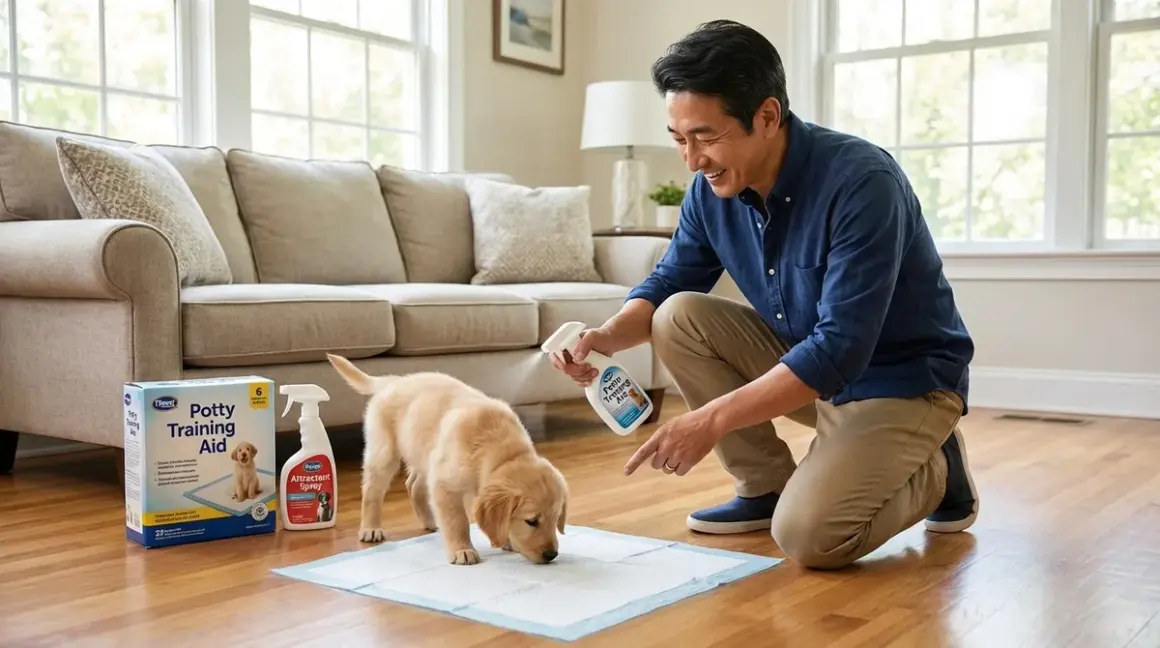

I'll be honest—when my sister asked me to help house-train her new Golden Retriever puppy last year, I was way out of my depth. My expertise is fish tanks, not four-legged chaos machines. But watching her struggle through those first few weeks with puddles on the carpet and confusion about which dog potty training aids actually worked reminded me a lot of my early fishkeeping days: information overload, conflicting advice, and a lot of expensive trial and error. After helping her sort through the options and seeing what actually produced results, I learned that the right training aids can genuinely accelerate the process—but only if you understand what you're buying and why it works. The quick verdict: attractant sprays work best for outdoor spot training, pads are essential for apartment dwellers and overnight containment, and pheromone-based products outperform fragrance-only options when you match them to your dog's age and training stage.
What to Look For in Dog Potty Training Aids
In my experience with researching this topic thoroughly (and watching my sister test products in real-time), the difference between dog potty training aids that work and ones that just smell nice comes down to a handful of specific factors. Here's what actually matters when you're choosing products.
Active Ingredients vs. Fragrance Fillers
The biggest mistake I saw my sister make initially was grabbing a spray that smelled great to humans but contained zero active attractants for dogs. Effective potty training sprays contain pheromone compounds or scent markers that mimic the natural territorial marking instincts in dogs—these are usually derived from synthetic versions of canine urine pheromones or plant-based compounds that dogs instinctively investigate. Look for ingredients like methyl anthranilate, natural grass scents, or proprietary pheromone blends on the label. Products that list only essential oils (lavender, eucalyptus, citrus) without these attractant compounds are essentially just air fresheners—they might cover up accident smells for you, but they won't communicate "go here" to your puppy. For dogs under six months, pheromone-based attractants work better because their scent-marking instincts aren't fully developed yet; older dogs and adult rescues often respond to products that layer territorial scent markers with subtle ammonia-like compounds that mimic other dogs' marking spots.
Pad Absorbency and Multi-Layer Construction
If you're using training pads—whether as a permanent indoor solution for a small breed or as a transitional tool for puppies—the construction quality makes a massive difference in whether your dog actually uses them. Quality pads feature at least five layers: a quick-dry top sheet (usually quilted polyethylene or non-woven fabric), a distribution layer that spreads liquid across the pad, a super-absorbent polymer core (the same stuff used in baby diapers), a waterproof backing, and adhesive corner tabs to prevent bunching. Cheap pads skip the distribution layer, which means liquid pools in one spot and your puppy steps in it—creating negative associations with the pad itself. For puppies under 20 pounds, look for pads that hold at least 2-3 cups of liquid; for dogs 20-50 pounds, you want 4-6 cup capacity, and for larger breeds, find pads rated for 6+ cups. The polymer core should turn gel-like when saturated but not leak when pressed—if liquid squishes back out when you apply pressure, the pad won't contain overnight accidents reliably. My sister learned this the hard way with bargain-bin pads that looked identical to premium ones but turned her kitchen into a slip hazard after one use.
Size and Placement Flexibility
This seems obvious until you actually start house training, then you realize how much spatial logistics matter. For outdoor attractant sprays, you need enough product volume to treat the same spot consistently for at least 3-4 weeks—a tiny 4-ounce bottle runs out after a week of twice-daily applications. Look for bottles in the 16-32 ounce range if you're training a puppy from scratch, or plan to buy multiples. For training pads, size matching is crucial: puppies under 15 pounds need 17x24-inch pads minimum (they tend to circle before squatting, so too-small pads result in missed edges), medium dogs need 22x22-inch or larger, and large breeds benefit from 28x30-inch or jumbo sizes. I watched my sister's Golden consistently miss the edges of standard pads until she sized up—suddenly, success rate jumped to 90%. Consider washable cloth pads for permanent indoor setups or if you're training multiple puppies simultaneously; the upfront cost is higher (usually around $40-60 for a four-pack), but they're far more economical over time and more environmentally friendly if you'll be using pads for months.
Odor Neutralization Technology
Here's something that surprised me: the products that eliminate odor for humans often don't eliminate the scent markers dogs use to recognize potty spots. This creates two competing needs—you want to remove smells that encourage re-soiling in the wrong places, but you want to preserve attractant scents in the designated potty area. Quality enzymatic cleaners break down the uric acid crystals in urine that dogs can smell long after humans think the area is clean; look for products containing protease and amylase enzymes specifically. For training pads, activated carbon or baking soda infused into the polymer core helps neutralize ammonia smells without masking the pheromone attractants on the pad surface. Some newer pads incorporate odor-locking technology that encapsulates smell molecules in gel pockets as the pad absorbs—these work noticeably better in small apartments or if you need pads to stay fresh for 8+ hours. Avoid pads or sprays that rely heavily on perfume or masking fragrances (words like "fresh linen scent" or "mountain breeze" are red flags), because dogs find these confusing at best and aversive at worst.
Compatibility with Training Methods
Different dog potty training aids align with different training philosophies, and mixing incompatible approaches causes confusion. If you're using positive reinforcement and clicker training (which modern veterinary behaviorists recommend), you want attractant sprays and pads that create consistent, predictable associations—products with stable, non-changing scent profiles work best. If you're transitioning from indoor pads to outdoor elimination, you need a spray that smells similar enough to the pad attractant that your puppy makes the connection, or you'll be starting from scratch. Some training systems incorporate both deterrent sprays (for areas you want to protect) and attractant products—these should be chemically distinct enough that your dog can tell them apart easily. I'd also note that puppies under 12 weeks have limited bladder control regardless of training aids; you need products that set realistic expectations for this developmental stage rather than promising overnight results. Similarly, adult dogs being retrained after bad habits or rescue dogs with unknown histories often need stronger pheromone concentrations and longer exposure times than puppy-focused products provide—check whether the product specifies age ranges or just says "all dogs," which usually means it's formulated for puppies and may underperform with adult dogs.
Our Top Picks
NatureVet Potty Here Training Spray
The NatureVet Potty Here Training Aid Spray🛒 Amazon is probably the most widely recommended attractant spray among professional dog trainers I spoke with while researching this, and after watching it work with my sister's puppy, I understand why—it's formulated with a pheromone blend that genuinely gets dogs interested in the sprayed spot without being overpowering to human noses. The 32-ounce bottle lasts 4-6 weeks with twice-daily applications, and the spray mechanism produces a fine mist rather than a stream, which helps you cover the designated area evenly without soaking it. It works especially well for puppies 8-16 weeks old during the critical window when they're just starting to develop spot preferences outdoors. I watched my sister's pup start sniffing the treated area within about three days and consistently eliminating there by day seven, which was a massive improvement over the random lawn roulette she'd been dealing with before.
Pros:
- Contains proprietary pheromone blend that triggers instinctive sniffing and elimination behaviors in most dogs
- Large 32 oz bottle provides good value for extended training periods (around $15-18 typically)
- Works for both outdoor spot training and indoor pad training when sprayed on pad corners
- Non-toxic, safe for use around children and other pets
- Can be effective for retraining adult dogs who've developed bad habits
Cons:
- The spray nozzle occasionally clogs if you don't wipe it clean after each use—learned this when my sister's bottle stopped misting properly after two weeks
- Effectiveness varies significantly between individual dogs; some puppies respond within days while others seem completely indifferent to it
- Scent dissipates relatively quickly outdoors in rain or heavy dew, requiring reapplication before each potty trip
Simple Solution Puppy Training Pads
What I appreciate about the Simple Solution Puppy Training Pads🛒 Amazon after seeing them in action is that they're genuinely engineered rather than just thrown together—the five-layer construction includes a rapid-dry top sheet that wicks moisture away from paws almost immediately, which prevents that hesitation many puppies develop when they step on a wet pad and decide they'd rather hold it. The built-in attractant is infused throughout the top layer rather than just sprayed on the surface, so it remains effective even after the pad has been used once (relevant for overnight use or if you need one pad to last through multiple eliminations). Each pad measures 22x22 inches and holds approximately 4 cups of liquid, making them suitable for dogs up to about 40 pounds. My sister used these during the overnight period when her puppy couldn't hold it for a full eight hours yet, and they consistently contained everything without leaking onto the floor—which isn't something I can say for the cheaper alternatives she tried first.
Pros:
- Multi-layer construction genuinely prevents leaks and tracking better than budget pads
- Quick-dry surface reduces paw moisture, which helps maintain positive associations with pad use
- Adhesive tabs on corners keep pad in place even with enthusiastic diggers or circlers
- Built-in attractant pheromone increases success rate compared to unscented pads
- Available in 50-count and 100-count boxes for better per-pad pricing
Cons:
- At roughly $30-35 for a 50-count box, these cost about twice as much as basic pads (though they actually work)
- The adhesive tabs are strong enough that they can pull up paint or finish when removed from hardwood or tile floors if left in place for multiple days
- Larger dogs (50+ pounds) produce more volume than these pads handle comfortably—you'll want the XL version
OUT! Go Here Attractant Indoor & Outdoor Dog Training Spray
The OUT! Go Here Attractant Indoor and Outdoor Dog Training Spray🛒 Amazon differentiates itself with a formula that works in both contexts—you can use it to mark outdoor potty spots and also spray it on training pads to enhance their attractiveness, which is genuinely useful during the transition period when you're moving a puppy from indoor pads to outdoor elimination. The active attractant uses a blend of natural scent compounds and pheromones that remain detectable to dogs for roughly 8-12 hours outdoors under normal conditions. The 32-ounce bottle includes both a spray trigger and a flip-top pour spout, which gives you flexibility in how you apply it (the trigger works better for outdoor spot marking, while the pour spout is useful for soaking a cloth to place under a training pad when you're first introducing it). What I found interesting from my sister's experience is that this spray seemed to work better for her puppy after about three weeks of training—once the dog had some basic concept of where potty spots were, this product reinforced those associations more strongly than it established them from scratch.
Pros:
- Versatile formula works for both outdoor potty spot marking and indoor pad enhancement
- Dual-application design (spray and pour) provides flexibility for different training scenarios
- Scent remains effective longer outdoors compared to most competitors (8-12 hours vs 4-6 hours)
- Can be used as a refresher for adult dogs who've regressed or during stressful transitions like moving
- Non-staining formula won't discolor grass, concrete, or indoor surfaces
Cons:
- The scent is noticeably stronger to human noses than some other brands—not unpleasant, but definitely detectable when you spray it
- Less effective for very young puppies (under 10 weeks) who haven't developed strong scent-association learning yet
- The trigger sprayer produces more of a stream than a mist, making it easy to over-apply and waste product
Glad for Pets Black Activated Carbon Puppy Pads
If you're dealing with small spaces or need pads to control odor for extended periods, the Glad for Pets Black Activated Carbon Puppy Pads🛒 Amazon incorporate activated carbon throughout the core layer, which genuinely neutralizes ammonia smells rather than just masking them with fragrance. I was skeptical of the marketing claims until my sister tested these during a particularly hot week when odor control became the limiting factor in how long she could leave pads down—these outperformed standard pads noticeably. The black color is a deliberate design choice that hides staining and discoloration, which matters more than you'd think for maintaining visual cleanliness in your living space. Each pad is 22x22 inches with a six-layer construction that includes both the carbon odor-control layer and a polymer core rated for 6 cups of liquid—these are legitimately heavy-duty pads designed for extended use or larger dogs. The surface texture is slightly rougher than smooth-top pads, which some dogs prefer because it provides better traction.
Pros:
- Activated carbon layer provides superior odor control compared to polymer-only pads—genuinely keeps spaces smelling neutral for 8-12 hours
- Black coloring hides stains and maintains visual cleanliness better than white pads
- Six-layer construction with high absorbency capacity makes these suitable for overnight use or multiple eliminations
- Textured surface provides traction that some dogs prefer, especially older dogs or those with mobility issues
- Leak-proof backing is notably thicker than most competitors
Cons:
- Price point is higher than standard pads (around $40-45 for a 50-count box), which adds up if you're using multiple pads daily
- The darker color makes it harder to assess saturation level at a glance—you can't see the wet zone as obviously as you can with white pads
- Some dogs are initially hesitant about the black color (though they typically adjust within a few uses)
Bodhi Dog Potty Training Spray for Puppies
The Bodhi Dog Potty Training Spray🛒 Amazon uses a concentrated formula that you can dilute if you find the scent too strong, which gives you more control over intensity than pre-mixed sprays—this is particularly useful if you're working with a scent-sensitive dog or want to gradually fade the attractant as training progresses. The 16-ounce bottle is smaller than some competitors, but because you can extend it with water (usually 1:1 or 1:2 dilution), you effectively get 32-48 ounces of usable product. The formula contains a blend of plant-derived enzymes and synthetic pheromones designed specifically for puppies under six months, and in my sister's experience, it worked noticeably better during the earliest training phase (8-12 weeks) than some of the all-ages sprays she tried. The scent profile is more grass-like and less chemical than many alternatives, which might explain why her puppy responded to it more enthusiastically. If you're looking for guidance beyond just the product itself, you might want to check out how to use puppy training spray for potty training success for detailed application techniques.
Pros:
- Concentrated formula allows dilution for cost savings and scent intensity control
- Formulated specifically for puppies under six months with age-appropriate pheromone concentrations
- Grass-like natural scent seems more appealing to puppies than chemical-smelling alternatives
- Works well in combination with positive reinforcement training methods
- Made in the USA with non-toxic ingredients safe for household use
Cons:
- The dilution flexibility means you can accidentally make it too weak if you over-dilute—takes some trial and error to find the right ratio
- Smaller initial bottle size (16 oz) requires mixing with water, which is an extra step some people find annoying
- Less effective for adult dogs or dogs over six months who need stronger territorial markers
Wee-Wee Superior Performance Dog Pee Pads
The Wee-Wee Superior Performance Dog Pee Pads🛒 Amazon offer a good middle-ground option for people who need better quality than basic pads but don't want to pay premium pricing—these typically run around $25-30 for a 50-count box, which is about 30% less than top-tier options while still delivering reliable performance. The five-layer design includes a wetness indicator that changes color (light blue to dark blue) so you can see saturation levels without touching the pad, which is genuinely convenient for monitoring throughout the day. Each 22x22-inch pad holds approximately 4.5 cups of liquid and includes floor armor leak-proof protection with plastic backing that extends slightly beyond the absorbent core—that extra margin prevents edge leaks that happen when dogs aim poorly. These worked reliably for my sister during the 3-5 month puppy phase when accidents were still frequent but bladder control was improving—they're not the absolute best at any single thing, but they're consistently good across the board at a reasonable price point. For a comprehensive overview of training tools that complement pads and sprays, the puppy training aids checklist covers the full spectrum of what most new owners need.
Pros:
- Wetness indicator provides visual feedback about saturation level without requiring touch-checks
- Price-to-performance ratio is strong—better than budget pads at only marginally higher cost
- Extended plastic backing reduces edge-leak incidents with dogs who aim imperfectly
- Available in multiple sizes (standard, large, XL) for different dog sizes and life stages
- Quilted top surface provides texture that most dogs find comfortable
Cons:
- Odor control is adequate but not exceptional—these work fine for 6-8 hours but start getting noticeable after that
- The wetness indicator, while useful, sometimes creates a slightly stiffer spot in the pad that some dogs avoid stepping on
- Adhesive tabs are weaker than premium options—very active dogs or enthusiastic diggers can bunch these up
Frequently Asked Questions
Do dog potty training sprays actually work or are they just marketing?
Dog potty training sprays do work for most puppies and dogs when the product contains genuine pheromone attractants or scent compounds that trigger instinctive elimination behaviors, but they're not magic solutions that override poor training practices or unrealistic expectations about puppy bladder control. In my experience watching these products in action, sprays containing synthetic pheromones derived from canine territorial marking chemicals (usually listed as "proprietary pheromone blend" or specific compounds like methyl anthranilate) create measurable increases in sniffing behavior and elimination attempts in the sprayed location—studies on canine scent-marking behavior confirm that dogs instinctively investigate and mark areas where they detect other dogs' pheromones, which is exactly the mechanism these products leverage. However, effectiveness varies significantly based on the individual dog's age (puppies under 16 weeks respond best), prior training experiences (dogs who've already formed strong location habits are harder to redirect), and how consistently you use the spray in combination with positive reinforcement techniques. The products that fail are typically fragrance-only formulas that smell good to humans but contain zero active attractants dogs can detect, or situations where owners expect the spray alone to house-train a puppy without also controlling feeding schedules, monitoring water intake, taking the dog out frequently, and rewarding successful eliminations—sprays amplify good training practices but can't replace them.
How often should I replace training pads during the day?
You should replace training pads immediately after each use if you're actively house-training a puppy under four months old, because allowing pads to sit used teaches puppies that it's acceptable to eliminate near their own waste, which contradicts the cleanliness instincts you're trying to cultivate for successful house-training. For overnight use or situations where immediate replacement isn't possible (during your workday, for example), high-quality multi-layer pads with adequate absorbency for your dog's size can remain in place for 8-12 hours, but this should be viewed as a necessary compromise rather than ideal practice. What I've observed watching house-training in action is that puppies who consistently encounter fresh, clean pads develop stronger preferences for using them versus eliminating elsewhere in the house (success rates around 85-90% after three weeks), while puppies whose pads are left saturated for hours show more resistance to pad training and more frequent elimination in adjacent areas—they're essentially getting mixed messages about cleanliness standards. For adult dogs using pads as a permanent indoor solution (common with toy breeds, dogs in high-rise apartments, or dogs with mobility issues), replacing pads every 6-8 hours maintains hygiene and odor control, though some dogs will refuse to use a pad they've already soiled and will communicate they need a fresh one. The quality of the pad matters significantly here—budget pads with poor absorbency need replacement after single use regardless of dog age, while premium pads with advanced polymer cores and odor control can handle 2-3 eliminations from a small dog before requiring replacement, though I'd still recommend freshening them as often as practical for training purposes.
Can I use training pads for senior dogs with incontinence issues?
Training pads absolutely work for senior dogs experiencing age-related incontinence, mobility limitations, or cognitive decline that makes reliable outdoor elimination difficult, though you'll want to approach setup differently than you would for puppy house-training—senior dogs need dignity-preserving solutions that accommodate their physical limitations rather than behavior correction tools. The key differences in using pads for senior dogs involve placement (multiple pad stations throughout the house in areas your dog frequents, rather than one designated training spot), size selection (larger pads or overlapping multiple pads to create a bigger target zone for dogs with poor aim or mobility), and product choice (maximum absorbency and odor control become priority features, while attractant pheromones become less important since senior dogs aren't learning new behaviors). I'd specifically recommend pads with activated carbon odor control and capacity ratings of 6+ cups for medium to large senior dogs, because incontinence often involves larger volume releases than normal controlled elimination, and you may not discover an accident immediately if your dog has an incident during the night or while you're in another room. Many pet parents of senior dogs also find washable, reusable cloth pads more practical and economical for long-term use—they're easier on arthritic paws, more environmentally sustainable when you're going through multiple pads daily, and the upfront cost (around $50-80 for a set) pays for itself within a few months compared to disposable pad expenses. The emotional aspect matters here too—most senior dogs with incontinence show distress about accidents because they've been house-trained their entire lives; providing accessible pad stations helps maintain their sense of control and reduces anxiety around elimination, which veterinary behaviorists confirm is important for quality of life in aging dogs.
What's the difference between potty training pads and regular pee pads?
The terms "potty training pads" and "pee pads" are often used interchangeably by manufacturers, but when distinctions exist, potty training pads typically incorporate attractant pheromones in the pad surface or core to encourage puppies to use them during active house-training, while basic pee pads are unscented absorbent pads intended for containment and cleanup rather than behavior modification. In practical terms, if you're house-training a puppy under six months old, pads specifically marketed as "potty training" or "attractant" pads provide measurably better results because the pheromone layer communicates "eliminate here" in a way dogs instinctively understand, while unscented pads rely entirely on the dog's existing preferences and your training consistency. The construction quality can also differ—genuine training pads marketed for active house-training typically feature better absorbency, leak-proof backing, and durability because they're designed for repeated use in the same location during weeks or months of training, whereas basic pads may prioritize low cost for situations where they're used occasionally (like long car trips or temporary containment during illness). What I found interesting researching this distinction is that many pet parents unknowingly buy basic pee pads expecting them to actively help with training, then become frustrated when their puppy shows no particular interest in using them—the pads are working exactly as designed (absorbing liquid and protecting floors) but without attractant compounds, they're not influencing the puppy's location choice. If you're training a young puppy or retraining an adult dog, spending the extra money for pheromone-enhanced training pads genuinely accelerates the process; if you're managing a senior dog's incontinence or providing emergency backup for an already house-trained dog, basic absorbent pads without attractants are perfectly adequate and save money. Related resources like house training aid for puppies: complete setup checklist can help you determine which product category fits your specific situation.
How long does it take for potty training attractant sprays to work?
Most dogs begin showing increased sniffing and investigation behaviors in sprayed areas within 2-4 days of consistent twice-daily application, but translating that interest into reliable elimination in the designated spot typically takes 7-14 days of combining the spray with proper training techniques—timing, positive reinforcement, and schedule consistency—which is actually faster than training without attractants (usually 3-4 weeks). What I've learned watching this process is that attractant sprays accelerate training by helping dogs develop location preferences faster, but they don't instantly override a puppy's limited bladder control, lack of established routine, or confusion about what behaviors humans want—if you spray a spot and then only take your puppy there once or twice a day at random times, the spray's effectiveness is severely limited because the dog never builds a reliable association between the scent, the location, and the opportunity to eliminate. The most successful protocol my sister followed involved spraying the designated outdoor spot every morning and evening, taking her puppy there immediately after waking, after meals, after play sessions, and every 2-3 hours throughout the day, and providing high-value treats plus enthusiastic praise within 3 seconds of successful elimination on the sprayed spot—this created a strong three-way connection between the attractant scent, the location, and the reward. Under those conditions, her puppy showed clear preference for the sprayed area by day 5 and was reliably seeking it out by day 10. However, dogs with previous house-training failures, adult dogs being retrained after developing bad habits, or puppies under 10 weeks with very limited cognitive development may take longer—realistic expectation for these situations is 3-4 weeks of consistent spray use and training before you see reliable results. The American Kennel Club's guidelines on puppy development provide helpful context about age-appropriate expectations that can help you assess whether your spray is actually working or whether your timing and expectations need adjustment.
The Verdict
After watching these dog potty training aids in real-world use and seeing the difference between products that actually contain active ingredients versus ones that just smell nice, I'm convinced that spending a bit more on quality pads and pheromone-based sprays genuinely shortens the house-training timeline and reduces frustration for both dogs and their humans. NatureVet Potty Here Training Spray remains my top recommendation for most puppy owners because of its proven pheromone blend and reasonable price point, while Simple Solution Puppy Training Pads deliver the construction quality that actually prevents leaks and maintains positive associations with pad use. What strikes me most is how much these tools work with natural canine instincts rather than against them—the best products essentially translate your training intentions into a language dogs already speak through scent, which is way more effective than hoping they'll figure out your preferences through repetition alone. If you're just starting the house-training journey, invest in quality products from the beginning rather than burning through cheap alternatives that don't work—it's the same lesson I learned with aquarium equipment years ago, and it applies just as well to puppies as it does to fish tanks. For a broader look at all the training tools that work together during those critical first months, check out best puppy training tools for new dog owners in 2026 to see how potty training aids fit into the larger training ecosystem.