


I've spent twenty years working with dogs, but here's something I've learned from countless conversations with cat owners: feeding cats isn't just about picking a bag off the shelf. The essential nutrients in cat food matter more than most people realize, because cats literally can't survive without certain compounds that dogs and humans can make on their own. Your cat's body works differently, and understanding what goes into their bowl can mean the difference between a thriving feline and one dealing with preventable health issues down the road.
What Are Essential Nutrients in Cat Food?
When we talk about essential nutrients in cat food, we're talking about the specific vitamins, minerals, proteins, fats, and amino acids that cats must get from their diet because their bodies can't produce these compounds internally. This isn't optional stuff—these are the building blocks your cat needs to survive.

Cats are obligate carnivores, which is fancy terminology for "they need meat to live." Unlike dogs, who are omnivores and can adapt to various food sources, cats evolved as hunters who ate almost nothing but prey animals. Their entire digestive system, metabolism, and nutritional requirements reflect this specialized diet.
Here's what makes cats different: over millions of years of evolution, they lost the ability to synthesize certain nutrients because they always got them from meat. It's like how humans need vitamin C from food because we can't make it ourselves—except cats have a much longer list of compounds they depend on external sources for.
The AAFCO (Association of American Feed Control Officials) establishes the nutritional standards that cat food manufacturers follow, defining minimum levels for over 40 essential nutrients across different life stages. When you see "AAFCO complete and balanced" on a label, it means the formula meets these baseline requirements—though as we'll discuss, not all cat foods deliver these nutrients equally well.
This is fundamentally different from dog nutrition, which is why you can't just feed cat food to dogs long-term or vice versa. If you're curious about the parallel requirements for dogs, I cover that in detail in my guide on how to choose the right dog food for your dog's needs.
How Cat Nutrition Works
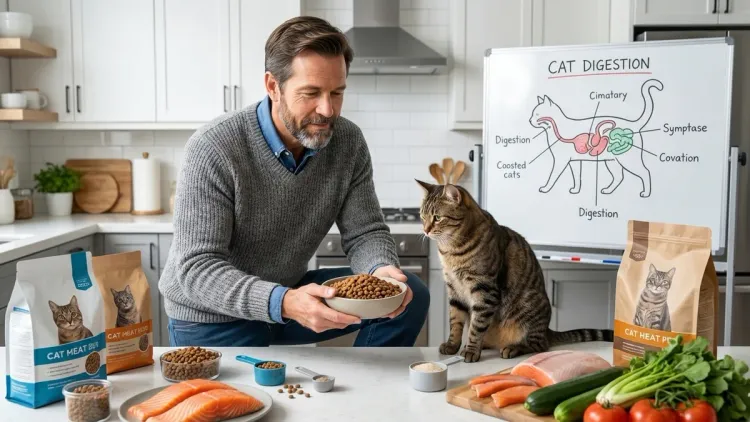
Your cat's body processes food in ways that reflect their evolutionary history as specialized predators. Understanding this helps explain why the essential nutrients in cat food look so different from what you'd see in dog or human nutrition.
Protein serves as the primary energy source for cats, not carbohydrates. While dogs and humans can efficiently convert carbs into glucose for energy, cats have a limited ability to do this. Their liver enzymes are calibrated to break down amino acids (protein building blocks) for fuel instead. This means cats need around 26% protein in their diet as a minimum, compared to 18% for dogs—and many nutrition experts recommend even higher levels, especially for kittens and active adults.
Fat metabolism works differently too. Cats need more fat than dogs do, both for energy and to absorb fat-soluble vitamins (A, D, E, and K). They require at least 9% fat in their diet, but most quality cat foods contain 15-20% or more. Unlike humans who can convert beta-carotene from plants into vitamin A, cats must get pre-formed vitamin A directly from animal tissues.
The digestive process itself is shorter and less adaptable. A cat's digestive tract is relatively short compared to omnivores, designed for quickly processing nutrient-dense meat rather than slowly fermenting plant material. This is why cats have minimal need for fiber—usually just 2-5% for hairball management and intestinal health, compared to the higher fiber levels often beneficial for dogs.
Here's something that surprises many cat owners: cats can't taste sweetness. They lack functional sweet taste receptors, which makes evolutionary sense—meat doesn't taste sweet. This is why you'll sometimes see cats ignore foods that dogs would devour. They're wired to respond to the savory, umami flavors found in animal protein and fats.
The kidney and liver work overtime in cats to process protein byproducts. This is normal and healthy in young cats, but it's also why senior cats often need special consideration for kidney support. Their entire system is optimized for a high-protein, moderate-fat, low-carb diet that closely mimics what they'd eat in the wild—which would be small prey animals consumed whole, including organs, muscle meat, and even bones.
Why Essential Nutrients in Cat Food Matter
I've seen what happens when cats don't get the right nutrition, and it's not subtle. We're not talking about minor performance differences like you might see in training treats—we're talking about serious, sometimes irreversible health conditions that develop from nutritional deficiencies.
Taurine deficiency is the classic example. Cats can't synthesize this amino acid sufficiently on their own, and without adequate taurine from their diet, they develop dilated cardiomyopathy (heart disease) and progressive retinal degeneration (blindness). These conditions take months or years to develop, so by the time symptoms appear, significant damage has already occurred. This is exactly why AAFCO standards exist and why you should pay attention to what is AAFCO certification and why it matters for cat food.
Vitamin A deficiency causes night blindness, poor coat quality, and immune system problems. Because cats can't convert plant-based beta-carotene into usable vitamin A, they need the pre-formed version found in animal tissues, particularly liver. I've talked to cat owners who tried feeding vegetarian diets, thinking they were doing right by their pets, only to face serious health consequences.
Arachidonic acid is an omega-6 fatty acid that dogs can synthesize from other fats, but cats can't. Without it, cats develop skin problems, poor wound healing, and reproductive issues. It's found naturally in animal fats, which is another reason why meat-based ingredients aren't negotiable for cats.
The practical significance extends to every aspect of your cat's wellbeing: energy levels, coat shine, muscle maintenance, immune function, and even behavior. A cat getting proper nutrition will typically be more active, maintain a healthy weight more easily, and show fewer signs of chronic low-grade inflammation. You'll see it in their eyes, their coat, and their overall demeanor.
When you're evaluating cat food options, understanding these requirements helps you cut through marketing claims. You can read ingredient panels with a critical eye and ask the right questions. My article on how to read cat food labels walks through exactly what to look for when you're standing in the pet food aisle trying to make sense of the back of the bag.
The Critical Essential Nutrients Cats Need

Let's break down the specific compounds that must be present in adequate amounts. This is where the rubber meets the road when evaluating any cat food formula.
Protein and Amino Acids
Complete protein from animal sources should be the foundation. Look for named meat proteins in the first few ingredients: chicken, turkey, salmon, beef, or other specific animal proteins rather than vague terms like "meat meal" or "by-product meal."
Taurine is the most critical amino acid for cats, required at minimum levels of 0.10% in dry food and 0.20% in wet food. Most quality formulas exceed these minimums significantly. Taurine supports heart function, vision, reproduction, and immune health.
Arginine is another essential amino acid that cats need in every single meal. Unlike dogs who can go a few days without it, cats deficient in arginine can develop ammonia toxicity quickly. They need it to process protein waste products through the urea cycle.
Methionine and cysteine work together to support coat quality, skin health, and various metabolic processes. These sulfur-containing amino acids are especially important for cats, who need them to produce taurine and maintain healthy urine pH.
Essential Fatty Acids
Arachidonic acid (AA) is a must-have omega-6 fatty acid that cats cannot synthesize. It's concentrated in animal fats, particularly poultry fat and fish oils. Without adequate AA, cats develop dry, flaky skin and poor coat quality.
Omega-3 fatty acids (EPA and DHA) support brain development, reduce inflammation, and promote cardiovascular health. These are found primarily in fish-based ingredients. While not technically essential in the strictest sense, they're so beneficial that most quality cat foods include them.
Linoleic acid is another omega-6 fatty acid that supports skin barrier function and coat quality. It's found in both plant and animal fats, though cats utilize animal-based sources more efficiently.
The ratio of omega-6 to omega-3 fatty acids matters, with most experts recommending somewhere between 5:1 and 10:1 for optimal health. If you're comparing feeding options, my article on wet vs dry cat food discusses how moisture content affects nutrient concentration, including these essential fats.
Vitamins
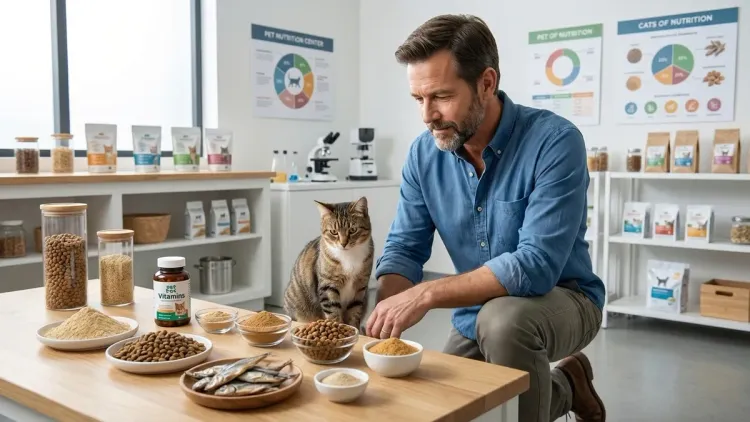
Vitamin A (retinol) must come pre-formed from animal sources. Cats need this for vision, immune function, and cell growth. Liver is particularly rich in vitamin A, which is why you'll often see it listed in quality cat foods.
Vitamin D3 (cholecalciferol) regulates calcium and phosphorus absorption. Cats have limited ability to synthesize vitamin D from sunlight like humans do, so dietary sources from fish and animal tissues are essential.
Vitamin E (tocopherols) acts as an antioxidant protecting cell membranes from damage. It's particularly important in foods high in fish oils, which are prone to oxidation.
B-complex vitamins—including thiamine (B1), riboflavin (B2), niacin (B3), pyridoxine (B6), and cobalamin (B12)—support energy metabolism, nervous system function, and red blood cell production. Cats need higher levels of these than dogs do because of their protein-centric metabolism.
Minerals
Calcium and phosphorus work in tandem to support bone health, with the ratio between them being critical—typically around 1:1 to 1.2:1 for adult cats. Imbalanced ratios can lead to skeletal problems, especially in growing kittens.
Magnesium needs to be present but not excessive. Too much magnesium, combined with alkaline urine and certain minerals, can contribute to urinary crystal formation in susceptible cats. Quality foods typically keep magnesium around 0.08-0.12%.
Potassium supports muscle function, including the heart muscle. Cats on certain therapeutic diets or those with kidney disease often need supplemental potassium.
Taurine gets its own mention here too, though it's an amino acid, because it's that critical. Every life stage and every formula—whether you're looking at best wet cat food or best dry cat food—must include adequate taurine or you're looking at a formula that will eventually harm your cat.
Water
This might seem obvious, but moisture is an essential nutrient that many cat owners overlook. Cats evolved in arid environments and have a naturally low thirst drive. They're designed to get most of their water from prey, which is about 70% moisture. Dry food contains only about 10% moisture, which is why many veterinarians recommend including wet food in your cat's diet or ensuring adequate water intake through other means.
Life Stage and Special Considerations
The essential nutrients in cat food don't change based on life stage, but the amounts and ratios do. Here's what shifts as your cat ages or faces specific health challenges.
Kittens
Kittens need roughly twice the calories per pound of body weight compared to adult cats because they're growing rapidly. They require higher protein levels (minimum 30% on a dry matter basis), more fat (minimum 9%, but often 15-20%), and higher concentrations of calcium and phosphorus to support bone development.
DHA (docosahexaenoic acid) is particularly important for brain and eye development in kittens, which is why many kitten formulas include fish oil or other DHA-rich ingredients. Look for foods specifically labeled for "growth and reproduction" or "all life stages"—these meet the higher nutritional demands of kittens.
Adult Cats (1-7 Years)
Adult maintenance diets can have slightly lower protein and fat levels than kitten foods, but they should still deliver robust nutrition. Minimum protein should be around 26% on a dry matter basis, with fat around 9%—though most quality adult foods exceed these minimums.
Calorie control becomes more important for indoor cats or naturally less active felines. Obesity is the most common nutritional disease I hear about from pet owners, and it stems largely from overfeeding and insufficient activity. Portion control matters as much as nutrient quality during this life stage.
Senior Cats (7+ Years)

Older cats often need higher protein levels despite common misconceptions to the contrary. Unless your cat has specific kidney disease requiring restriction, protein helps maintain muscle mass as metabolism changes with age.
Phosphorus restriction becomes important if kidney disease develops, as excess phosphorus accelerates kidney damage. Senior formulas often include lower phosphorus levels as a preventive measure.
Joint support compounds like glucosamine and chondroitin aren't essential nutrients in the technical sense, but they can help aging cats maintain mobility. Some senior formulas include these supplements, though they're not required by AAFCO standards.
Health Conditions
Cats with urinary issues may need foods that promote dilute, slightly acidic urine to prevent crystal formation. This involves careful balance of minerals, particularly magnesium, phosphorus, and calcium.
Diabetic cats benefit from high-protein, low-carbohydrate formulas that minimize blood sugar spikes. Many veterinarians recommend wet food for diabetic cats because it naturally has fewer carbohydrates than dry food.
Food-sensitive cats may need limited-ingredient diets or hydrolyzed protein formulas where the protein molecules are broken down too small to trigger immune reactions. This is different from grain-free feeding, which I discuss in my article comparing grain-free vs grain-inclusive cat food.
Frequently Asked Questions
What are the most essential nutrients in cat food?
The most essential nutrients in cat food are high-quality animal protein providing complete amino acids (especially taurine and arginine), pre-formed vitamin A from animal sources, arachidonic acid (an omega-6 fatty acid), vitamin D3, niacin, and adequate moisture content, because cats are obligate carnivores who cannot synthesize these compounds sufficiently on their own.
Can cats get enough nutrients from plant-based cat food?
Cats cannot thrive on plant-based food because they require several nutrients that only come from animal sources, including pre-formed vitamin A (not beta-carotene), arachidonic acid, taurine in adequate amounts, and complete protein profiles that match their evolutionary needs as obligate carnivores—plant proteins lack the right amino acid ratios and bioavailability for feline health.
How do I know if my cat's food has all essential nutrients?
You can verify your cat's food has all essential nutrients by checking for an AAFCO statement on the package that says "complete and balanced for all life stages" or for your cat's specific life stage (kitten, adult, or senior), which means the formula meets established nutritional standards through either feeding trials or formulation analysis, and by reviewing the guaranteed analysis and ingredient panel for animal protein as the first ingredient.
Do indoor cats need different nutrients than outdoor cats?
Indoor cats need the same essential nutrients as outdoor cats, but they typically require fewer calories because they're less active, so you'll want to adjust portion sizes rather than nutrient types—though some indoor formulas include extra fiber for hairball control and L-carnitine to support healthy metabolism, these aren't different essential nutrients but rather helpful additions for managing indoor cat lifestyle factors.
Can kittens eat adult cat food?

Kittens should not eat adult cat food as their primary diet because they need significantly higher levels of protein, fat, calcium, phosphorus, and calories to support rapid growth and development—adult maintenance formulas don't provide adequate nutrition for kittens, though kittens can safely eat food labeled "for all life stages" which meets the higher nutritional requirements of growth.
Building Your Cat's Nutritional Foundation
Look, I'm a dog guy by trade, but the fundamental principle applies across species: nutrition isn't something you can afford to guess about. The essential nutrients in cat food form the foundation of your cat's long-term health, affecting everything from heart function to coat quality to how well they age into their senior years.
When you're evaluating food options—whether you're choosing between best wet cat food options or best dry cat food formulas—focus on these key indicators: animal protein as the primary ingredient, AAFCO certification for your cat's life stage, named fat sources that provide arachidonic acid, and adequate taurine levels clearly listed in the guaranteed analysis.
If you're making a switch, take it slow. Cats can be finicky about changes, and their digestive systems need time to adjust. My complete cat food transition checklist walks through exactly how to make changes without causing stomach upset.
Your cat depends on you to understand what goes in their bowl. They can't read labels or make nutritional decisions—they just know whether something tastes good and whether they feel satisfied. You're the one who has to bridge the gap between marketing claims and actual nutritional adequacy. Take the time to learn what your cat really needs, read those labels with a critical eye, and choose food that delivers complete nutrition rather than just convenient feeding.