


I'll be honest—when I brought home my first puppy about a decade ago, I thought I could wing the training part with just treats and determination. That lasted exactly three days before I realized I was in over my head, dealing with puddles on the carpet, a pup who thought my shoelaces were chew toys, and absolutely no idea how to communicate what I actually wanted from this adorable little chaos machine. What I've learned since then, through plenty of trial and error (and yes, some expensive mistakes), is that having the right puppy training aids from day one makes an enormous difference in how quickly your pup learns and how much stress you both experience during those critical first 90 days.
Quick verdict: You don't need a garage full of gadgets, but you absolutely need five core tools—a well-fitted harness or collar, a quality clicker or marker, high-value training treats, designated potty training aids, and something to manage confinement during the learning phase. Everything else is optional depending on your specific challenges.
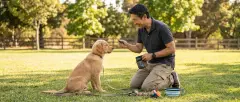
What to Look For in Puppy Training Aids
Age-Appropriate Sizing and Safety
Here's something I wish someone had emphasized to me earlier: puppies grow absurdly fast, especially large breeds, and what fits perfectly at 8 weeks might be dangerously tight by 12 weeks. When selecting puppy training aids, you need equipment that's adjustable or sized specifically for your pup's current weight and breed projection. A harness that's too loose lets a determined puppy slip right out (learned that one the hard way during a squirrel encounter), while one that's too tight can restrict breathing or cause chafing that makes your pup associate training time with discomfort.
Safety certifications matter more than I initially realized. Look for products that meet relevant safety standards—leashes and collars should have secure closures and reinforced stitching, while anything your puppy might chew on or interact with orally should be made from non-toxic materials. The American Kennel Club recommends avoiding retractable leashes for puppies still learning leash manners, since they don't provide the consistent feedback that helps pups understand boundaries. In my experience, a 6-foot standard leash gives you way more control during those early weeks when everything is new and potentially overwhelming.
Breed and Temperament Compatibility
Not all training aids work equally well across different breeds and energy levels. What works beautifully for a food-motivated Labrador puppy might completely fail with an independent-minded Husky or a toy-breed puppy who gets full after three tiny treats. I learned this when trying to use the same clicker training approach with two very different dogs—one responded immediately, the other seemed completely indifferent to the clicking sound and needed a different marker signal altogether.
For potty training specifically, consider your living situation and your puppy's eventual adult size. If you're in an apartment on the fifth floor with a large-breed puppy, you'll need different dog potty training aids than someone with a small-breed pup and immediate yard access. Scent-based attractant sprays work well for some puppies but seem to have zero effect on others—it's genuinely individual, and you might need to try a couple of approaches before finding what clicks with your specific dog.
Training Method Alignment
The puppy training aids you choose should support positive reinforcement methods, which behavioral science has consistently shown to be the most effective and humane approach for teaching puppies. This means you're looking for tools that help you reward desired behaviors rather than punish unwanted ones. Clickers, treat pouches, and target sticks all fall into this category. I've found that having a clear, consistent marker for "yes, that's exactly what I wanted!" speeds up learning dramatically compared to just verbal praise alone, though verbal praise absolutely has its place too.
Avoid training aids that work through aversive methods—shock collars, prong collars, and similar tools that rely on discomfort or fear. Beyond the ethical concerns, research shows these methods can create anxiety, aggression, and long-term behavioral issues that are way harder to fix than whatever problem you were originally trying to solve. The American Veterinary Society of Animal Behavior explicitly recommends against punishment-based training, and I've personally seen puppies shut down emotionally when training became associated with negative experiences.
Practical Durability and Cleanability
Puppies are messy. I mean truly, impressively messy in ways that seem to defy physics. Your training aids need to survive being dropped in mud puddles, chewed on when you're not looking, drooled on extensively, and washed repeatedly. What looked like a cute fabric treat pouch fell apart on me within two weeks because I hadn't considered how often I'd need to throw it in the washing machine after a particularly enthusiastic training session that involved, shall we say, digestive issues.
For items like training pads or artificial grass patches used in house training aid for puppies setups, look for materials that are genuinely leak-proof and have odor-control properties. The cheapest options might save you a few dollars upfront but often fail when you actually need them to work, which means you're cleaning your floors more and potentially confusing your puppy about where they're supposed to go. Washable, reusable options can be more economical long-term if you're committed to maintaining them, but disposable pads offer convenience that's genuinely valuable when you're already overwhelmed with new-puppy responsibilities.
Multi-Functionality and Value
The best puppy training aids serve multiple purposes throughout your pup's development. A quality adjustable harness can transition from early leash training to more advanced loose-leash walking as your puppy matures. A clicker used for basic obedience can later help with trick training and more complex behaviors. What I've found works best financially and practically is investing in fewer, higher-quality items that grow with your dog rather than buying a bunch of single-purpose gadgets that end up in a drawer after three weeks.
That said, don't fall into the trap of thinking expensive automatically equals better. Some of the most effective training aids are remarkably simple—a basic box clicker that costs a few dollars works exactly as well as a fancy electronic one for most puppies. Similarly, while you can find elaborate treat pouches with multiple compartments and carabiner attachments, a simple drawstring pouch that clips to your belt might be all you actually need. Focus your budget on items where quality genuinely impacts safety or effectiveness, like a well-constructed harness or a durable leash.
Our Top Picks
PetSafe Gentle Leader Headcollar
The PetSafe Gentle Leader Headcollar🛒 Amazon is a training tool that works on the principle of steering rather than restraining—it fits over your puppy's snout and behind their ears, giving you control over where their head (and therefore body) points. I was skeptical at first because it looks a bit like a muzzle, but it functions completely differently and doesn't restrict your puppy's ability to pant, drink, or take treats. What I've found particularly useful is how it immediately stops pulling without requiring you to yank back on a collar that puts pressure on your puppy's throat.
Pros:
- Provides immediate control without force, especially helpful for larger breed puppies who will outweigh you by month four
- Reduces pulling behavior significantly faster than collar-based methods in my experience
- Comes with a detailed training DVD that actually walks you through the acclimation process
- Adjustable fit accommodates growth through the puppy stage
Cons:
- Requires a proper acclimation period—puppies often paw at it initially and need gradual introduction
- The noseband can rub if fitted incorrectly, causing temporary marks (not painful, but cosmetically noticeable)
- Not suitable for flat-faced breeds like Pugs or French Bulldogs due to their muzzle structure
Starmark Pro-Training Clicker
The Starmark Pro-Training Clicker🛒 Amazon is a box-style clicker with a distinct, sharp sound that cuts through environmental noise better than many button clickers I've tried. What makes this one stand out is the comfortable thumb-press design and the attached wrist coil that keeps it accessible—I can't tell you how many basic clickers I've lost in coat pockets or dropped during outdoor training sessions. The click sound is consistent and loud enough that your puppy can hear it clearly even when they're a few yards away or when you're training in a slightly distracting environment.
Pros:
- Ergonomic design prevents hand fatigue during longer training sessions
- Attached coil means you won't lose it in your pocket or leave it on the kitchen counter
- Clear, distinct sound that's easier for puppies to distinguish from environmental noise
- Affordable enough to keep multiple ones in different locations (car, treat pouch, living room)
Cons:
- The click is quite loud, which might startle very sensitive or anxious puppies initially
- The wrist coil can get tangled with leashes if you're not mindful during walks
Zuke's Mini Naturals Training Treats
The Zuke's Mini Naturals Training Treats🛒 Amazon have become my go-to recommendation for puppy training specifically because of their size, ingredient quality, and the fact that puppies genuinely love them. Each treat is about the size of a small pea, which means you can reward frequently without overfeeding—something that's genuinely important when you're doing multiple short training sessions throughout the day like you should be during those first 90 days. The primary protein source is real chicken, turkey, or pork depending on the variety, and they're made without corn, wheat, or soy, which matters if your puppy has sensitivities.
Pros:
- Small size allows for high-frequency rewards without calorie overload (about 3 calories per treat)
- Soft texture makes them quick to chew and won't distract your puppy for long between repetitions
- Strong aroma that maintains your puppy's motivation and focus during training
- Available in multiple protein options if you need to rotate or avoid specific ingredients
Cons:
- The soft texture means they crumble easily in your pocket or treat pouch, creating mess
- More expensive per pound than basic training treats, though the appropriate sizing justifies the cost
- Some puppies with extremely sensitive stomachs may need an even more limited-ingredient option
For more guidance on how to maximize the effectiveness of training treats without creating weight or digestive issues, check out our detailed guide on how to use treats for puppy training.
Simple Solution Puppy Training Pads
The Simple Solution Puppy Training Pads🛒 Amazon feature a five-layer construction with leak-proof backing and built-in attractant that actually seems to work (unlike some competing brands I tried that my puppy completely ignored). What I appreciate most is the quick-dry surface that pulls moisture away from the top layer—this reduces tracking and means your puppy isn't standing in wetness, which can discourage pad use. The attractant is subtle enough that your house doesn't smell like artificial chemicals, but apparently noticeable enough to puppies to guide them toward the pad rather than your carpet.
Pros:
- Large size (22" x 22") gives puppies a decent target area and reduces misses at the edge
- Leak-proof plastic backing genuinely prevents seepage to your floors (tested extensively, unfortunately)
- Built-in attractant increases success rate, especially during the early weeks of potty training
- Available in bulk packs that bring the per-pad cost down significantly
Cons:
- Some puppies view the pads as entertaining toys to shred, which creates a massive mess
- The attractant scent can sometimes encourage puppies to seek out other similar textures like bathroom rugs
- Not environmentally friendly if you're conscious about disposable products
For a complete system approach to setting up your puppy's potty area, including pad placement and transition strategies, our house training aid for puppies guide covers the full setup.
Paw5 Wooly Snuffle Mat
The Paw5 Wooly Snuffle Mat🛒 Amazon is a feeding enrichment tool that doubles as a fantastic training aid for teaching impulse control and providing mental stimulation that genuinely tires puppies out. It's essentially a rubber base with hundreds of fleece strips attached—you hide kibble or small treats throughout the fabric strips, and your puppy has to use their nose to search and forage for the food. What I've found particularly valuable is using this before training sessions to take the edge off a puppy's frantic energy without doing exhausting physical exercise that might make them too tired to focus.
Pros:
- Slows down eating dramatically, reducing gulping and potential digestive upset
- Provides significant mental stimulation—15 minutes of snuffle work tires puppies as much as a walk
- Machine washable, which you'll need because puppies drool all over this thing
- Non-slip rubber backing prevents the mat from sliding around during use
Cons:
- Determined chewers will pull out the fleece strips (ask me how I know), shortening the product's lifespan
- Initial setup of hiding treats in all those strips is time-consuming until you develop a rhythm
- Takes up considerable space if you don't have a designated storage spot
Midwest iCrate Folding Dog Crate
The Midwest iCrate Folding Metal Dog Crate🛒 Amazon is a training essential that serves as your puppy's safe space, management tool, and den throughout their development. This particular model features a divider panel that lets you adjust the interior size as your puppy grows—critical because you want just enough space for them to stand, turn around, and lie down comfortably, but not so much space that they can potty in one corner and sleep in another. The double-door design (front and side entry) gives you flexibility in tight spaces and makes crate training easier since you can approach from whichever angle works best for your home layout.
Pros:
- Divider panel means one crate lasts from puppyhood through adulthood, saving money long-term
- Sturdy metal construction contains even enthusiastic chewers without risk of escape
- Plastic pan bottom removes easily for cleaning after inevitable accidents
- Folds flat for transport or storage when not in use
Cons:
- Metal construction is noisy when puppies bump against it or shift positions at night
- Requires a separately purchased crate pad or bedding—the plastic floor alone isn't comfortable
- Heavy and awkward to move once assembled, despite technically being "portable"
Frequently Asked Questions
What puppy training aids do I actually need in the first week?
In your very first week home, you need exactly four things: a properly fitted collar or harness with ID tags, a standard 6-foot leash, high-value training treats in very small pieces, and a designated potty area with either pads or access to a specific outdoor spot. Everything else can wait until you've assessed your specific puppy's personality and challenges. I made the mistake of buying a dozen different tools before my puppy even arrived, and most sat unused while I scrambled to address issues I hadn't anticipated. Start with the absolute basics, observe your puppy's learning style and problem areas during that first week, then add targeted tools to address whatever specific challenges emerge—whether that's crate training resistance, mouthing behavior, or potty training difficulties.
Are clickers necessary or can I just use verbal markers?
Clickers aren't strictly necessary—you can absolutely train a puppy successfully using verbal markers like "yes!" or "good!"—but they offer a distinct advantage in terms of precision and consistency. What I've found through training multiple dogs is that the mechanical click sound is identical every single time, whereas my verbal tone varies depending on my mood, energy level, or how frustrated I'm feeling in the moment. Puppies pick up on those emotional variations, which can muddy the communication. The click is emotionally neutral and marks the exact instant your puppy does the right thing with millisecond precision that's genuinely difficult to match with verbal markers. That said, if you're committed to maintaining a consistent verbal marker regardless of circumstances, it can work fine—it's just harder to maintain that consistency than you might think during real-life training situations.
How many training treats can I give my puppy per day?
Training treats should make up no more than 10% of your puppy's total daily caloric intake, which in practical terms means you need to account for training calories in their overall feeding plan. For young puppies doing frequent short training sessions, this might translate to 15-30 small treats daily depending on their size and caloric needs. What I actually do in practice is reduce their regular meal portions slightly on heavy training days to compensate—if I know we're doing multiple sessions that day, I'll hold back about a quarter cup of their regular food and use those calories for training treats instead. For detailed guidance on calculating these numbers based on your specific puppy's needs, our article on how many treats can I give my puppy during training breaks down the math and practical strategies for managing treat intake without derailing your puppy's nutrition.
Should I use puppy training pads or go straight to outdoor training?
This depends entirely on your living situation, your puppy's age and vaccination status, and your schedule flexibility. If you live in an apartment without immediate outdoor access, work long hours, or have a very young puppy who can't hold it long enough to get outside consistently, training pads serve as a valuable interim solution that prevents accidents and sets up good habits even if the location will eventually change. However, if you have easy outdoor access and can take your puppy out every 1-2 hours during the day, going straight to outdoor training eliminates the extra step of transitioning away from pads later. What I've learned is that pads aren't a failure or a shortcut—they're a practical tool for specific circumstances—but they do add an extra training phase since your puppy will eventually need to learn that the outdoors is the permanent potty spot. Consider using a puppy training spray on your chosen potty area (whether indoor pad or outdoor spot) to help establish location preference from day one.
When should I introduce more advanced training aids like target sticks or agility equipment?
Focus exclusively on basic obedience, potty training, and socialization for your first 60-90 days before introducing anything more advanced. Your puppy's brain is already processing an overwhelming amount of new information during those early weeks—learning their name, understanding house rules, figuring out what human gestures mean, and adjusting to their new environment. Adding complex training tools before they've mastered the absolute fundamentals tends to confuse rather than enhance learning, at least in my experience. Once your puppy reliably responds to their name, understands basic markers (whether clicker or verbal), and has solid potty habits, then you can start introducing target sticks for more precise positioning work or very basic introduction to agility obstacles. For most puppies, this happens around the 3-4 month mark, though toy breeds may mature slightly faster and giant breeds slightly slower in terms of training readiness.
The Verdict
The puppy training aids you choose during those first 90 days set the foundation for everything that follows, but more important than having the perfect tools is using whatever tools you have consistently and with clear intention. What I've learned through years of working with puppies—both my own and those belonging to friends who've asked for help—is that the most expensive gadget in the world won't overcome inconsistent training, but basic tools used thoughtfully and patiently will get you remarkably far. Start with the core essentials that support positive reinforcement methods, add specialized tools only when specific challenges reveal themselves, and remember that the most powerful training aid you have is your own attention and consistency during these critical early weeks.