
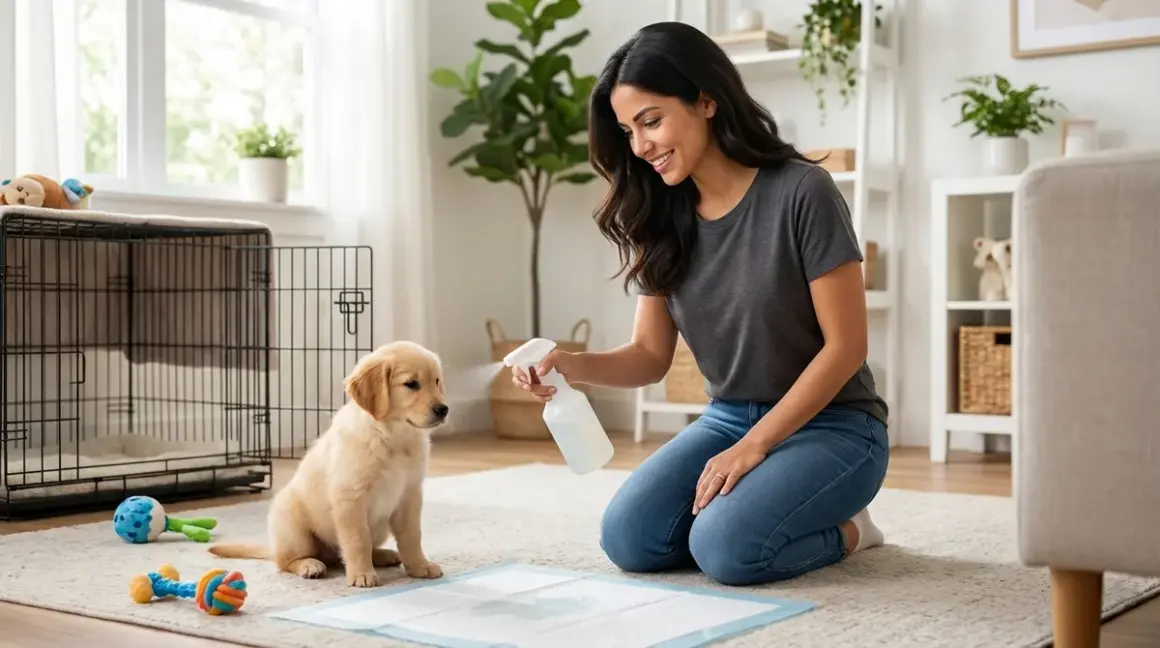

I'll be honest—when I first heard about puppy training spray, I was skeptical. My experience has been mostly with small pets (guinea pigs don't exactly need potty training the same way), but after helping my sister navigate the chaos of her new Labrador puppy's house training journey, I became a believer in these scent-based training aids. If you're drowning in accidents and wondering if there's a faster way to communicate where your puppy should actually go, puppy training spray might be the missing piece in your potty training puzzle.
This guide will walk you through exactly how to use puppy training spray effectively—from choosing the right spot to timing your applications for maximum success. You'll learn the science behind why these sprays work, how to integrate them with positive reinforcement training, and the common mistakes that sabotage results. Skill level: Beginner-friendly. Time commitment: About 10 minutes daily for the first 2-4 weeks, with most puppies showing significant improvement within 7-14 days when used consistently alongside a proper potty schedule.

What You'll Need
Before you start, gather these supplies:
- Puppy training spray (attractant formula containing pheromone analogs or natural scent compounds like ammonia derivatives)
- Designated potty area (specific outdoor spot, pee pad, or artificial grass patch)
- High-value training treats (small, soft pieces your puppy loves—check out our guide on how to use treats for puppy training for sizing and frequency tips)
- Enzymatic cleaner for accidents (to fully neutralize odors from mistakes)
- Leash for outdoor training sessions
- Notebook or phone app to track potty times and successes
- Patience and realistic expectations (this isn't magic, just a helpful tool)
For a comprehensive overview of all the tools you'll need during those hectic first months, our puppy training aids checklist covers everything from crate training to basic obedience supplies.
Step 1: Choose and Prepare Your Designated Potty Zone
The first thing you need to do—before you even crack open that spray bottle—is decide exactly where you want your puppy to eliminate. This sounds obvious, but I've seen too many people spray multiple spots "just in case," which completely confuses the puppy about where the bathroom actually is.
For outdoor training: Pick a specific 3-foot by 3-foot area in your yard. It should be easily accessible from your door (remember, you'll be making frantic runs here at 3 AM), away from high-traffic play areas, and on a surface that drains reasonably well. Avoid spots right next to your vegetable garden—the ammonia in urine isn't great for most plants.
For indoor pad training: Choose a low-traffic corner that's always accessible. Avoid placing pads near your puppy's food, water, or sleeping area—dogs instinctively avoid soiling their den space, which is actually helpful for crate training but works against you if the pad is too close.
Clean the area thoroughly with an enzymatic cleaner first, even if it looks clean. Previous scent markers from wildlife, other dogs, or even residual cleaning products can interfere with the training spray's effectiveness. Let it dry completely before moving to the next step.
Step 2: Apply the Training Spray Correctly
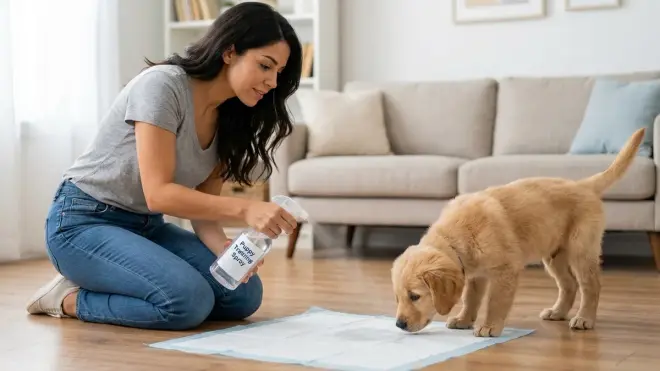
Now here's where technique matters. Most people just spray randomly and wonder why it doesn't work. The puppy training spray contains scent compounds that mimic the pheromones and odors left by dog urine, which triggers your puppy's natural instinct to eliminate where other dogs have gone.
Application method: Hold the bottle 6-8 inches from the surface and apply 3-5 sprays in a concentrated area (not spread all over the pad or yard). You want a distinct scent zone, not a faint whiff everywhere. If you're using pee pads, spray the center area. For outdoor spots, spray directly on the grass or gravel.
Timing is everything: Apply the spray about 2-3 minutes before you bring your puppy to the area. This gives the scent time to settle rather than just wafting away as your puppy arrives. The goal is for them to encounter the smell right at ground level where they naturally sniff.
Reapply after rain if training outdoors, or every 24 hours for the first week even if your puppy has successfully used the spot. Once they start going reliably (usually after 5-7 successful uses), you can reduce application frequency to every other day, then eventually phase it out.
Step 3: Time Your Potty Breaks Strategically
The spray works best when paired with smart scheduling—you're setting your puppy up to succeed by bringing them to the scented spot precisely when their bladder is full. No amount of spray will make a puppy with an empty bladder suddenly need to go.
Key potty trigger times for puppies aged 8-16 weeks:
- Immediately after waking up (this includes naps)
- Within 15-20 minutes after eating or drinking
- After vigorous play sessions
- Every 2-3 hours during the day (younger puppies may need hourly breaks)
- Right before bedtime
Set alarms on your phone if you need to. I watched my sister do this religiously, and the difference between structured breaks and random outdoor trips was night and day. Bring your puppy on leash to the sprayed area—don't let them wander around the yard first, or they'll forget why they're outside.
Step 4: Use the "Sniff and Wait" Technique
Once you've brought your puppy to the sprayed area at the right time, resist the urge to hover or cheer them on immediately. This step requires patience that I honestly didn't think I had until I saw it work.
Stand quietly with your puppy on a 4-6 foot leash, keeping them in the scented zone. Let them sniff around naturally—the training spray's whole purpose is to attract them to this spot and trigger the elimination reflex. Don't talk to them, don't pet them, don't check your phone distractedly (guilty). Just be present and boring.
Most puppies will circle, sniff intensely, and then squat or lift a leg within 3-5 minutes if they actually need to go. If nothing happens after 5 minutes, calmly take them back inside and try again in 15-20 minutes. This teaches them that outside time isn't automatically playtime—there's a job to do first.
The second they start to eliminate, use a consistent verbal cue like "go potty" or "do your business" in a calm, neutral tone. You're building an association between the command, the scented location, and the action. Don't shout it excitedly—save the enthusiasm for after they finish.
Step 5: Deliver Immediate, Enthusiastic Rewards
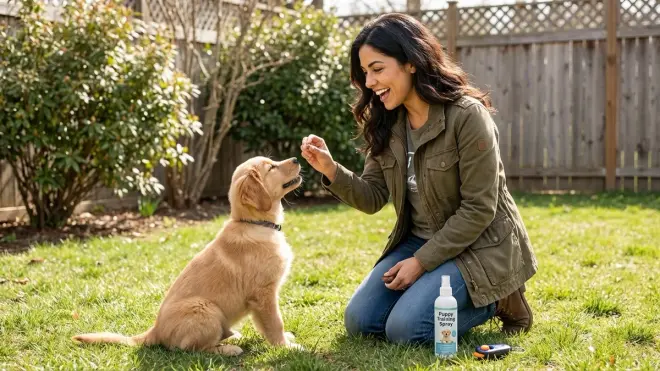
The moment—and I mean within 2 seconds—your puppy finishes eliminating in the sprayed area, throw a little party. This is where the real learning happens. The spray brought them to the right spot and encouraged them to go, but positive reinforcement is what makes them eager to repeat the behavior.
Give them a high-value treat immediately (something more exciting than their regular kibble), use a happy voice with specific praise like "Good potty outside!" and offer some gentle pets or a quick play session if that's what motivates your individual puppy. Some puppies are food-focused, others prefer play or affection—figure out what lights up your specific dog.
Timing is critical here. If you wait until you're back inside to give the treat, your puppy won't connect it to the potty success—they'll think they're being rewarded for walking through the door. The treat needs to happen right there in the potty zone, within seconds of them finishing.
Keep outdoor potty breaks short and businesslike until they've eliminated. After they've earned their reward, then you can extend the outdoor time for play or exploration. This creates a clear pattern: potty first = treats and fun. No potty = back inside, try again later.
Step 6: Address Indoor Accidents Without Punishment
Even with perfect spray application and scheduling, accidents will happen. Puppies have small bladders—an 8-week-old can typically hold it for about 2 hours max, a 12-week-old for maybe 3 hours. If you're seeing frequent accidents, you're probably waiting too long between breaks.
When you catch an accident in progress: Calmly interrupt with a gentle "uh-uh" (not yelling), immediately scoop up your puppy, and carry them to the sprayed potty area. If they finish eliminating there, praise and treat as if it was planned all along. You're redirecting, not punishing.
For accidents you discover after the fact: Clean them thoroughly with an enzymatic cleaner and move on. Scolding a puppy for an old accident does nothing except make them afraid of you. They won't connect your anger to something they did 20 minutes ago—they'll just learn that you're randomly scary sometimes.
Never use the training spray on indoor accident spots as punishment or to "show them where they went wrong." This backfires spectacularly by marking those areas as acceptable potty zones. The spray is for attracting them to the correct location only.
Step 7: Gradually Phase Out the Spray
Once your puppy has successfully eliminated in the designated spot for 10-14 consecutive days without accidents (or with only rare mistakes), you can start reducing your dependence on the training spray. The goal is for the location itself to become the cue, not the artificial scent.
Start by skipping the spray every other day, then every third day, while maintaining your consistent potty schedule. Most puppies will continue using their established spot because the habit is formed and they've likely added their own scent markers by now—real urine odor is a stronger attractant than any commercial spray.
If you see regression when you reduce the spray (accidents increase or puppy seems confused about where to go), you moved too fast. Go back to daily applications for another week before trying to phase out again. Every puppy learns at their own pace, and breeds known for stubbornness (hello, Beagles and Dachshunds) may need longer with the training wheels on.
For outdoor-trained puppies, the natural scent buildup in your designated area usually maintains the habit. For pad-trained puppies transitioning to outdoor potty breaks later, you may need to reintroduce the spray when you change locations.
Step 8: Maintain Consistency Across All Caregivers
The final—and often overlooked—step is making sure everyone in your household follows the exact same protocol. If you're diligently using the spray and taking your puppy out every two hours, but your partner lets them roam unsupervised and forgets the spray half the time, you're sabotaging your own efforts.
Write down your specific routine: where you spray, how much, what times you take potty breaks, what verbal cue you use, and what treats you give. Post it where everyone can see it (fridge, near the puppy's crate, wherever). Consistency is the secret ingredient that makes any training method actually work.
This matters especially if you have kids helping with puppy care, or if you're juggling multiple people's schedules. The puppy can't learn the pattern if the pattern keeps changing. Everyone needs to bring the puppy to the same sprayed spot, use the same command, and reward the same way.
I've seen well-meaning families completely confuse their puppies by having dad spray the front yard, mom use pads in the laundry room, and the kids just let the puppy out the back door randomly. Pick one method, one location, and stick with it until the habit is rock solid.
Pro Tips & Common Mistakes
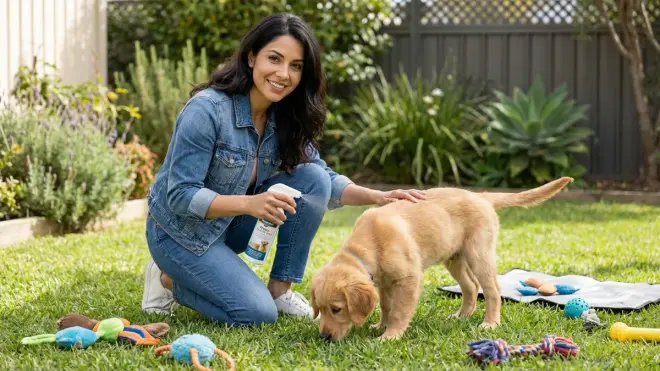
The reapplication trap: I see people spray once on day one and then wonder why it stops working by day three. Most training sprays' scent compounds break down or dissipate within 24-48 hours, especially outdoors. Daily application for at least the first week isn't optional—it's how the product is designed to work.
Mixing sprays with deterrent products: Don't spray your potty area with training spray and then spray your puppy's favorite chewing spot (nearby) with a bitter deterrent spray on the same day. Competing scent signals confuse their nose and dilute the potty training message. Space out different training projects by a few days.
Using too little spray: Three to five good sprays creates a detectable scent zone. One half-hearted spritz does nothing. You should be able to faintly smell it yourself (most training sprays have a slightly ammonia-like or grassy scent). If you can't detect any odor, your puppy probably can't either—and they're the ones doing the work here.
Expecting instant results: Training spray speeds up the process, but it's not a magic wand. You still need proper scheduling, supervision, and rewards. Think of the spray as a helpful arrow pointing to the right spot—your puppy still has to learn to follow the arrow, and that takes repetition.
Age-appropriate expectations: Puppies under 12 weeks physically cannot hold their bladder for long periods, regardless of how perfect your technique is. If you're demanding 4-hour stretches from a 10-week-old, no amount of spray will help. Adjust your schedule to match your puppy's developmental stage.
One more thing: store your training spray away from extreme temperatures. I learned this the hard way when my sister's bottle sat in her hot car all afternoon and the formula separated into weird layers that didn't spray properly anymore. Room temperature storage keeps the pheromone compounds stable.
Frequently Asked Questions
How long does puppy training spray take to work?
Puppy training spray typically shows results within 3-7 days when used consistently with proper scheduling and positive reinforcement, though the exact timeline depends on your puppy's age, breed temperament, and how consistently you apply the spray and maintain potty breaks. Younger puppies (8-10 weeks) may need 2-3 weeks to develop reliable habits, while older puppies (14-16 weeks) often catch on faster because they have better bladder control and longer attention spans.
Can I use puppy training spray on real grass and pee pads interchangeably?
Yes, you can use the same puppy training spray formula on grass, gravel, pee pads, or artificial turf, but you should not train your puppy to use multiple different surfaces or locations simultaneously, as this creates confusion about where the acceptable potty area actually is. Choose one designated spot (either outdoor grass or indoor pads) and apply the spray consistently there until the habit is established, then transition to a different surface later if needed using the spray to mark the new location.
What ingredients should I look for in an effective puppy training spray?
Effective puppy training sprays typically contain pheromone analogs, natural ammonia derivatives, or grass scent compounds that mimic the odor markers dogs use to identify elimination spots, and should be non-toxic, safe for pets and grass, and free from harsh chemicals that could irritate your puppy's sensitive nose. Look for products that list specific active ingredients rather than vague "proprietary blends," and avoid sprays with artificial fragrances that smell pleasant to humans but can actually mask the attractant scents your puppy needs to detect.
How often should I reapply training spray during potty training?
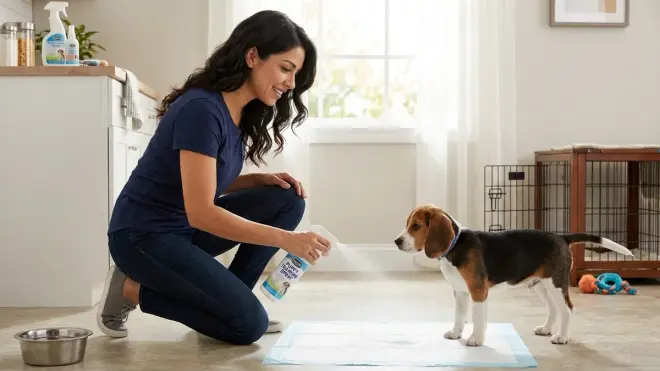
You should reapply puppy training spray daily for the first 7-10 days of training, then gradually reduce to every other day once your puppy has successfully used the designated spot for at least a week consecutively, and outdoor applications need to be reapplied after rain or heavy watering since moisture dilutes and washes away the scent compounds. Continue some level of application until your puppy shows 10-14 days of consistent success without accidents, at which point their own scent markers will usually maintain the habit without artificial spray assistance.
Your Puppy's Potty Training Success Starts With Consistency
Puppy training spray works best as one tool in your house training toolkit—not a standalone solution. When you combine the scent-based attraction of quality spray products with smart scheduling, immediate positive reinforcement, and patient consistency, most puppies develop reliable potty habits within 2-4 weeks.
The spray gives your puppy a clear scent marker for where you want them to go, which is especially helpful during those early weeks when everything is new and confusing. But your commitment to taking them out frequently, rewarding successes, and cleaning up accidents without drama is what actually builds the long-term habit.
Start with daily spray applications, stick to a predictable potty schedule based on your puppy's age and feeding times, and celebrate every successful trip to the designated spot. Before you know it, your puppy will be heading to that area on their own—no spray needed.
For a broader look at all the training tools that can help during those challenging first months, check out our guide to dog training aids that covers everything from clickers to crate training essentials.