
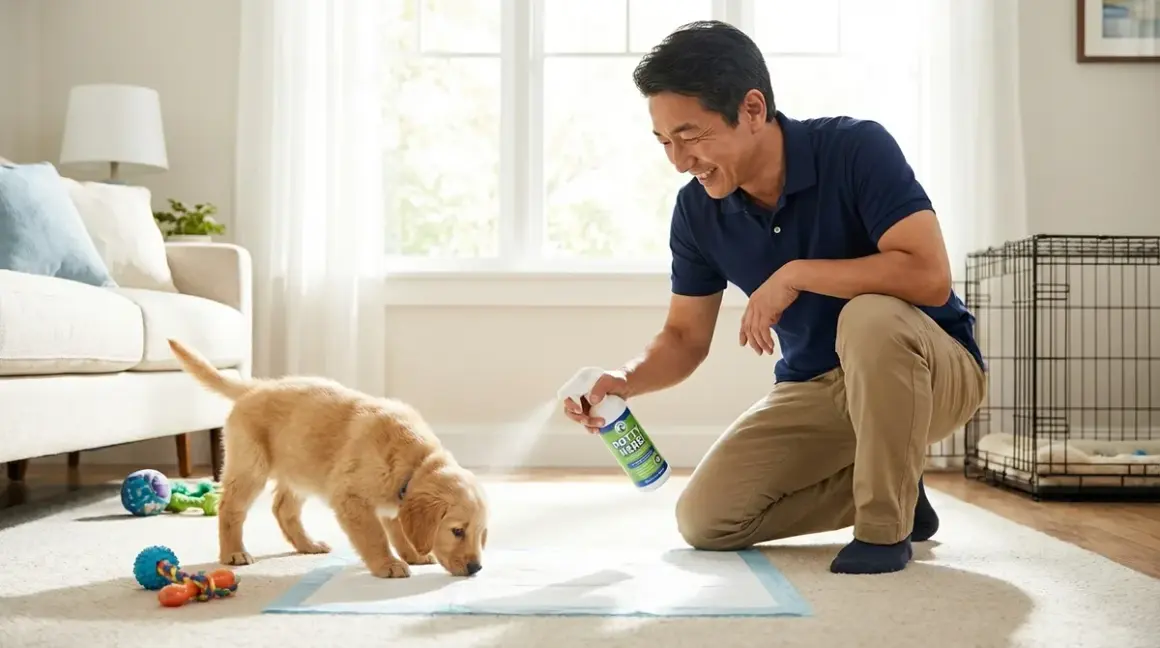

I'll be honest—when I first heard about potty here spray for puppies, I was skeptical. Coming from a background in aquarium keeping where chemical additives are usually more hype than help, I figured these sprays were just snake oil for desperate dog owners. Then my sister brought home an eight-week-old golden retriever puppy last year, and I watched her struggle with house training for weeks before finally trying one of these sprays. The difference was immediate enough that I had to eat my words. What I've found through helping her (and doing way too much research afterward) is that potty training sprays work through scent-marking principles rooted in canine behavioral science—but only if you choose the right formula and use it correctly.
In this guide, you'll learn how to evaluate potty here spray products based on their ingredient profiles, understand the science behind pheromone attractants versus synthetic scents, and match spray types to your specific puppy's age and training stage. Whether you're working with a stubborn eight-week-old terrier or transitioning a rescue puppy to a new home, this should take about 15 minutes to read and will save you from wasting money on formulas that don't match your situation.

What You'll Need
Before you start evaluating different potty training sprays, gather these items to make informed decisions:
- Your puppy's current age and breed information (small breeds under 20 lbs adult weight have different bladder control timelines than large breeds)
- A list of any known allergies or sensitivities your puppy has shown to cleaning products or fragrances
- Your training location details: indoor pads, outdoor grass, artificial turf, or a combination
- Product ingredient lists from 3-4 different spray brands (available on manufacturer websites or retailer descriptions)
- A notebook or phone to track which formulas you test and your puppy's response over 3-5 days
- Access to your veterinarian's contact information for questions about specific ingredients if your puppy has health conditions
- Your local pet store return policy in writing, since you may need to try more than one formula
- Basic understanding of your puppy's training progress: completely untrained, partially trained, or just needs location reinforcement
Step 1: Understand the Two Main Types of Potty Training Sprays

The market splits potty training sprays into two distinct categories, and choosing the wrong type is the fastest way to waste money and confuse your puppy. Pheromone-based attractant sprays use synthetic versions of scent markers that mimic the natural waste signals dogs recognize instinctively, while scented lure sprays rely on unfamiliar fragrances (often herbal or citrus) that theoretically attract dogs through novelty or pleasant associations.
In my experience helping my sister test both types with her golden retriever puppy, the pheromone formulas like NatureVet Potty Here Training Spray produced faster, more consistent results than the herbal-scented alternatives. The science backs this up—puppies as young as three weeks old respond to scent-marking signals from other dogs, which is why they naturally sniff and circle before eliminating. Pheromone sprays essentially create a "this is the bathroom" signal that taps into that hardwired behavior, whereas scented lures require your puppy to learn a completely new association between an arbitrary smell and the desired action.
That said, some puppies (particularly those with respiratory sensitivities or certain brachycephalic breeds like pugs and bulldogs) react poorly to synthetic pheromones and do better with gentler herbal formulas. If your puppy sneezes repeatedly, rubs their nose on the floor after you spray, or actively avoids the treated area, that's a sign the pheromone concentration might be too strong or your specific puppy needs the alternative approach. The key is understanding what you're buying before you commit to a full-size bottle.
Step 2: Evaluate Active Ingredients and Concentration Levels
This is where most puppy owners get lost, because ingredient labels on potty training sprays are notoriously vague and often don't list concentration percentages. What I've found works is looking for specific marker compounds that indicate quality formulations versus filler products. For pheromone-based sprays, you want to see either "proprietary pheromone blend" or specific compounds like methyl p-hydroxybenzoate (a common canine attractant stabilizer) listed within the first three ingredients. If the label just says "natural scents" or "herbal extracts" without naming the actual compounds, you're probably looking at a product that relies more on marketing than science.
Water should be the primary carrier—typically making up 85-95% of the formula—with the active attractants suspended in solution. Avoid sprays that list alcohol (ethanol or isopropyl) as a primary ingredient, especially for puppies under sixteen weeks old, since the harsh smell can actually repel dogs and the residue can irritate their sensitive paw pads and noses. I learned this the hard way when my sister initially bought a bargain-brand spray that was basically scented rubbing alcohol; her puppy wouldn't go anywhere near the treated pads until we switched formulas and thoroughly cleaned the area.
For herbal-based sprays, look for specific plant extracts like lemongrass oil, chamomile extract, or ginger root essence rather than generic "botanical fragrances." The Bodhi Dog Potty Training Spray uses a lemongrass-forward formula that some trainers prefer for outdoor training since it doesn't interfere with the natural grass scents puppies need to recognize. Whatever formula you choose, avoid anything with artificial dyes—if the liquid is bright blue or green, that's purely cosmetic and adds unnecessary chemicals your puppy will be inhaling and potentially licking. For more context on choosing quality training tools, check out our guide to puppy training aids that covers the broader equipment landscape.
Step 3: Match Spray Type to Your Training Environment
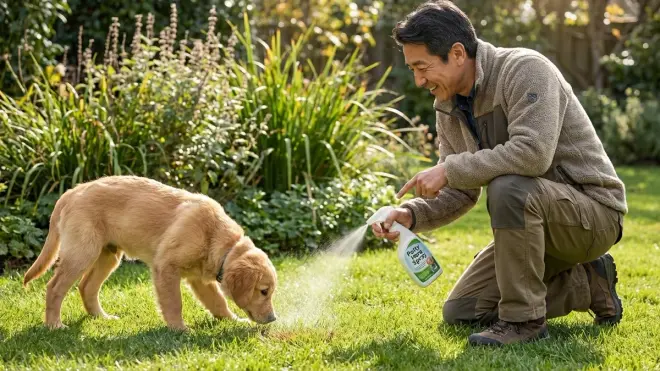
Indoor pad training versus outdoor grass training requires completely different spray strategies, and this is where I see the most confusion from new puppy owners. Pheromone sprays work exceptionally well for indoor pads because you're creating a concentrated scent marker in a controlled space where competing smells are minimal. My sister used a pheromone spray on disposable pads in her apartment during the first month, and the puppy reliably hit the target within three days of consistent application—each morning, she'd spray a light mist on a fresh pad, let it sit for about thirty seconds to absorb, then place it in the designated spot before the puppy's first morning elimination window.
Outdoor training is trickier because you're competing with hundreds of natural scents—grass, soil, other animals, weather changes—that can easily overwhelm a training spray. For outdoor use, I've found that herbal lure sprays with stronger, more distinctive scents actually perform better than subtle pheromones, which get diluted too quickly in open air. You also need to reapply more frequently outdoors; what lasts 8-12 hours on an indoor pad might only remain effective for 2-3 hours on grass, especially after dew, rain, or if other animals pass through the area.
If you're using a combination approach—indoor pads at night or when you're away, outdoor training during the day—consider using the same scent profile for both locations so your puppy builds one consistent association rather than having to learn two different "this is the bathroom" signals. That might mean spraying your outdoor training patch with the same pheromone formula you use on indoor pads, or vice versa. The transition gets much smoother when the scent cue remains constant even as the physical location changes. For a complete overview of training aid options including sprays, our article on dog potty training aids breaks down how different tools work together.
Step 4: Consider Your Puppy's Age and Breed-Specific Factors
Puppies under twelve weeks have dramatically different bladder control and scent recognition abilities than older puppies, and the spray you choose needs to account for these developmental stages. Very young puppies (8-10 weeks) have limited bladder capacity—typically holding it for only 2-3 hours maximum—and their scent recognition is still developing, which means you need a stronger, more obvious attractant to get their attention. For these youngest puppies, I'd recommend a pheromone spray with a higher concentration and applying it more liberally (3-4 sprays per pad or 2-foot training area) compared to the lighter application you'd use for a four-month-old puppy who already understands basic training concepts.
Breed size also matters more than most people realize. Small breeds like chihuahuas, Yorkshire terriers, and toy poodles—those under 10 pounds at adult weight—have faster metabolisms and smaller bladders, which means more frequent elimination cycles and potentially less time to detect and respond to training sprays. These tiny breeds often do better with more frequent spray applications on smaller, more numerous training pads rather than one large treated area. When my sister's friend tried to pad-train a Yorkie puppy using the same approach that worked for the golden retriever (one large pad, twice-daily spray application), the little dog kept missing the target simply because the treated area was too big relative to the puppy's size and search pattern.
Large breed puppies—German shepherds, golden retrievers, Labrador retrievers, any breed over 50 pounds at adult weight—present the opposite challenge: they grow fast, their elimination volume increases rapidly, and they often develop independence and stubbornness earlier than smaller breeds. These puppies benefit from wider spray coverage and outdoor training earlier in the process, since they'll quickly outgrow indoor pad solutions around 14-16 weeks anyway. If you're working with a large breed puppy, don't invest heavily in pad-specific sprays; instead, choose a formula that works equally well on grass or gravel outdoor spots where you'll be doing most of your training by month three. Similar to how you'd choose the right dog food for your dog's needs based on breed and life stage, training spray selection should align with your puppy's physical development timeline.
Step 5: Check for Safety Certifications and Veterinary Endorsements

This step requires some detective work because the pet training aid industry has minimal regulation compared to, say, pet food standards. What I've found works is looking for products that explicitly state they're formulated by veterinarians or certified animal behaviorists rather than generic "pet products" companies. The NatureVet Potty Here Training Spray, for example, comes from a brand that employs veterinary consultants and lists their credentials on the company website—that's a meaningful quality signal compared to products from anonymous manufacturers with no traceable expertise.
Beyond professional formulation, check whether the product carries any third-party testing certifications. While there's no FDA approval process for training sprays (they're not regulated as drugs), reputable manufacturers will have their products tested for pH balance appropriate for dog skin contact (ideally between 6.5-7.5), absence of known canine toxins, and stability under normal storage conditions. This information is rarely on the bottle itself—you'll need to dig into the manufacturer's website, look for product spec sheets, or contact their customer service directly. I know that sounds like a hassle, but I've seen too many bargain sprays that either separated into layers after a few weeks or caused mild skin irritation on sensitive puppies, and a five-minute research investment beats dealing with a puppy's dermatitis.
Also verify that the spray is explicitly labeled safe for the age of your puppy. Some formulas contain stronger solvents or fragrances meant for adult dogs with fully developed respiratory and metabolic systems, and using these on eight-week-old puppies can cause unnecessary stress or physical reactions. If the product label doesn't specify "safe for puppies 8 weeks and older" or similar age guidance, that's actually a red flag—it suggests the manufacturer hasn't bothered to test or consider developmental safety factors. When in doubt, you can cross-reference ingredients with the ASPCA's Animal Poison Control Center database to check for known irritants or toxins.
Step 6: Assess Bottle Design and Application Method

Here's something I didn't appreciate until I actually watched my sister use these sprays daily for weeks: bottle ergonomics matter way more than you'd think when you're applying spray 4-6 times per day during intensive training periods. Trigger-spray bottles (the kind you squeeze with your index finger) give you the most control over spray pattern and volume, but they fatigue your hand quickly if you're training multiple puppies or applying frequently. Pump-spray bottles (press down with your palm) are easier on your hand but tend to deliver less consistent coverage, often creating a concentrated wet spot in the center with barely any coverage at the edges.
I've also noticed that spray nozzles with adjustable patterns—switching between fine mist and direct stream—provide more versatility across different training scenarios. A fine mist works better for large outdoor areas where you want even coverage, while a concentrated stream is more economical for small indoor pads where you need to maximize scent concentration in a specific spot. The Bodhi Dog spray uses an adjustable nozzle that my sister found helpful when she transitioned from indoor pads to outdoor training, since she could adapt the application without buying a completely different product.
Also pay attention to bottle size and cost per ounce. An 8-ounce bottle might seem like the economical choice, but if you're training a puppy from scratch, you'll realistically go through 2-3 ounces per week during the first month of intensive training. Running out of spray mid-training cycle is frustrating and can set back progress, so I'd recommend starting with a 16 or 24-ounce bottle even if the per-unit cost is slightly higher. Just make sure whatever size you buy includes a manufacture date or expiration date—these sprays typically remain effective for 18-24 months unopened but start degrading once exposed to air, so you don't want old inventory that's been sitting in a warehouse for years.
Step 7: Plan Your Testing Protocol and Success Metrics
This final step separates effective training from just spraying stuff and hoping for results. You need a structured testing approach to determine whether a spray actually works for your specific puppy, and that means tracking data rather than relying on vague impressions. Before you apply your first spray, decide on clear success metrics: For example, "successful elimination on the treated pad or area within 10 minutes of natural elimination timing" or "reduced off-target accidents from 4 per day to 1 or fewer per day within one week."
Set up a testing timeline of at least 5-7 days per spray formula before switching products, because puppies need consistency to form associations. If you rotate between different sprays every couple of days because you're impatient for results, you'll just confuse your puppy and won't get accurate data on what actually works. During your test period, log each application time, spray amount (light mist, moderate coverage, heavy application), puppy's response time (how long until they investigated the area), and outcome (successful elimination, accident elsewhere, or no elimination during that cycle).
What I've found through helping multiple friends with their puppies is that most training sprays show their true effectiveness between days 3-5 if they're going to work at all. Day one results are often misleading because puppies are still learning the association; day two might show regression as they test boundaries; but by day three or four, you should see a pattern emerging either toward consistent success or clear failure. If you're not seeing at least 60-70% success rate by day five—meaning your puppy successfully uses the treated area at least 6-7 times out of every 10 opportunities—that particular spray probably isn't a good match for your puppy's training needs, and you should try an alternative formula. For comprehensive guidance on the broader training process, our article on how to use puppy training spray walks through the day-by-day application schedule and what to expect at each stage.
Pro Tips & Common Mistakes
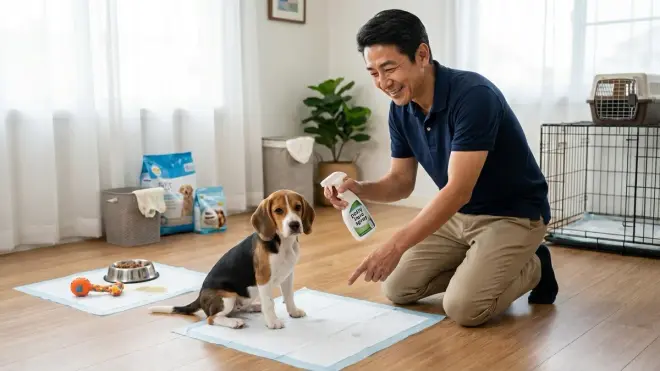
The biggest mistake I see puppy owners make is over-applying spray in hopes of faster results, which actually backfires by creating an overwhelming scent that confuses rather than attracts. More isn't better here—you want a noticeable but not overpowering scent marker. A good rule of thumb is 2-3 short sprays (about one second each) for a standard puppy pad or a two-foot-square outdoor training area. If the surface looks visibly wet or you can smell it strongly from five feet away, you've applied too much.
Another common error is applying spray immediately before placing your puppy on the training area. The chemicals need 30-60 seconds to settle and start working—if you spray and immediately plop your puppy down, they're inhaling atomized droplets rather than detecting ground-level scent markers. My sister learned this when her puppy kept sneezing and backing away from freshly sprayed pads; once she started spraying a minute or two in advance, the problem disappeared.
Also, don't use potty training spray as a punishment tool by spraying it on areas where your puppy has had accidents, hoping they'll learn to use those spots. That creates the opposite association—your puppy learns that eliminating leads to the spray appearing, not that the spray marks appropriate bathroom areas. Always apply spray to where you want elimination to happen, never where accidents have already occurred. Clean accident areas with enzymatic cleaners that completely remove scent markers rather than trying to repurpose them with training spray.
Finally, remember that potty training spray is a training aid, not a magic solution. It works by enhancing your puppy's natural instincts, but it can't replace consistent timing, positive reinforcement with treats for puppy training, and your own observation skills. If your puppy isn't responding to spray after two weeks of consistent use, the issue might not be the spray formula—it might be timing problems (not taking them out frequently enough), insufficient positive reinforcement, or underlying health issues affecting bladder control that need veterinary attention.
Frequently Asked Questions
How long does potty here spray remain effective after application?
Potty here spray typically remains effective for 8-12 hours on indoor pads or surfaces when applied correctly, though environmental factors significantly impact this timeline. Outdoors on grass or soil, effectiveness drops to 2-4 hours due to air circulation, ground moisture, and competing natural scents. Pheromone-based sprays generally last longer than herbal lure sprays because synthetic pheromones bind more strongly to porous surfaces, and reapplication is necessary before each anticipated elimination window rather than on a fixed time schedule—so if your puppy typically needs to go out every three hours, apply fresh spray about five minutes before each scheduled break.
Can I use potty training spray on real grass or only artificial surfaces?
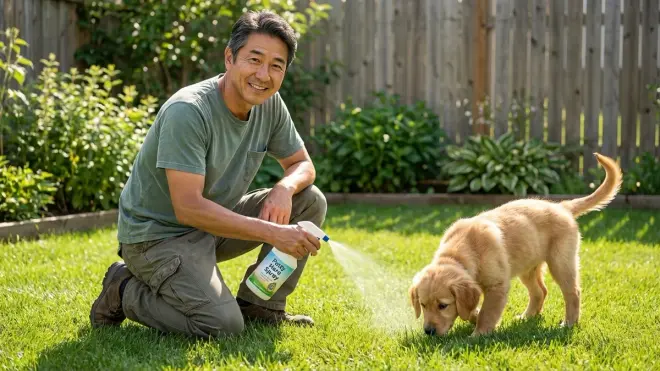
You can absolutely use potty training spray on real grass, and many trainers prefer this for outdoor training since it helps puppies associate natural grass with elimination from the start. Apply spray in a consistent outdoor spot—ideally a two-foot square area—where you want your puppy to go, and use slightly more product outdoors than you would on indoor pads because grass absorbs and disperses the scent more rapidly than nonporous surfaces. Avoid spraying grass immediately after mowing or fertilizing, since those strong competing scents can overwhelm the training spray's attractant properties, and choose a spot with relatively short grass (under three inches) where the scent can settle near ground level where your puppy's nose naturally searches.
Is potty training spray safe if my puppy licks the treated area?
Quality potty training sprays formulated specifically for puppies are generally safe if licked in small amounts, since reputable manufacturers use non-toxic ingredients that won't cause harm with incidental contact. However, you should still discourage licking behavior because ingesting larger quantities can cause mild digestive upset—loose stools or temporary nausea—even with non-toxic formulas, and the goal is scent detection rather than taste association. If your puppy persistently licks treated areas, that usually indicates either over-application (the wetness attracts licking) or an inappropriately flavored formula; switch to a different brand and reduce application volume, and consult your veterinarian if you notice any vomiting, diarrhea, or behavioral changes after spray exposure.
How do I know if my puppy is having an allergic reaction to training spray?
Signs of allergic reaction or sensitivity to potty training spray include excessive sneezing, pawing at the nose or face, watery eyes, skin redness or rash where spray contacted fur or paws, and avoidance behavior like refusing to approach treated areas. Respiratory symptoms—wheezing, coughing, or labored breathing—require immediate veterinary attention and immediate discontinuation of the product, while mild skin irritation or persistent sneezing means you should stop using that formula and thoroughly clean all treated surfaces before trying an alternative spray with different ingredients. Brachycephalic breeds (pugs, bulldogs, Boston terriers) show higher sensitivity rates to synthetic pheromones and strong fragrances, so if you own one of these breeds, start with hypoallergenic or unscented formulas and test with minimal application before committing to regular use.
Summary
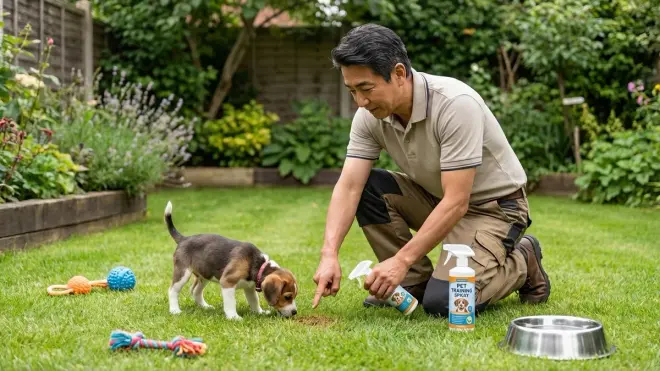
Choosing the right potty here spray comes down to matching formula type (pheromone versus herbal), active ingredient concentration, and application method to your specific puppy's age, breed, training environment, and individual responses. What I've learned through hands-on experience is that no single spray works universally—you'll likely need to test 2-3 different products before finding the one that clicks with your puppy's natural behaviors and your training setup.
The investment in a quality spray pays off when you see your puppy consistently hit their target area within a week of starting training, but success requires more than just buying the right bottle. You need proper application timing, consistent reapplication schedules, realistic expectations about effectiveness windows, and the willingness to track results systematically rather than guessing. Combine the right spray with patient observation, frequent elimination opportunities timed to your puppy's natural cycles, and positive reinforcement, and you'll work through house training significantly faster than trying to tough it out without chemical assistance. The spray doesn't train your puppy—you do—but it gives you a tool that taps into their hardwired scent-marking instincts to speed up the learning process.