
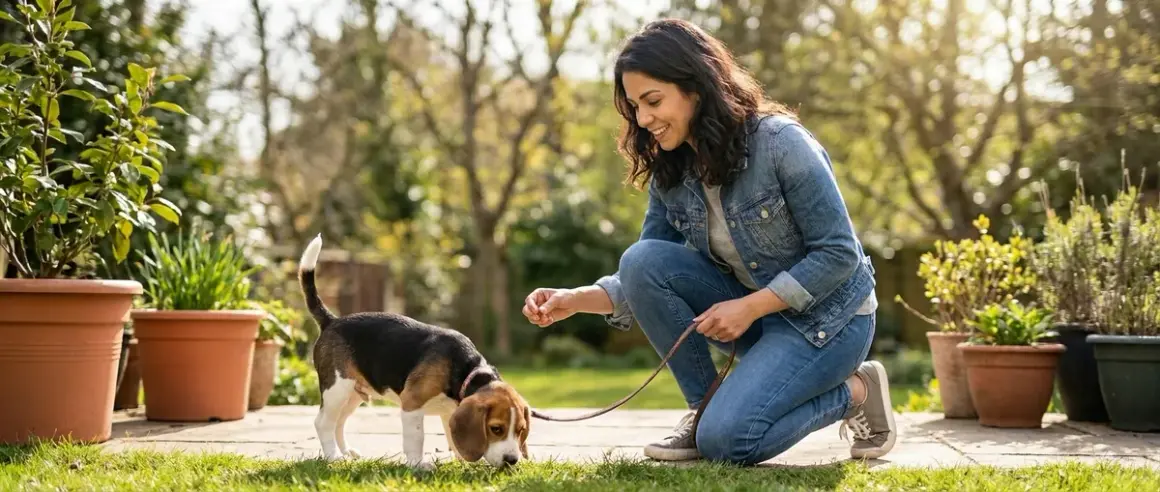

I'll be honest—I know more about guinea pig potty corners than puppy training pads. My seven years of cavy parenting didn't exactly prepare me for how to potty train a stubborn puppy. But when my neighbor begged me to help with her impossibly headstrong Beagle puppy last spring, I dove into the research with the same obsessive energy I'd used to master piggy care. What I discovered? The fundamental principles aren't that different from teaching small pets—it's all about consistency, understanding their natural instincts, and refusing to give up when they make you want to scream into a pillow.
In this guide, you'll learn proven techniques for potty training even the most defiant puppies (ages 8 weeks to 6 months), including recognizing why your puppy isn't responding, modifying your approach to match their temperament, and troubleshooting the most frustrating setbacks. This is intermediate-level training that requires patience and commitment—expect to dedicate 2-4 weeks of intensive work before you see real consistency, though some stubborn pups may take 8-12 weeks. Fair warning: there will be accidents, moments of doubt, and the distinct smell of enzyme cleaner in your future.
What You'll Need
Before you tackle how to potty train a stubborn puppy, gather these essential supplies:
- High-value training treats (small, soft, irresistible to your specific puppy—think real meat, cheese, or liver)
- Enzyme-based cleaner specifically formulated for pet urine (enzymatic formulas break down odor molecules completely)
- Leash (6-foot standard length for outdoor training sessions)
- Crate or confinement area sized appropriately for your puppy's breed (they should be able to stand, turn, and lie down comfortably)
- Potty training pads if using indoor training methods (absorbent core with leak-proof backing)
- Timer or phone for scheduling bathroom breaks
- Notebook or training log to track patterns and progress
- Potty training spray (optional attractant to designate the bathroom spot)
- Patience and realistic expectations (not sold in stores, unfortunately)
For a complete breakdown of supplies with specific product recommendations, check out our Puppy Potty Training Supplies Checklist.
Step 1: Identify Why Your Puppy Is Being "Stubborn"
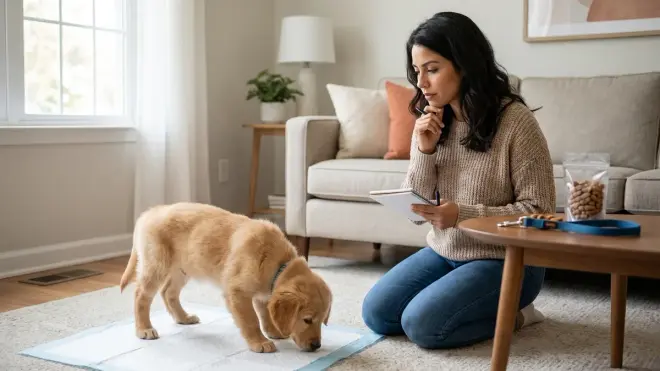
Here's the thing most first-time puppy parents don't realize: your puppy probably isn't being stubborn out of spite. That's a very human interpretation of what's often a completely different issue.
I spent three hours one Saturday watching my neighbor's Beagle puppy completely ignore the designated potty area, only to squat triumphantly next to the back door five minutes after being brought inside. Stubborn? Maybe. But more likely? The puppy was overwhelmed by outdoor distractions (squirrels, leaves, fascinating smells) and couldn't focus on the task at hand.
Common reasons puppies seem stubborn about potty training:
- Medical issues like urinary tract infections, parasites, or digestive problems that make it physically difficult to control elimination
- Inadequate supervision leading to unnoticed accidents that become habitual
- Inconsistent schedules that confuse the puppy about when and where they're supposed to go
- Previous punishment for accidents, making the puppy afraid to potty in front of you (even outdoors)
- Wrong training method for that individual puppy's temperament and learning style
- Breed-specific challenges (some breeds, like Beagles and Dachshunds, are notoriously harder to housetrain due to their independent nature and scent-driven focus)
- Age considerations (puppies under 12 weeks have extremely limited bladder control—expecting perfection is setting yourself up for frustration)
Schedule a veterinary exam to rule out medical causes before assuming behavioral stubbornness. According to the American Kennel Club, young puppies can typically hold their bladder for one hour per month of age, plus one hour—so a 3-month-old puppy maxes out at about 4 hours.
Understanding the why behind your puppy's resistance completely transforms your approach. You're not battling their will—you're solving a puzzle.
Step 2: Establish an Ironclad Routine (No Exceptions)
Stubborn puppies thrive on—or more accurately, require—military-level consistency. The same wishy-washy schedule that might work for an eager-to-please Golden Retriever puppy will fail spectacularly with a willful terrier.
Create a non-negotiable bathroom schedule based on your puppy's age and predictable trigger moments:
- First thing in the morning (within 5 minutes of waking)
- After every meal (15-30 minutes post-eating, depending on your puppy's digestion speed)
- After drinking water (10-20 minutes later)
- After play sessions (immediately when playtime ends)
- After naps (the moment they wake up)
- Before bedtime (last chance before crate time)
- Every 1-2 hours for young puppies (8-12 weeks), gradually extending as they mature
Set actual alarms on your phone. I'm not kidding. When I helped train that Beagle, we set hourly chimes for the first week because my neighbor kept getting distracted and "forgetting" the schedule. Guess when most accidents happened? Right. During the forgotten windows.
The routine must be identical every single time: same door, same route to the potty spot, same verbal cue ("go potty," "do your business," whatever phrase you choose—just stick with it), same reward immediately after success. Stubborn puppies are looking for patterns they can predict and manipulate. Give them a pattern so consistent they can't find loopholes.
For age-specific scheduling guidance, our Puppy Potty Training Schedule breaks down exactly how many bathroom breaks your puppy needs at each developmental stage.
Step 3: Master the Art of Strategic Confinement
This is where a lot of puppy parents feel guilty and back off. Don't.
Proper confinement isn't cruel—it's the foundation of successful potty training because it leverages a dog's natural instinct to keep their sleeping area clean. Even the most stubborn puppy doesn't want to lie in their own mess.
Choose one of these confinement methods based on your living situation:
Crate training works beautifully for most puppies. The crate should be just large enough for your puppy to stand up, turn around, and lie down—no bigger, or they'll designate one end as a bathroom. For growing puppies, invest in an adjustable crate with a divider panel rather than buying three different sizes. When you can't supervise, puppy goes in the crate. No exceptions for "just five minutes."
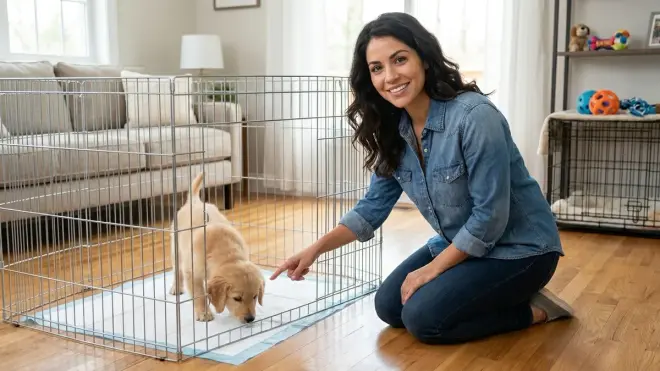
Puppy playpen confinement creates a slightly larger safe zone (useful for very small breeds or if you're gone longer than the puppy can reasonably hold it). Place the crate inside with the door open, put potty pads in the opposite corner. This setup acknowledges reality while still encouraging them to hold it when possible.
The controversial truth? Some stubborn puppies need tethering—literally attaching a 6-foot leash to your belt when they're out of the crate so they can't sneak off to pee behind the couch. It feels ridiculous. It looks ridiculous. It works.
I watched my neighbor's face when I suggested tethering. "That seems extreme," she said. Two weeks later, after the puppy stopped having stealth accidents in the dining room? "Why didn't we do this immediately?"
For more on comparing confinement methods, see Crate Training vs Puppy Pads.
Step 4: Revolutionize Your Reward Timing and Value
Here's what I learned from guinea pig training that translates perfectly to stubborn puppies: generic rewards get generic results.
When I first started reinforcing my guinea pigs' potty corner habits, I used regular pellets. Meh. They'd use the corner... sometimes. When I switched to tiny pieces of bell pepper (cavy crack, basically), their accuracy shot up to 90%. Same principle applies to puppies.
Your stubborn puppy needs rewards so incredible they'll overcome every distraction:
Find what your specific puppy goes absolutely bonkers for. Real chicken? Freeze-dried liver? String cheese? Hot dog bits? Test different options during play—whichever treat makes them completely lose their minds is your potty training currency. The Zuke's Mini Naturals Training Treats worked well for my neighbor's Beagle because they're tiny, soft, and strongly scented.
The timing matters more than the treat itself. You have approximately 2-3 seconds after the puppy finishes eliminating to deliver the reward and praise. Not when they walk back to you. Not when you get back inside. The instant they finish.
This means you're standing outside in your pajamas at 6 AM, treat pouch strapped to your waist like a deranged crossing guard, hyper-focused on your puppy's bathroom habits. Glamorous? No. Effective? Absolutely.
Verbal praise alone won't cut it with stubborn puppies. They need the food reward every single time for the first 2-3 weeks minimum, then you can gradually fade to intermittent reinforcement. Rush this transition and you'll regress.
For more reward strategies, check out How to Use Treats for Puppy Training.
Step 5: Become Fluent in Your Puppy's Pre-Potty Signals
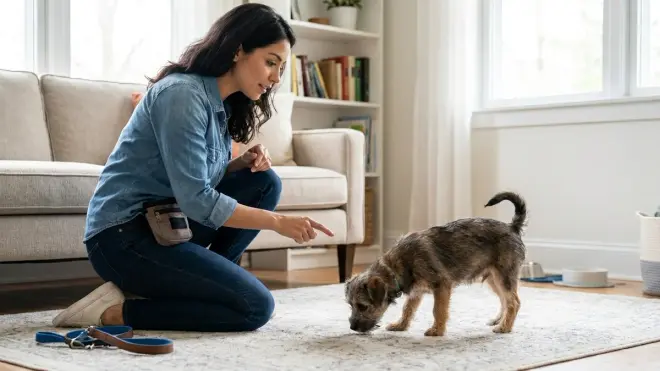
Stubborn puppies won't always tell you they need to go. Unlike eager-to-please breeds that might whine at the door or ring a bell, your strong-willed pup might just... go. Your job is learning to read their body language before they've committed to the act.
Watch obsessively for these pre-elimination signals:
- Circling (often combined with intense sniffing)
- Sudden sniffing in a focused, methodical pattern
- Whining or restlessness (pacing, unable to settle)
- Heading toward a previously soiled area (they remember, trust me)
- Sudden distraction during play (they stop mid-action and look purposeful)
- Scratching at doors or floor (some puppies develop this naturally, others need bell training)
- Squatting posture (this is your 2-second emergency window—scoop and run)
The moment you spot any of these signals, interrupt gently (no scolding), attach the leash, and go directly to the potty spot using your consistent route. If they're already starting to squat inside, a quick "oops!" or neutral noise as you scoop them up works better than yelling (which just teaches them to hide from you next time).
I kept a running list in my phone of every signal the Beagle showed in the hour before accidents. After five days, a pattern emerged: he always sniffed the baseboards near the kitchen before peeing. That became our early-warning system.
For puppies who show zero signals, set your timer for even more frequent bathroom breaks. You're creating artificial opportunities until their bladder control catches up to their stubbornness.
Step 6: Transform How You Handle Accidents
Let's talk about the moment you find a puddle. Or worse, step in a surprise pile. Your emotional response is completely understandable—but also potentially training-destructive.
The cardinal rule: never punish after the fact. If you didn't catch your puppy in the act (and I mean actively eliminating, not walking away from a puddle), they have zero idea why you're upset. Rubbing their nose in it, scolding, or any form of punishment just teaches them that you're unpredictable and scary—not that peeing inside is wrong.
This is counterintuitive. I get it. Every frustrated bone in your body wants to react. But with stubborn puppies especially, punishment creates sneaky pottyers who hide behind furniture to go. You want a puppy who's comfortable eliminating in front of you (in the right spot).
When you discover an accident:
Take a deep breath. Put the puppy in their crate or another room without drama. Clean the area thoroughly with an enzyme-based cleaner like Nature's Miracle Stain and Odor Remover—regular household cleaners leave scent molecules that tell the puppy "bathroom here!" Saturate the area (if it's carpet, you need to reach the padding underneath). Let it air dry completely.
If you catch them mid-act: use a neutral interrupter sound ("oops!" or a quick hand clap—nothing harsh), immediately scoop them up (yes, even if they're still going), and hustle outside to the potty spot. If they finish there, jackpot reward like they just won the lottery.
Log the accident in your notebook with time, location, and what happened in the 30 minutes before. Patterns emerge. My neighbor discovered her Beagle had accidents every single time after the kids played rough with him—the excitement triggered his bladder before the scheduled bathroom break.
If you're struggling with frequent accidents, our article Why Is My Puppy Having Accidents in the House covers eight common causes with specific solutions.
Step 7: Introduce Potty Training Aids Strategically
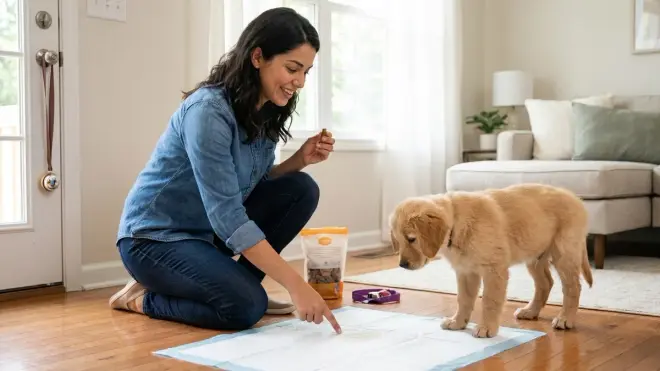
Some stubborn puppies need extra help understanding where you want them to go. Potty training aids work best when combined with all the previous steps—not as a replacement for consistency and supervision.
Attractant sprays contain scent compounds that encourage puppies to eliminate in specific spots. The NatureVet Potty Here Training Aid Spray uses herbal extracts to create an appealing potty location. Spray your designated outdoor spot (or training pad) before each bathroom break.
The catch? Some puppies couldn't care less about the spray. Others respond immediately. It's worth trying for a week—if you see no change in your puppy's behavior, discontinue and save your money.
Potty training pads serve two purposes: emergency backup for puppies who can't hold it during the day, and a transition tool for apartment dwellers working toward outdoor training. Choose pads with built-in attractant and leak-proof backing like those recommended in our guide to the Best Puppy Potty Training Pads.
The key with pads: place them consistently in one designated spot. Don't scatter them everywhere hoping the puppy finds one—that teaches them the entire house is a bathroom. Start with a small area covered, then gradually reduce the pad coverage as accuracy improves.
Bell training teaches your stubborn puppy to actively communicate their bathroom needs. Hang bells on the door handle at puppy nose-height. Every single time you take them out, tap their nose or paw against the bells, say your cue phrase, then go outside. Within 1-2 weeks, most puppies make the connection: ring bells = door opens = potty outside.
The adorably frustrating side effect? Some clever puppies start ringing the bells constantly just to go outside and explore. You'll need to distinguish between genuine potty requests and manipulation attempts.
For comprehensive coverage of training aids, read our Dog Potty Training Aids Explained guide.
Step 8: Gradually Increase Freedom (Without Sabotaging Progress)
You've been following the protocol religiously for three weeks. Your puppy has had seven accident-free days in a row. You're feeling confident. Time to give them house freedom, right?
Slow down.
Stubborn puppies will absolutely take advantage of premature freedom. The puppy who's been perfect under supervision will gleefully pee in the guest bedroom the first time you leave them unsupervised for ten minutes.
Expand freedom incrementally:
Start with supervised freedom in one room where you've spent the most time training. Stay in that room with them, watching for signals. If they go 3-4 days without accidents during these sessions, add a second room.
Use baby gates to control access rather than giving them the whole house. One additional room per week is a reasonable pace—faster for some puppies, slower for the truly stubborn ones.
Test longer durations slowly. If your puppy successfully holds it for 2 hours in their crate, try 2.5 hours of supervised house freedom. Success? Next time try 3 hours. An accident? You pushed too far—scale back.
The Beagle puppy I helped train seemed completely reliable at four months old during supervised time. We tried leaving him loose in the kitchen for 30 minutes while my neighbor ran errands. He peed in three different spots like he was marking territory. We went back to square one in that room, rebuilding trust over another two weeks.
Night-time freedom comes last. Even a seemingly housetrained puppy should sleep in their crate at night until they're at least 6-8 months old and have been accident-free during the day for a solid month. For help with nighttime routine, see How to Crate Train a Dog to Sleep Through the Night.
Your puppy's stubbornness means they'll test every boundary. Give them freedom only after they've proven they can handle it—not based on your hopeful timeline.
Pro Tips & Common Mistakes
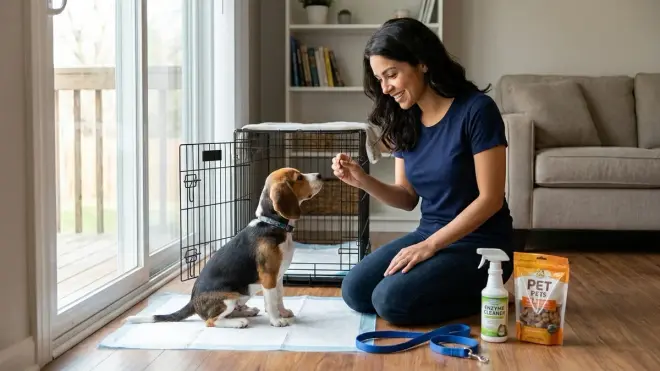
Pro tips from the trenches:
Keep a "potty journal" for at least three weeks. Track every successful outdoor potty, every accident, meal times, water intake, and activities. The patterns that emerge will astound you. You'll discover your puppy always pees exactly 20 minutes after eating, or that rainy weather means they rush through their business without fully emptying their bladder.
Use a "potty word" consistently. Choose one specific phrase ("go potty," "do your business," "get busy") and use it every single time they're eliminating. Eventually, this becomes a cue that triggers the behavior on command—invaluable for rushed mornings or traveling.
Adjust your schedule seasonally. In summer, puppies drink more water and need more frequent breaks. In winter, they may rush through outdoor bathroom time because it's cold—you'll need to wait longer to ensure they fully empty.
Feed on a strict schedule rather than free-feeding. Meals at consistent times lead to predictable bathroom times. Most puppies need to eliminate 15-30 minutes after eating.
Common mistakes that sabotage progress:
The biggest mistake? Inconsistency between family members. One person follows the protocol perfectly while another lets the puppy roam unsupervised or skips the reward timing. The puppy gets confused, progress stalls. Everyone in the household must follow identical procedures.
Assuming they're "trained" too early. Just because your puppy went a week without accidents doesn't mean they're reliable. True housetraining takes months, not weeks. Keep up the supervision and scheduled breaks.
Switching methods mid-training. Trying pads for a week, then switching to outdoor-only, then back to pads creates confusion. Pick one approach and stick with it for at least a month before evaluating effectiveness.
Getting emotional about setbacks. Regressions happen—teething, growth spurts, household changes, and developmental phases all cause temporary backsliding. Stay neutral, return to more intensive supervision, and work through it without frustration.
Frequently Asked Questions
How long does it take to potty train a stubborn puppy?
Most stubborn puppies require 8-12 weeks of consistent training to achieve reasonable reliability, with full maturity-level control not developing until 6-8 months of age. Breed, individual temperament, and your consistency level all impact the timeline—some notoriously stubborn breeds like Beagles, Dachshunds, and Shih Tzus may take up to 6 months for complete housetraining. The key is maintaining your protocol without exception even when progress feels glacially slow.
Should I use puppy pads or go straight to outdoor training for a stubborn puppy?
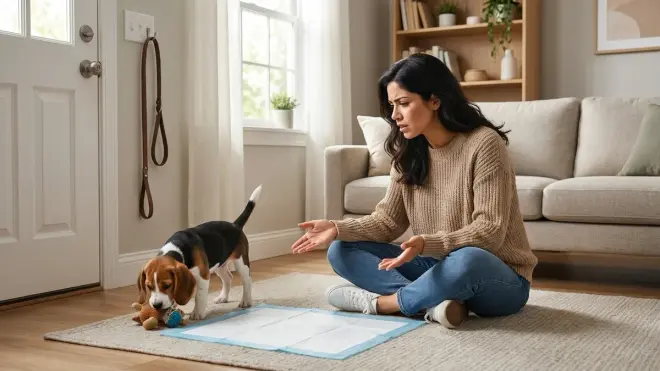
Outdoor training typically produces faster results for stubborn puppies because it creates one clear bathroom location rather than teaching them that indoor elimination is acceptable in certain circumstances. However, if you live in an apartment above the third floor, work long hours, or have a very young puppy (under 10 weeks) with limited bladder control, pads serve as a necessary interim solution. If you do use pads, place them in one consistent location and plan to transition to outdoor-only as soon as your puppy's age and your schedule allow.
My puppy pees outside and then comes in and pees again immediately—what am I doing wrong?
Your puppy isn't fully emptying their bladder during outdoor bathroom breaks, usually because they're distracted, rushing due to weather, or haven't developed complete muscle control yet. Extend your outdoor sessions to 10-15 minutes, walking them around the potty area to encourage multiple elimination opportunities. Wait for at least two separate pees before heading inside, and reward each one. Some puppies need the physical movement of walking to trigger complete bladder emptying.
Can you potty train a stubborn puppy using positive reinforcement alone, or do I need corrections?
Positive reinforcement is the most effective method for potty training all puppies, including stubborn ones, because it builds enthusiasm for the desired behavior rather than creating fear that leads to hiding and sneaking. Corrections and punishment don't teach the puppy where they should go—only that you're unpredictable and scary. Focus your energy on heavily rewarding correct behavior, preventing opportunities for mistakes through confinement and supervision, and maintaining consistency. The science of applied animal behavior strongly supports reward-based training over aversive methods for housetraining.
Summary
Learning how to potty train a stubborn puppy demands more patience than training an eager-to-please pup, but the fundamental principles remain the same: unwavering consistency, strategic confinement, perfect reward timing, and realistic expectations based on your puppy's age and physical capabilities.
Your stubborn puppy isn't trying to ruin your life—they're just being a normal puppy with a more independent temperament. Establish an ironclad routine, supervise obsessively during freedom periods, reward successful outdoor potties like they just performed brain surgery, and refuse to get emotionally derailed by inevitable setbacks.
The day your previously impossible puppy sits at the door and waits to be let out? That's the day all those weeks of frustration pay off. It happens. Sometimes later than you hoped, but with consistency, it absolutely happens.