


I've spent almost a decade working with dogs of every temperament at the grooming shop, and introducing cats to dogs comes up constantly in conversations with clients. The good news? With a structured desensitization protocol, most dogs and cats can learn to coexist peacefully—and sometimes even become friends. This guide walks you through the gradual, layered process of introducing cat to dog safely, minimizing stress for both animals while setting up long-term success in your multi-pet household management.
This protocol typically takes 2-6 weeks depending on your dog's prey drive and your cat's confidence level. You'll need patience, consistency, and a willingness to move at the slower animal's pace. I've helped dozens of grooming clients through this transition with their own pets, and I've watched the process unfold with friends who've added cats to dog households. The method works—but only if you resist the urge to rush it.

Skill level: Beginner to intermediate
Time commitment: 20-30 minutes daily for 2-6 weeks
Best for: Adult dogs and cats of any age; requires modification for puppies under 6 months or dogs with strong prey drive
What You'll Need
Before you begin the introduction process, gather these supplies:
- Solid-core door or baby gate (minimum 36 inches tall for medium to large dogs)
- Separate room with door that closes completely for initial cat isolation
- High-value dog treats (small, soft pieces like freeze-dried liver or cheese)
- Cat treats or wet food (something your cat finds irresistible)
- Leash and properly fitted harness or collar for your dog
- Cat carrier (wire or hard-sided with good visibility)
- Scent-swapping materials (clean towels or blankets)
- Clicker or verbal marker if you use marker training
- Calming aids (optional): Feliway diffuser for cats, Adaptil for dogs
- Puzzle feeders or food toys for both species
- Tall cat furniture or wall shelves for vertical escape routes
You'll also need buy-in from everyone in your household—inconsistent handling by different family members will undermine the entire process.
Step 1: Establish Complete Physical Separation
Start by setting up your cat in a room your dog cannot access—a bedroom, home office, or spare bathroom works well. This room becomes your cat's base camp for the first 3-7 days and should include everything they need: litter box, food and water (placed away from the litter box), scratching post, hiding spots, and comfortable resting areas.
During this phase, your dog should have zero visual or physical access to the cat. I can't stress this enough. I've seen too many clients try to speed past this step because "they just want to see each other," and it almost always backfires. Your cat needs time to adjust to the new environment's sounds and smells without the pressure of a dog's presence, and your dog needs to understand that the new scent in the house isn't immediately accessible.
Keep your dog's routine as normal as possible during this time. If you typically walk them twice daily, maintain that schedule. If they're used to sleeping in your bedroom and the cat is now in there, you'll need to adjust—consider setting the cat up in a different room instead. Routine stability helps your dog handle the environmental changes that come with adding a cat.
Watch for: Signs of stress in your cat (hiding constantly, refusing to eat, not using the litter box) or obsessive door-focused behavior in your dog (whining, scratching, staring at the door for extended periods). Some curiosity is normal; fixation is a red flag.
Step 2: Begin Scent Swapping

Once your cat is eating normally and using their litter box (usually after 2-4 days in their safe room), start the scent exchange process. Take a clean towel and gently rub it on your cat's cheeks, chin, and the base of their tail—these areas contain scent glands. Place this towel in an area where your dog rests or eats. Do the same in reverse: rub a towel on your dog and place it near your cat's feeding station or sleeping area.
Replace these towels every 12-24 hours with freshly scented ones. You're building familiarity through olfactory exposure, which is how both species primarily gather information about their environment. From my grooming work, I've learned that a dog who's anxious about nail trims becomes calmer when I let them sniff the tools first—the same principle applies here. The unknown is always scarier than the known.
I also recommend sock swapping—wear a pair of socks while spending time with your cat, then let your dog sniff them. Wear different socks while handling your dog, then leave them in the cat's room. Your scent acts as a bridge between the two animals, creating a positive association through their bond with you.
Progression indicator: Your dog sniffs the cat-scented towel with interest but then moves on with their day. Your cat investigates the dog-scented towel without fleeing or displaying defensive body language (flattened ears, dilated pupils, hissing).
Step 3: Conduct Controlled Door Feeding Sessions
After 4-7 days of scent swapping, begin feeding both animals on opposite sides of the closed door. Start with bowls placed 4-6 feet away from the door—far enough that neither animal feels pressured, but close enough that they're aware of each other's presence during a positive activity.
I learned this technique from a behaviorist client at my grooming shop who specializes in multi-species households, and it's become my go-to recommendation. Feeding creates a positive emotional state, and when that state consistently occurs in proximity to the other animal's scent and sounds, you're building a foundation for peaceful coexistence. This is classical conditioning in action—the same principle behind crate training puppies to love their crates.
Do this twice daily at regular mealtimes. If either animal refuses to eat, the bowls are too close—move them back a foot or two and try again the next day. With my own dogs, I've noticed that my terrier mix becomes too stimulated to eat if something exciting is happening nearby, so I had to start his bowl much farther from the door than my calmer shepherd needed.
Over the course of 5-10 days, gradually move the bowls closer to the door—about 6 inches per feeding session if both animals are eating calmly. Your goal is to eventually have both animals eating contentedly within a foot of the door, one on each side. The question of separate feeding stations versus shared bowls becomes relevant here, and in this introduction phase, separation is always the right choice.
Warning sign: If your dog barks, lunges at the door, or refuses to focus on their food, you've moved too fast. Go back to the previous distance for another 2-3 days.
Step 4: Introduce Visual Contact Through Barriers
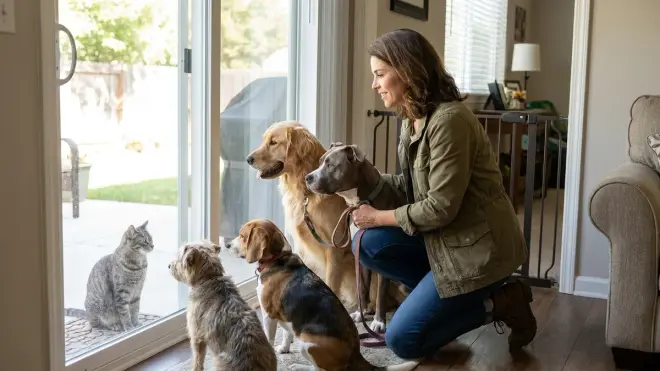
Once both animals are eating calmly within a foot of the closed door, it's time for the first visual introduction. You have two options here: use a baby gate installed in the doorway, or crack the door open just 2-3 inches while your dog is on leash.
I prefer the baby gate method for most dogs because it provides consistent visual access while maintaining clear physical boundaries. Install a tall, pressure-mounted gate (minimum 36 inches for medium to large dogs—some athletic or determined dogs may require a taller gate secured with hardware). If your dog is small enough to slip through standard gate bars, look for gates with narrow spacing or mesh panels.
The first visual session should be brief—just 2-3 minutes. Have your cat in their safe room with the gate installed, and bring your dog to the gate on leash. Bring high-value treats. The moment your dog looks at the cat, mark the behavior (with a clicker or "yes") and reward. You're not rewarding fixation or intensity—you're rewarding the simple act of acknowledging the cat's existence calmly.
Repeat this protocol twice daily, gradually increasing session length by 1-2 minutes as both animals remain calm. If your dog shows any of the following behaviors, end the session immediately and go back to door feeding for another 3-5 days:
- Intense staring with body stiffness
- Whining, barking, or lunging toward the gate
- Ignoring high-value treats completely
- Play bow position followed by stalking posture
For cats, warning signs include hissing, spitting, flattened ears pinned back, or hiding for more than an hour after the session ends.
Step 5: Practice Leashed Proximity in Neutral Spaces

After 7-10 days of calm visual contact through the barrier, you're ready for the first face-to-face introduction. This is where most people make critical mistakes, and I've seen the fallout at the grooming shop—dogs who've developed obsessive cat-chasing behaviors because the introduction was mishandled at this exact stage.
Choose a neutral room where your dog doesn't normally spend much time—not their primary sleeping area or favorite hangout spot. Before bringing your cat in, exercise your dog thoroughly. A tired dog has a lower arousal threshold and better impulse control. I take my terrier mix on a 45-minute walk before any high-stimulation training session; a quick trip around the block won't cut it.
Place your cat in a wire carrier (not a closed carrier—both animals need to see each other) elevated on a table or counter. Bring your dog into the room on leash, maintaining at least 8-10 feet of distance initially. Have those high-value treats ready. Your dog gets rewarded for:
- Looking at the cat calmly then looking back at you
- Sitting or lying down
- Disengaging from the cat when asked
- Any relaxed body language (soft eyes, closed mouth, loose tail)
Session length: 5-10 minutes, twice daily. If your dog remains calm and responsive for three consecutive sessions, reduce the distance by 2 feet. This gradual approach may feel painfully slow, but I've groomed enough dogs with cat-related behavioral issues to know that rushing this phase creates problems that take months to fix.
Over 10-14 days, work your way down to 3-4 feet of distance with your dog maintaining relaxed body language and responding to cues. Only then should you consider allowing direct interaction.
Step 6: Supervised Free Interaction With Safety Measures
The first leash-free interaction happens only after your dog has demonstrated calm, responsive behavior at close proximity for at least a week. Before you allow this, ensure your home has vertical escape routes for your cat—tall cat trees, wall-mounted shelves, or furniture arranged to create pathways your dog cannot access. I've watched too many cat-dog relationships sour because the cat felt trapped with no escape option.
Keep your dog's leash attached but drop it on the floor—this gives you a way to intervene quickly if needed without grabbing for a collar (which can trigger defensive responses). Let your cat out of the carrier in the same neutral room you've been using. Have another person present to observe and assist if possible.
Watch for these positive interaction signals:
- Cat approaches the dog voluntarily with tail up
- Dog offers a play bow with loose, wiggly body language
- Both animals sniff briefly then disengage
- Cat slow-blinks at the dog
- Dog looks away or sniffs the ground when cat approaches (calming signals)
Intervene immediately if you see:
- Dog fixating on cat with stiff body posture
- Cat hissing, spitting, or swatting with claws extended
- Dog attempting to chase if cat moves quickly
- Either animal showing signs of intense stress (panting, drooling, dilated pupils)
These first sessions should last 10-15 minutes maximum, even if everything is going well. End on a positive note and separate the animals before anyone becomes overstimulated. Repeat daily, gradually extending session length as both animals remain calm.
Multi-pet home safety means you need to stay vigilant during this transition period, watching for signs that stress is building in either animal.
Step 7: Establish Household Routines and Resource Management

Once your dog and cat are tolerating each other's presence for 30-45 minute periods without intervention, you can begin integrating them into daily household routines. This is where the long-term success of your introduction really gets tested—it's not about a single successful meeting, but about sustainable coexistence.
Resource management becomes your ongoing responsibility. Even animals who seem to get along can develop tension over food, toys, resting spots, or human attention. Keep feeding areas completely separate (different rooms if possible, or feed at different times). My own dogs have different food motivations—my shepherd is relaxed about meals, but my terrier would absolutely resource-guard against a cat given the opportunity.
Create cat-only zones that your dog cannot access under any circumstances. This might mean installing a baby gate at the entrance to a hallway or bedroom, with a cat door cut into the gate. Cats need the psychological security of knowing they can escape canine attention whenever they want. I've seen households where the cat and dog genuinely like each other, but the cat still uses their safe room daily just to decompress.
Maintain separate litter box access—this is non-negotiable. Some dogs find litter boxes (and their contents) fascinating in ways that are both unsanitary and disturbing to cats. Place litter boxes in areas your dog cannot reach, using baby gates with cat doors or placing boxes in closets with cat-sized openings. Understanding why pets fight over food and resources helps explain why even toilet areas can become points of conflict in multi-species homes.
During this phase, continue supervising all interactions until you're confident both animals have established a peaceful routine. For some households, this happens within 2-3 weeks of free interaction. For others—particularly with high-prey-drive dogs or anxious cats—supervision may need to continue for several months.
Step 8: Recognize When You Need Professional Help
Not every dog-cat pairing will work, and recognizing when you need professional intervention can prevent injury and chronic stress for both animals. I've groomed dogs who live peacefully with cats and dogs who absolutely cannot be trusted around felines—breed, age, and individual temperament all play a role.
Consult a certified animal behaviorist (CAAB or ACAAB credential) if you observe:
- Dog making repeated, intense attempts to chase or grab the cat despite training
- Escalating aggression from either animal over time rather than improvement
- Cat refusing to eat, use the litter box, or leave hiding spots after 3+ weeks
- Dog unable to disengage from fixating on the cat even with high-value rewards
- Any injury to either animal, even minor scratches or bite marks
High-risk dog profiles for cat introductions include dogs with documented prey drive (sighthounds, terriers, some herding breeds), dogs with a history of injuring or killing small animals, and dogs who've never been properly socialized to cats during their critical socialization period (3-14 weeks of age). This doesn't mean these dogs can never live with cats, but it means you need professional guidance rather than a DIY approach.
Some dogs who seem perfect in every other way simply have too strong a predatory sequence to live safely with cats. I've known wonderful family dogs who were gentle with children and other dogs but could not control their chase response around cats. Accepting this reality early—before an injury occurs—is the responsible choice.
Pro Tips & Common Mistakes
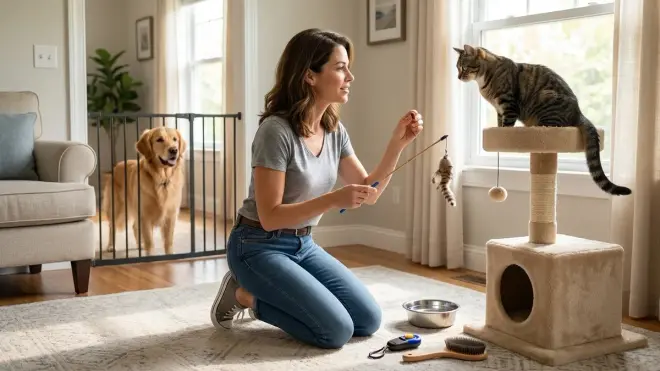
The single biggest mistake I see people make is moving too fast because "they seem fine." Seeming fine during a 5-minute interaction doesn't predict how they'll behave when tired, hungry, or competing for your attention on the couch. I always tell grooming clients: if you think you're going too slowly, you're probably moving at the right pace.
Feed on a schedule rather than free-feeding during the introduction period and beyond. Scheduled meals give you multiple daily training opportunities and prevent resource guarding around food bowls. My terrier mix, who's food-motivated and territorial, does much better with clear feeding times rather than having food available constantly.
Don't punish your dog for being interested in the cat—this creates negative associations and can actually increase fixation. Instead, reward disengagement and calm behavior around the cat. When my clients ask how to stop their dog from staring at the cat, I tell them: you don't punish the staring, you make not staring more rewarding.
Tire your dog out before every training session. I can't emphasize this enough. A dog who's had a long walk, a play session, or some mentally engaging activity beforehand has better impulse control and a longer attention span. The difference between introducing my terrier to new situations before and after exercise is dramatic.
Watch for displacement behaviors in both animals—yawning, excessive grooming, sniffing the ground, or looking away. These aren't signs of relaxation during introductions; they're stress signals. If you see them repeatedly, slow down your timeline.
Consider the cat's personality as much as the dog's. A confident, dog-experienced cat can often handle a faster introduction than a timid, cat-only-household cat. I've watched bold cats completely dismiss nervous dogs, and I've seen anxious cats hide for weeks from gentle, disinterested dogs. The cat sets the pace as much as the dog does.
Frequently Asked Questions
How long does it take to successfully introduce a cat to a dog?
Most successful cat-to-dog introductions take between 2-6 weeks when following a structured desensitization protocol, though some pairs need 2-3 months to fully acclimate to each other. The timeline depends on your dog's prey drive, previous cat exposure, and training level, as well as your cat's confidence and past experiences with dogs. High-prey-drive dogs and anxious or cat-inexperienced felines need longer, more gradual introductions with extended periods at each stage before progressing.
Can I introduce a kitten to my adult dog faster than an adult cat?

Young kittens (8-16 weeks) can sometimes adapt to dogs more quickly than adult cats because they're still in their critical socialization period and haven't developed strong fear responses yet, but this doesn't mean you should rush the introduction process. Kittens are also more vulnerable to injury from even playful dogs due to their small size and fragile bones, so supervision and safety protocols become even more critical. Some adult cats who've lived with dogs before actually adapt faster than kittens because they already understand canine body language and boundaries.
What if my dog has a strong prey drive—should I even try introducing a cat?
Dogs with strong prey drive can sometimes learn to live peacefully with cats, but it requires extensive training, management, and often professional behaviorist support to ensure safety for both animals. Breeds developed for chasing small game—sighthounds like Greyhounds or Whippets, terriers, and some herding breeds—have genetic predispositions toward prey behavior that training can manage but may never fully eliminate. If your dog has a documented history of injuring or killing small animals, attempting a cat introduction carries significant risk and should only proceed with certified behaviorist guidance and potentially muzzle training for safety.
Should I let my dog and cat work it out on their own after the initial introduction?
Never leave a newly introduced dog and cat to "work it out" without supervision, as this can lead to injury, trauma, or permanent negative associations between the animals that make peaceful coexistence impossible. Even after successful initial introductions, you should supervise all interactions for at least several weeks and sometimes months until you're confident both animals have established predictable, safe behavior patterns with each other. Many households maintain some level of management indefinitely—such as separating animals during feeding times or when no one is home—because prevention is always easier than fixing problems that develop from unsupervised conflict.
Summary
Introducing cat to dog successfully requires patience, structured protocols, and a willingness to move at the pace of your more anxious animal. Start with complete separation, progress through scent swapping and barrier feeding, introduce visual contact gradually, and only move to supervised free interaction once both animals demonstrate calm body language at close proximity.
I've worked with enough dogs over the years to know that shortcuts in this process almost always backfire. The grooming clients who tell me their dog and cat are best friends? They're the ones who took 6-8 weeks for introductions, followed every step carefully, and didn't rush because they thought things were going well.
Your goal isn't just a single successful meeting—it's building a household where both animals feel safe, have their needs met, and can coexist without chronic stress. Some dogs and cats become genuine friends. Others maintain a respectful distance. Both outcomes are success stories if neither animal is anxious or fearful in their own home.