
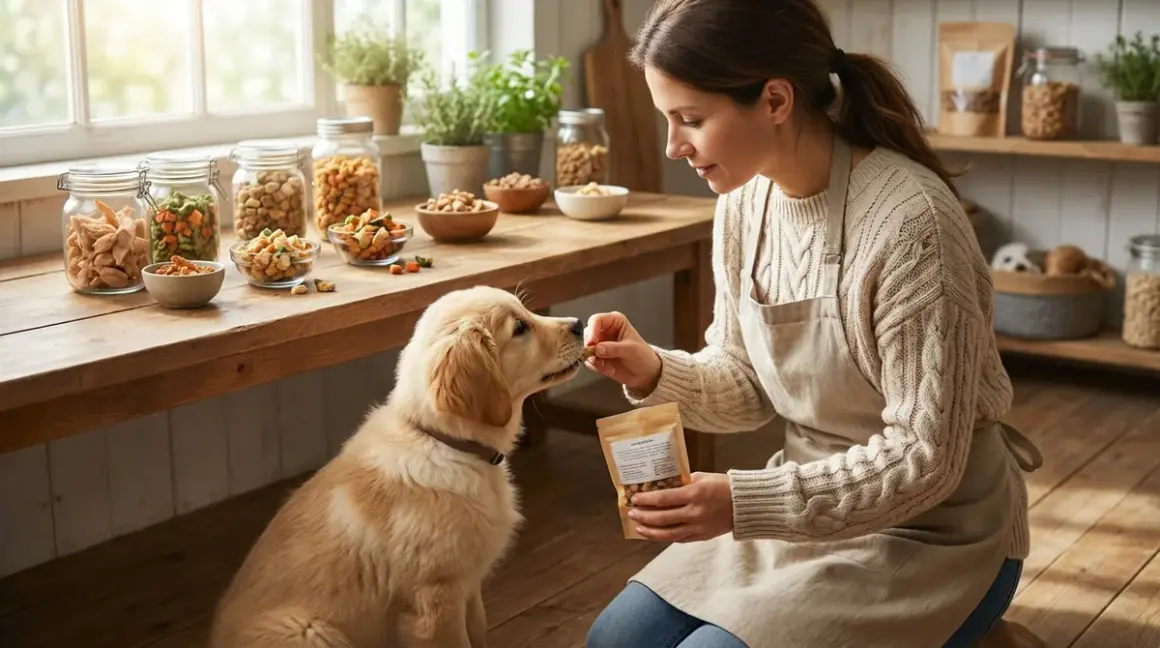

I've worked with hundreds of puppies over the years, and here's what I see all the time: owners get excited about training, buy a bag of treats, and start rewarding every good behavior. Three weeks later, their puppy's putting on weight faster than they're learning new commands. The problem isn't the training—it's the treats. When you're working on housebreaking, basic commands, and socialization, you're handing out dozens of treats every single day. Those calories add up fast, especially with small and medium breed puppies. The good news? Low calorie training treats for puppies let you reward consistently without turning your pup into a chubby teenager.
Quick verdict: The best low calorie training treats for puppies balance minimal calories (under 3 calories per treat) with high palatability, soft texture for quick consumption, and quality ingredients that won't upset developing digestive systems. My top pick is Zuke's Mini Naturals for their tiny size and single-calorie punch, but several other options work brilliantly depending on your puppy's preferences and dietary needs.

What to Look For in Low Calorie Training Treats for Puppies
Finding treats that actually support training without sabotaging your puppy's weight takes more than just grabbing the first bag labeled "low calorie." Here's what really matters.
Calorie Content Per Treat
This is the big one. A proper training treat should contain no more than 3 calories per piece, and ideally closer to 1-2 calories. During active training sessions, you might hand out 50-100 treats in a day. At 3 calories each, that's 150-300 calories—which could be 10-30% of a small puppy's daily caloric needs. I've seen trainers use regular-sized treats and wonder why their 15-pound puppy suddenly needs to go on a diet at six months old. Do the math before you buy. Check the guaranteed analysis label for calories per treat, not just per cup or per 100 grams.
Small size matters too. Treats should be pea-sized or smaller for most puppies. Large treats force you to either break them up (annoying during training) or give fewer rewards (slowing down learning). If you're working on how to use treats for puppy training effectively, you need to be able to rapid-fire rewards during the critical learning window.
Ingredient Quality and Digestibility
Puppies have developing digestive systems that can't handle the same stuff adult dogs process easily. Look for limited ingredient formulas with recognizable whole foods as the first three ingredients. Chicken, turkey, beef, salmon, sweet potato, and pumpkin are all solid choices. Skip anything with corn, wheat, or soy as primary ingredients—these are cheap fillers that add calories without much nutritional value.
Artificial colors, flavors, and preservatives are completely unnecessary. If a treat is bright red or neon green, it's theater for you, not nutrition for your puppy. I've never met a puppy who cared what color their reward was.
Check for common allergens if your puppy has shown any digestive sensitivity. Single-protein treats (just chicken, or just salmon) make it easier to identify what works for your individual dog.
Texture and Palatability
Here's something a lot of articles skip: the treat needs to be more exciting than the distraction. During early puppy training, you're competing with every leaf, smell, and passing butterfly. A boring treat doesn't stand a chance. That said, you also need something your puppy can eat in under two seconds. Soft, chewy treats beat crunchy ones for training because puppies can swallow them quickly and refocus on you instead of spending fifteen seconds chomping.
The "squish test" works well: press the treat between your fingers. If it gives easily, it's probably soft enough for quick consumption. Rock-hard treats might be fine for adult dog training, but puppies often struggle to break them down quickly, which kills your training momentum.
Size Appropriateness for Different Breeds
A treat that's "small" for a German Shepherd puppy is massive for a Chihuahua puppy. I always recommend starting with the smallest size available in any treat line. You can always give two treats if needed, but you can't make a too-large treat smaller without creating crumbly mess in your pocket.
For toy and small breed puppies (under 15 pounds adult weight), look for treats specifically marketed as "mini" or "training size." For medium to large breed puppies, regular training treats usually work fine, but count the calories carefully—bigger puppies eat more treats in absolute numbers even though they need them proportionally less.
No Artificial Additives or Common Allergens
This ties back to ingredient quality, but it's worth stating plainly: puppies don't need artificial anything. Propylene glycol, BHA, BHT, ethoxyquin—if you need a chemistry degree to pronounce it, your puppy doesn't need to eat it. These preservatives extend shelf life for manufacturers but add zero training value.
Common allergens to watch for include chicken (surprisingly common), beef, dairy, eggs, and wheat. If your puppy shows signs of food sensitivity—itchy skin, ear infections, soft stools—switching to a limited-ingredient or novel protein treat often helps. Salmon, duck, and venison are good alternatives.
Real-World Practicality
Nobody talks about this, but it matters: the treat needs to work with your lifestyle. If you train outdoors in summer, super-soft treats will melt into pocket pudding. If you're working in a training class with other puppies, your treats need to be more enticing than whatever the person next to you brought. If you're clumsy like me, you want treats that don't crumble into dust and coat the inside of your treat pouch.
Some treats require refrigeration after opening. That's fine for home training, but annoying if you're out at the park. Consider where and when you'll actually use these treats before committing to a five-pound bag.
Our Top Picks
Zuke's Mini Naturals Training Treats
The Zuke's Mini Naturals Dog Training Treats🛒 Amazon are what I reach for first with most puppies. At just 1.5 calories per treat, these tiny morsels let you reward dozens of times without worrying about weight gain. They're made with chicken as the first ingredient, plus cherries and rosemary for natural preservation, and they have a soft, moist texture that puppies demolish in one bite.
I've used these with everything from Maltese puppies to Golden Retriever puppies, and the size works across the board. They're small enough that toy breeds get a satisfying reward, but you can easily give two or three to a larger puppy during high-value training moments.
Pros:
- Only 1.5 calories each—among the lowest available
- Soft texture perfect for rapid reward delivery
- Comes in multiple proteins (chicken, pork, duck, rabbit, salmon)
- No corn, wheat, or soy
- Resealable bag keeps them fresh
Cons:
- They can get crumbly in very hot weather
- Some puppies find the duck flavor less exciting than chicken
- The bag size means you'll go through them quickly with multiple daily training sessions
Wellness Soft Puppy Bites
The Wellness Soft Puppy Bites Natural Dog Treats🛒 Amazon are specifically formulated for growing puppies, with 3 calories per treat and added DHA for brain development. These are slightly larger than Zuke's, about the size of a pencil eraser, but they tear easily if you need smaller pieces. The ingredient list is clean: lamb and salmon are the primary proteins, plus flaxseed for omega fatty acids.
What I like about these is the texture—they're soft and chewy without being sticky or greasy. I've carried them in my pocket through hour-long training sessions without creating a mess, which is saying something.
Pros:
- Formulated specifically for puppy nutritional needs
- DHA supports cognitive development during critical learning period
- Soft but not mushy—maintains shape in your pocket
- Grain-free recipe works for sensitive stomachs
- Strong smell that puppies find highly motivating
Cons:
- At 3 calories each, they're on the higher end for training treats
- Only available in one flavor combination (lamb and salmon)
- Slightly more expensive per treat than other options
Blue Buffalo Blue Bits Training Treats
The Blue Buffalo Blue Bits Soft-Moist Training Dog Treats🛒 Amazon deliver 2 calories per treat in a soft, savory formula that even picky puppies usually accept. These use real turkey, chicken, or beef as the first ingredient (depending on which flavor you choose), and they're completely free of chicken or poultry by-product meals.
The size is perfect for training—small enough to give frequently but substantial enough that puppies recognize they're getting something good. I've found these work especially well with puppies who are food-motivated but not obsessed, where you need that extra flavor punch to maintain attention.
Pros:
- Good middle-ground calorie count at 2 per treat
- Multiple protein options let you rotate flavors
- No artificial preservatives or chicken by-products
- Stays soft without refrigeration
- Price point makes it affordable for daily training
Cons:
- Contains some potato starch as filler
- The turkey flavor can be less appealing than chicken for some puppies
- Treats stick together slightly in the bag, requiring you to separate them
Charlee Bear Dog Treats
Charlee Bear Original Crunch Dog Treats🛒 Amazon take a different approach with a crunchy texture and 3 calories per treat. Unlike most training treats, these are baked hard, which some puppies actually prefer. They're made with a liver flavor that dogs find intensely rewarding, and the ingredient list is surprisingly clean for such an affordable option.
I'll be honest: I don't use these for rapid-fire puppy training because the crunch factor slows things down. But for puppies who need to chew their treats or for training sessions where you're working on longer-duration behaviors (like stay or down), the crunch actually helps mark the reward more clearly.
Pros:
- Super affordable—you get a huge bag for minimal cost
- Crunchy texture helps with puppy teething needs
- Liver flavor is extremely high-value for food-motivated dogs
- Doesn't get sticky or mushy in warm weather
- Long shelf life without refrigeration
Cons:
- The crunch slows down treat consumption during training
- Not ideal for very young puppies still learning to chew properly
- Contains wheat flour, which doesn't work for grain-sensitive dogs
- Fairly large size requires breaking in half for toy breeds
Pupford Freeze-Dried Training Treats
The Pupford Freeze-Dried Training Treats🛒 Amazon offer 1 calorie per treat, making them one of the lowest-calorie options available. These are pure protein—just freeze-dried beef liver—with absolutely nothing else added. No preservatives, no fillers, no grain, no nothing. Just meat.
The freeze-dried texture means they're lightweight and won't make your training pouch gross, but they do crumble more easily than soft treats. I use these primarily for high-distraction training or when I need an absolute "jackpot" reward for breakthrough moments. The smell is intense—which is great for training but less great for your pocket.
Pros:
- Only 1 calorie per treat—lowest option for serious training
- Single ingredient makes it perfect for elimination diets
- Extremely high value for food-motivated puppies
- No refrigeration needed
- Works for dogs with multiple food sensitivities
Cons:
- They crumble easily, creating dust in your treat pouch
- The smell is very strong (that's good for puppies, less good for you)
- More expensive per treat than most other options
- Some puppies need time to adjust to the texture
Old Mother Hubbard Crunchy Classic Treats
Old Mother Hubbard Classic Crunchy Natural Dog Treats🛒 Amazon deliver 5 calories per treat, which puts them at the higher end of what I'd consider acceptable for training. But here's why they make the list: they break cleanly into 3-4 pieces, effectively giving you 1.5 calories per reward. These are small, crunchy biscuits made with whole wheat flour, oats, and chicken—simple ingredients that have been around for decades.
I grew up using these with my family's dogs, and they still work reliably with puppies today. They're best for home training sessions where you can pre-break them into smaller pieces, rather than on-the-go training where you need grab-and-reward speed.
Pros:
- Breaks cleanly into multiple training-sized pieces
- Simple, recognizable ingredient list
- Crunchy texture puppies enjoy
- Extremely shelf-stable
- Budget-friendly for extended training programs
Cons:
- Requires pre-breaking for proper portion control
- Contains wheat, making it unsuitable for grain-free diets
- At 5 calories per whole treat, you must remember to break them
- Crunch factor slows down rapid training sequences
Stewart Pro-Treat Freeze-Dried Treats
The Stewart Pro-Treat Freeze Dried Dog Treats🛒 Amazon contain 2 calories per treat and use a single protein source (your choice of beef liver, chicken breast, or lamb liver). These are popular in competitive obedience training circles because they're intensely motivating but won't fill up a dog quickly.
The texture is similar to Pupford's freeze-dried option but slightly more robust—they still crumble less than I'd like, but they hold together better than pure liver treats. I've used these extensively with puppies preparing for more advanced training, and the motivation level they provide is excellent.
Pros:
- Strong protein smell creates high motivation
- Single-ingredient formula simplifies allergy management
- Size is consistent, making portion control easy
- Works across all breed sizes
- Lightweight for carrying multiple training sessions' worth
Cons:
- The texture is slightly dry for some puppies' preference
- Creates some dust/crumbs in your pocket or pouch
- More expensive than conventional training treats
- The smell lingers on your hands after training
Frequently Asked Questions
How many low calorie training treats can I give my puppy per day?
Your puppy's daily treat calories should stay under 10% of their total daily caloric intake. For a 10-pound puppy needing around 500 calories daily, that's 50 calories from treats—which gives you 25-50 training treats depending on which product you're using. During intensive training periods, you can go slightly higher (up to 15%) by reducing their meal portions proportionally, but I don't recommend making this your everyday approach. If you're wondering about how many treats can I give my puppy during training, the answer depends on your puppy's size, age, and activity level, but low-calorie options give you much more flexibility than standard treats.
Are freeze-dried treats better than soft treats for puppy training?
Freeze-dried treats typically contain fewer calories per piece and use single-protein sources, making them excellent for food-sensitive puppies. However, soft treats work better for rapid-sequence training because puppies consume them faster without the crunch-and-chew time. I use both: freeze-dried for jackpot rewards and breakthrough moments, soft treats for the bulk of repetitive training. The "better" option depends on your training context—if you're doing 50 repetitions of sit-stay in ten minutes, soft wins. If you're rewarding a major breakthrough like your puppy's first successful recall past a distraction, freeze-dried creates a more memorable moment.
Can I use regular dog treats but just break them into smaller pieces?
You can, but it's annoying and messy. Most regular dog treats don't break cleanly—they crumble into dust and uneven chunks that make consistent reward timing difficult. During training, you need to deliver rewards within 1-2 seconds of the desired behavior for clear association. Fumbling with breaking treats or picking up the right-sized piece disrupts that timing. Purpose-made training treats are sized appropriately from the start, letting you maintain training momentum. That said, if you already have regular treats and your puppy is maintaining a healthy weight, go ahead and break them up. It's better than buying something new when what you have works fine.
Should I avoid chicken-based treats if my puppy has sensitive skin?
According to research on canine food allergies, chicken is one of the more common allergens in dogs, though true food allergies are less common than people think. If your puppy shows signs of food sensitivity—chronic ear infections, itchy skin without fleas, digestive upset—switching to a novel protein like salmon, duck, or venison makes sense. But don't avoid chicken preemptively without reason. Most puppies handle chicken-based treats perfectly fine, and they're often more affordable and available than alternative proteins. If you suspect a sensitivity, work with your veterinarian to do a proper elimination diet rather than guessing, because the problem might not be chicken at all.
Do low calorie training treats provide enough nutrition for my puppy?
Training treats aren't meant to provide nutrition—they're for behavioral reinforcement, not dietary sustenance. Your puppy's complete and balanced puppy food handles all their nutritional needs for growth and development. That said, better-quality training treats with real meat, minimal fillers, and no artificial additives contribute small amounts of protein and healthy fats rather than just empty calories. Some puppy-specific treats, like Wellness Soft Puppy Bites, include beneficial additions like DHA, but these are bonuses, not necessities. Never replace meal portions with training treats, even high-quality ones. The 10% treat rule exists because puppies need the proper nutrient ratios found in formulated puppy food, especially during their rapid growth phases.
The Verdict
Low calorie training treats for puppies aren't optional if you're serious about training—they're essential tools that let you reward frequently without compromising your puppy's health. Zuke's Mini Naturals remain my go-to for most puppies because of their tiny size and single-calorie efficiency, but Pupford's freeze-dried options work brilliantly for high-value rewards, and Wellness Soft Puppy Bites add developmental nutrients alongside training value.
Here's the real takeaway from twenty years of training puppies: consistency matters more than perfection. Pick a low-calorie treat your puppy loves, use it religiously during training sessions, and you'll build strong behaviors without building a chunky puppy. If you find yourself going through more than you expected, check out best puppy training treats for more options, or try homemade puppy training treats recipes for the most control over ingredients and portions. Your puppy's waistline—and their training progress—will thank you.