


I've been working with reactive, fearful, and downright stubborn dogs on my grooming table for nearly ten years now, and the question I hear most often is: "Should I use a training collar?" It's a loaded topic, wrapped in strong opinions and outdated myths. But here's what I've learned handling hundreds of dogs—dog training collars, when properly matched to the dog and used with clear technique, can be legitimate tools. They can also cause real harm if misapplied. This guide walks through what these devices actually are, how they function, and the safety considerations every dog owner needs before buckling one on.
What Is a Dog Training Collar?
A dog training collar is a specialized collar designed to provide feedback—typically auditory, vibrational, or stimulation-based—to modify or interrupt specific behaviors. Unlike your everyday flat collar or martingale, these devices deliver a controlled signal timed to your dog's actions, usually via a handheld remote.

You'll see them marketed under names like e-collars, remote training collars, static collars, or (the term that makes most people wince) shock collars. I avoid the word "shock" in my own work because it conjures images of livestock prods, which isn't accurate for modern units. Most quality devices deliver adjustable electrostatic stimulation ranging from a barely-there tingle to a noticeable muscle contraction. Some models skip electricity entirely, relying on vibration, ultrasonic tones, or citronella spray.
These collars are fundamentally different from canine training aids like clickers or treat pouches—they work through aversive or interruptive feedback rather than positive reinforcement. That distinction matters, and we'll dig into it.
In my grooming salon, I encounter dogs wearing training collars for everything from recall issues to separation barking to aggression management. The results vary wildly. I've seen a high-strung Australian Shepherd transform into a reliable off-leash hiker, and I've also seen a nervous beagle shut down completely after poorly-timed corrections. The collar itself is neutral—it's the handler's understanding that determines the outcome.
How Dog Training Collars Work
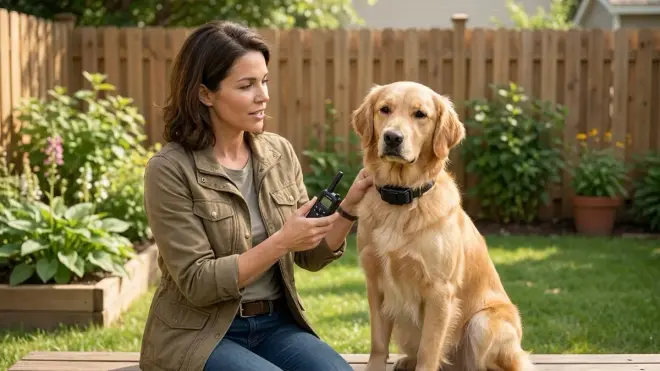
The mechanics are straightforward: you fit a receiver collar snugly on the dog's neck (contact points must touch skin through the coat), and you hold a transmitter that sends a wireless signal—usually up to 1,000 yards or more on mid-range models. When your dog exhibits the target behavior (or fails to respond to a cue), you press a button to deliver the programmed stimulus.
Electrostatic stimulation collars use a small electrical pulse delivered through metal contact points. Quality units offer 50–100+ adjustable intensity levels, starting at a threshold your dog barely perceives—maybe a slight ear flick—and escalating to a level that interrupts focus. The goal in proper training is to identify the lowest effective level, not to crank it to maximum. I think of it like the static shock you get touching a doorknob in winter: mildly annoying, not painful, but enough to redirect attention.
Vibration-only collars skip electricity and rely on a buzzing motor, similar to a phone on vibrate. These work well for dogs who startle easily or for hearing-impaired dogs who can't respond to voice cues. Some dogs ignore vibration entirely—my terrier mix treats it like a massage—but others find it intensely distracting.
Spray collars release a burst of citronella, lemon, or unscented air near the dog's muzzle when triggered. The sudden hiss and smell interrupt barking or unwanted behavior. They're popular for bark control but less effective for distance training since the dog needs to be wearing the collar for every session, and refill cartridges add ongoing cost.
Ultrasonic collars emit a high-frequency tone audible only to dogs. I've seen mixed results—some dogs couldn't care less, while others respond immediately. Effectiveness seems breed- and individual-dependent.
The key variable across all types is timing. The feedback must occur within 1–2 seconds of the behavior to create a clear association. Miss that window, and you're just confusing the dog. This is where most amateur handlers stumble—they react to what they think the dog is about to do, or they delay while fumbling with the remote. I've watched clients inadvertently correct their dog for sitting because they pushed the button three seconds after a bark ended.
Proper protocols involve conditioning the dog to the stimulus first. You don't just slap on a collar and start zapping. Professional trainers introduce the sensation at low levels during neutral moments, pair it with a verbal cue, and gradually build the dog's understanding that the feeling predicts a command or consequence. Without this foundation, the dog experiences random discomfort with no clear way to make it stop—a recipe for anxiety.
Why Dog Training Collars Matter for Specific Situations
I'll be honest: most pet dogs don't need a training collar. The four rescues in my house learned loose-leash walking, recall, and house manners with treats, patience, and consistency. But there are legitimate scenarios where these devices solve problems that other methods can't touch—or at least can't touch in a reasonable timeframe.
Distance recall in high-distraction environments is the big one. If you have a hound who vanishes into the woods after deer, or a livestock guardian breed who patrols your acreage, a long line isn't always practical. An e-collar gives you the ability to communicate "no, come back" at 500 yards when your voice won't carry. I've had clients with working ranch dogs who rely on this tech daily.
Interrupting dangerous behaviors is another valid use case. A dog with a prey drive so strong they'll bolt into traffic chasing a squirrel, or one with same-sex aggression that escalates in seconds—these situations demand instant intervention. A well-timed vibration or low-level stim can break the fixation faster than yanking a leash, and it can literally save the dog's life. I know a Border Collie who wore a collar specifically to interrupt car-chasing; the owner credits it with preventing what would have been a fatal hit.
Reinforcing known commands when off-leash is where e-collars shine for competitive obedience, hunting dogs, and service dog training. These aren't teaching tools in the traditional sense—they're used to enforce reliability once the dog already understands what "sit" or "heel" means. Think of it as a long-distance leash pop, minus the physical force on the neck.
Here's what they don't do well: they don't teach new skills, they don't address anxiety-based behaviors (like separation barking—using a collar for that often worsens the panic), and they don't replace relationship-building. If you strap a collar on a fearful dog who already mistrusts you, you'll deepen that mistrust. One of my senior rescues came from a home where a bark collar was left on 24/7. She arrived shut down, unwilling to vocalize even in play. It took months of positive work to rebuild her confidence.
Types and Variations of Dog Training Collars

The market is crowded, and feature sets vary wildly. Here's how to parse the categories:
Stimulation-Based (E-Collars)
These deliver electrostatic pulses and usually include vibration and tone options as well. Look for models with at least 50 intensity levels—units with only 5–10 jump too steeply between settings, making it hard to find the right threshold. Reputable brands include Garmin, SportDOG, and Dogtra. Receiver weights matter for small dogs; anything over 2 ounces feels bulky on a 15-pound terrier. Most mid-tier units are waterproof (rated IPX7 or similar), which matters if your dog swims or works in wet conditions.
Collars designed for small breeds (under 20 pounds) need lighter receivers and lower starting stimulation levels. Generic models often begin at levels too intense for toy breeds. I've seen a Pomeranian yelp at the "lowest" setting on a big-dog collar—it's not that the dog is weak, it's that smaller necks and less muscle mass amplify the sensation.
Vibration-Only Collars
These skip electricity entirely. They're gentler entry points for nervous dogs or owners uncomfortable with stim. Drawback: some dogs ignore vibration after a few repetitions, especially thick-coated or highly focused working breeds. I use vibration mode on my shepherd mix for recall reinforcement—it's enough to turn her head but doesn't interrupt her if she's in serious prey mode.
Spray Collars
Primarily marketed for bark control, these trigger automatically when the dog vocalizes. The hiss of compressed air plus a citronella burst usually startles dogs into silence. They work best for nuisance barking (boredom, attention-seeking) and poorly for alert barking or anxiety. Refills run around $15–$25 per cartridge, which empties fast if you have a vocal dog. Also, they can't differentiate between your dog's bark and a neighbor dog's, leading to mistimed corrections.
GPS-Integrated Tracking Collars
High-end models like the Garmin Alpha series combine e-collar functionality with real-time GPS tracking. If you hunt with dogs or hike in remote areas, these are game-changers—you can see your dog's location on a map and deliver a recall cue remotely. Trade-off: they're expensive (often over $600 for the system) and require subscription fees for some features.
Bark-Activated Collars (Automatic Modes)

Some units switch to automatic mode, triggering whenever the collar's microphone detects barking. I'm cautious about these—dogs don't always understand why they're being corrected, especially if they're barking reactively at a real threat. If you go this route, pair it with active training during the day so the dog connects the dots.
For readers exploring broader training tools, check out dog training aids for a full breakdown of complementary options like clickers, target sticks, and long lines.
Frequently Asked Questions
Are dog training collars safe for all dogs?
Dog training collars are generally safe for healthy adult dogs when properly fitted and used at appropriate intensity levels, but they are not recommended for puppies under six months, dogs with heart conditions, or anxious dogs without professional guidance. Proper fit means the contact points touch skin (you may need to trim fur or use longer prongs for thick-coated breeds), and the collar sits high on the neck just behind the ears—not loose and sliding around. Over-tightening restricts breathing; under-tightening means inconsistent contact and ineffective corrections. For detailed safety protocols, see our dog training collar safety checklist.
Can training collars cause aggression or fear in dogs?
Yes, training collars can cause fear, anxiety, and even redirected aggression if used incorrectly—particularly if the dog doesn't understand why they're receiving stimulation or if the intensity is too high. I've seen this firsthand: a reactive German Shepherd whose owner used an e-collar to "correct" lunging at other dogs. Because the timing was off and the level too intense, the dog began associating the pain with the presence of other dogs rather than his own behavior, escalating his aggression. A 2023 study published by the International Association of Animal Behavior Consultants found that aversive training methods correlated with increased stress behaviors compared to reward-based approaches. That doesn't mean e-collars are inherently harmful—it means user error has real consequences. If your dog shows signs of shutting down, excessive stress panting, or avoidance behaviors, stop immediately and consult a certified trainer.
How do I choose the right stimulation level for my dog?
Start at the absolute lowest setting and increase incrementally until you observe the mildest reaction—typically an ear flick, head turn, or brief pause—then use that level or one step below it during training. This is called finding the dog's "working level." It should feel like a tap on the shoulder, not a jolt. I walk clients through this during a calm moment at home, never during high-arousal situations. If you're using a collar with 100 levels and your dog doesn't respond until level 40, either the contact points aren't touching skin, the collar is positioned wrong, or (less commonly) your dog has an unusually high threshold. Thick double coats (huskies, malamutes) often require longer contact prongs—usually 5/8″ instead of the standard 3/8″—to penetrate to skin. Never assume "more is better"; I've watched handlers crank settings because they're impatient, and it always backfires.
Are vibration collars as effective as e-collars for training?
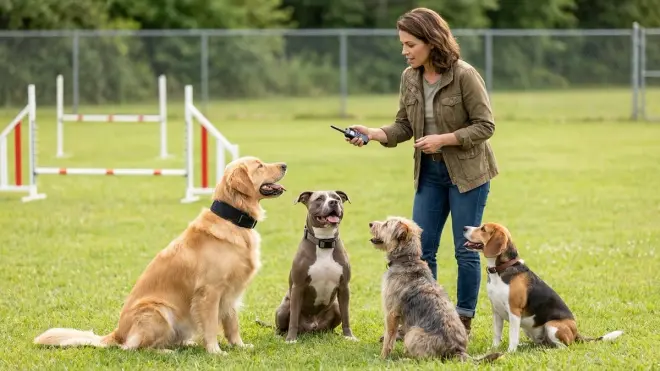
Vibration collars are effective for interrupting low- to moderate-intensity behaviors and for dogs who respond well to novelty stimuli, but they are less reliable than e-collars for distance recall or breaking high-drive behaviors like chasing. My terrier mix ignores vibration entirely when she's locked onto a scent trail, but my younger shepherd mix responds instantly—she finds it genuinely unpleasant. Vibration works best as a secondary cue or "reminder" for dogs who already understand the command. For deaf dogs, vibration is invaluable since auditory cues aren't an option. If you're exploring entry-level options, vibration-only units are a lower-risk starting point, but expect diminishing returns if your dog habituates to the sensation.
How long should a dog wear a training collar each day?
A dog should wear a training collar only during active training sessions, typically no more than 8–12 hours per day maximum, with regular breaks to prevent skin irritation or pressure sores from the contact points. The metal prongs can cause localized pressure ulcers if left in the same position for extended periods, especially on dogs with sensitive skin. I rotate the collar's position slightly every few hours during long training days, and I always remove it overnight. Bark collars set to automatic mode are sometimes left on during the day while owners are at work, but this increases risk—I've seen raw spots develop under the contact points after just a few days of continuous wear. If you're using a collar for behavior modification, the goal should be to phase it out over time, not make it a permanent fixture. For additional guidance on gradual introduction, see how to introduce a training collar to your dog.
Summary
Dog training collars span a wide range of technologies and applications, from gentle vibration units to multi-level e-collars with GPS tracking. They're powerful tools when matched correctly to the dog's temperament, size, and specific training goals—but they demand careful technique, proper conditioning, and an honest assessment of whether the situation truly calls for aversive feedback. I've seen them solve dangerous recall issues and interrupt life-threatening behaviors. I've also seen them misused in ways that eroded trust and deepened anxiety.
If you're considering a training collar, start with the least invasive option (vibration or low-level stim), work with a certified professional for the first few sessions, and commit to learning proper timing. These devices aren't shortcuts, and they don't replace the relationship-building work that makes training stick. My own dogs respond to their names, recalls, and boundaries because we've put in the hours with treats, consistency, and patience—the collar is a backup, not the foundation. Use it that way, and you'll avoid the pitfalls that give these tools their controversial reputation.