


You're lying in bed, finally drifting off to sleep, when your dog suddenly starts barking at the dark hallway. You check—there's nothing there. No intruder, no mouse, no obvious reason. So why does my dog bark at nothing at night? I've worked with hundreds of dogs whose owners ask this exact question, and the answer is almost never "nothing." Your dog is reacting to something—you just can't see, hear, or smell what they can.
In this guide, I'll walk you through nine specific reasons dogs bark at seemingly empty spaces after dark, and more importantly, what you can actually do about it. We'll cover everything from their incredible sensory abilities to age-related changes that affect senior dogs. You'll learn practical steps to identify what's triggering your dog and how to address the underlying cause—not just the symptom.

Skill level needed: Beginner to intermediate—no special training experience required.
Time commitment: 2-4 weeks to systematically identify and address the cause, with noticeable improvement often within the first week.
What You'll Need
Before we dive into the reasons and solutions, here's what you'll want to have on hand:
- A journal or note app to track when, where, and how often your dog barks at night
- Flashlight or smartphone light to check for physical triggers (shadows, reflections, pests)
- High-value training treats (small, soft, low-calorie options work best for multiple rewards)
- White noise machine or fan (optional but helpful for masking outdoor sounds)
- Pet camera with night vision (optional—helps identify what happens when you're not in the room)
- Your dog's complete health records (if you suspect medical issues, you'll need these for your vet)
- Baby gate or exercise pen (useful for managing access to certain areas while you work on the issue)
- Puzzle toys or long-lasting chews for mental enrichment during evening hours
Step 1: Rule Out Medical Issues First
I always tell people to start here, because pain and discomfort can make dogs bark at night when they never did before. Older dogs especially may develop cognitive dysfunction syndrome (CDS)—essentially canine dementia—which causes confusion, disorientation, and nighttime vocalizations. Dogs with CDS often bark at walls, corners, or empty spaces because they're genuinely confused about where they are.
Vision and hearing loss also increase with age. A dog who's losing their sight might bark at shadows they can't identify, or react to movement they can't see clearly. Dogs with declining hearing may bark more because they can't hear their own voice as well, or they're startled by sounds they used to recognize.
Painful conditions like arthritis, dental disease, or gastrointestinal problems can cause nighttime barking too. If your dog is uncomfortable lying down, or experiencing chronic pain, they might bark as a way of communicating distress—especially when the house is quiet and there are fewer distractions.
Schedule a veterinary exam before you assume this is purely behavioral. Bring your journal notes about when the barking happens and what you've observed. Your vet can assess for cognitive decline, vision and hearing problems, pain indicators, and other medical factors. If you've got a senior dog (generally 7+ years for large breeds, 10+ for small breeds), this step is absolutely non-negotiable.
Step 2: Understand What Your Dog Actually Hears and Smells

Here's the thing most people don't realize: your dog's sensory world is completely different from yours. Dogs can hear frequencies up to 65,000 Hz—humans top out around 20,000 Hz. They can detect sounds at four times the distance we can. At night, when ambient noise drops, these abilities become even more pronounced.
So what might your dog be hearing? Rodents moving inside walls. Possums or raccoons on the roof. Neighbors coming home late. A cat walking across the yard. The high-pitched hum of electronic devices that you literally cannot hear. Wind causing subtle creaking in your home's structure. I've seen dogs bark consistently at 2 AM because that's when their neighbor's refrigerator compressor cycles on.
The scent factor is equally dramatic. Dogs have up to 300 million olfactory receptors compared to our 6 million. They can smell other animals that passed by your property hours ago. They can detect the scent of unfamiliar people from remarkable distances. If you've got vents or gaps in your home's structure, outdoor scents flow in more freely at night when temperature differences create air movement.
Your dog isn't barking at nothing—they're responding to sensory information you don't have access to. Once you accept this, you can start investigating what specific triggers might be present in your home. Walk through your house at night with your dog. Watch where they focus their attention. Check for gaps, vents, and openings where sound and scent might enter. This detective work matters.
Step 3: Identify Visual Triggers and Optical Illusions
Dogs see motion better than detail, and they have excellent night vision thanks to the tapetum lucidum—a reflective layer behind their retina. But this also means they're incredibly sensitive to visual changes that barely register for us. A passing car's headlights can create moving shadows throughout your home. Moonlight shifting through tree branches makes patterns on walls that seem to move and change.
I worked with a Labrador who barked at the same corner every single night around 11 PM. The owners were convinced their house was haunted. Turned out a neighbor's motion-activated security light was positioned just right to create a brief reflection on their window, which cast a moving shadow in that exact corner. Once they installed blackout curtains, the "ghost" disappeared.
Reflective surfaces cause problems too. Windows, mirrors, glass cabinet doors, and even TV screens can create confusing reflections at night. Your dog might see their own reflection and not recognize it, or see distorted shapes that trigger their alert response. Polished floors can reflect passing lights in ways that look like something moving underneath.
Walk through your home at night with only outdoor light sources (streetlights, neighbors' lights, moonlight). Watch for shadows, reflections, and movement. If your dog consistently barks at specific locations, position yourself there and observe what's happening visually in that space during the time they typically bark. You'll often find a repeating pattern—a car that drives by at a certain time, a tree shadow that moves in a specific way, or a reflection that appears under certain conditions.
Step 4: Address Anxiety and Hypervigilance
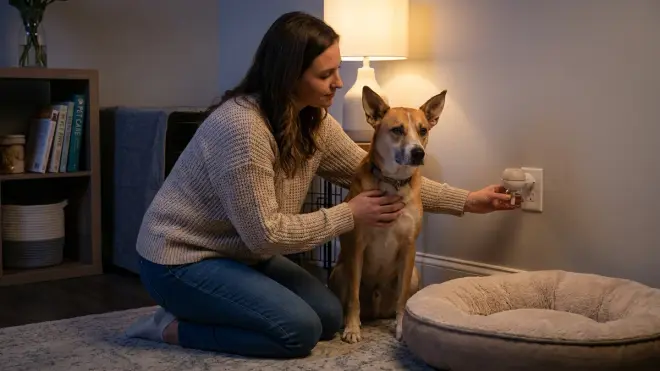
Some dogs bark at night because they're in a heightened state of alert—their nervous system is essentially stuck in "guard mode." This is especially common in dogs with general anxiety, dogs who've been rehomed or experienced trauma, and herding breeds who have strong instincts to monitor their territory.
Separation anxiety doesn't always mean barking when you leave the house. For some dogs, nighttime separation (when you're in a different room sleeping) triggers anxiety. They bark to check that you're still there or to try to get you to come to them. This often happens when dogs are crated in a separate area or when bedroom doors close and they can't access you.
Creating a secure, comfortable sleeping area helps tremendously. Many dogs sleep better when they can hear and smell their people. If your dog is barking from a crate in the laundry room, consider moving the crate to your bedroom—you might be surprised how much this changes their nighttime behavior. For guidance on helping dogs settle overnight, check out how to crate train a dog to sleep through the night without barking.
Evening routine matters. A predictable sequence of events before bed helps anxious dogs relax. Try this: last potty break, small drink of water, five minutes of calm petting or massage, then settle into sleep area. Same order, same timing, every night. Hypervigilant dogs need help downregulating their nervous system, and routine provides that structure.
Consider adding white noise machines or fans to mask outdoor sounds that might be triggering alert responses. The consistent background noise gives their brain less to monitor and analyze. I've seen this make a huge difference for dogs who are environmentally sensitive.
Step 5: Evaluate Activity Level and Mental Stimulation

A tired dog is usually a quiet dog, but there's a catch—you need both physical exercise and mental exhaustion. I've seen plenty of dogs who get an hour-long walk but still have energy to spare at night because their brains weren't engaged during the day. Mental enrichment tires dogs out in ways that pure physical exercise doesn't.
If your dog isn't getting adequate exercise during the day, they'll have pent-up energy that comes out at night as restlessness, hyperawareness, and barking. Breed matters here. Working breeds like Border Collies, Belgian Malinois, and German Shepherds need substantially more activity than companion breeds like Bulldogs or Shih Tzus. Age matters too—young adult dogs (1-5 years) typically need the most exercise.
But timing is just as important as quantity. If your dog's only substantial exercise happens at 6 AM, they've got all day and evening to rebuild energy. Try splitting exercise into morning and late afternoon/early evening sessions. That evening activity helps burn off accumulated energy right before the quiet nighttime hours.
Mental stimulation is the secret weapon most people miss. Twenty minutes of scent work, puzzle toys, or training sessions can tire a dog's brain more effectively than a 45-minute walk. Before bed, give your dog something to work on: a stuffed KONG toy, a snuffle mat with hidden treats, or a puzzle feeder. This gives them a calm, focused activity that transitions them toward rest rather than vigilance.
Feed your dog's last meal in a puzzle feeder or scatter it across the yard for a "sniff safari." This engages their most powerful sense and satisfies the foraging instinct. A mentally satisfied dog settles better than one who's just physically tired.
Step 6: Check for Actual Nocturnal Intruders
Sometimes your dog really is alerting you to something concrete—you just haven't identified it yet. Mice, rats, possums, raccoons, and insects are all more active at night, and your dog can detect them long before you see evidence. This is particularly common in older homes, rural areas, or properties with crawl spaces and attics.
Look for physical signs: droppings, grease marks along walls where rodents travel, scratching sounds in walls or ceilings, or disturbed insulation in accessible areas. Check your attic, basement, and crawl spaces with a flashlight during the hours your dog typically barks. Set up an inexpensive pet camera with night vision in the room where your dog barks most frequently—you might spot movement you'd otherwise miss.
Outdoor animals matter too. Cats, foxes, deer, or even neighbor dogs passing through your yard leave scent trails and sometimes sounds. If your dog barks while looking toward windows or doors, they might be detecting animals outside that you can't see or hear. I worked with a couple whose Terrier barked every night around midnight—turns out a family of possums crossed their yard at exactly that time on the way to a neighbor's compost bin.
If you discover an actual pest problem, address it. Contact pest control for rodents or consult with a wildlife removal service for larger animals. You can't train a dog to ignore what their instincts are specifically designed to detect—you have to remove the trigger.
For outdoor animals, motion-activated lights or sprinkler systems can deter regular visitors. Removing outdoor food sources (securing garbage, bringing in pet food bowls, cleaning up fallen fruit from trees) reduces what attracts wildlife to your property in the first place.
Step 7: Teach an Alternative Behavior to Replace Barking
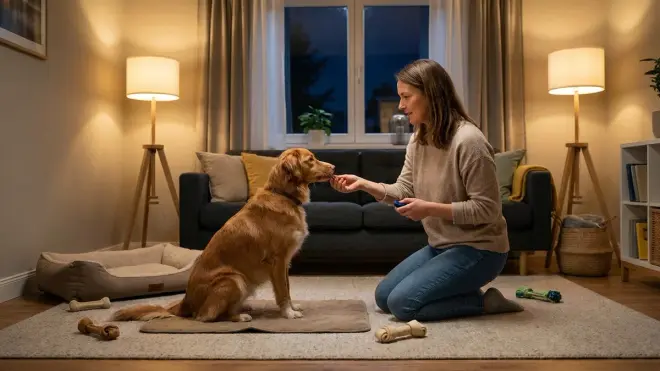
Once you've addressed medical issues, identified triggers, and adjusted the environment, it's time to give your dog something else to do instead of barking. This is where actual behavior training comes in. You're not trying to suppress the alert—you're teaching a different response to the same trigger.
Start with the "look at me" or "watch me" command during the day. Hold a treat near your eyes, say your chosen cue word, and reward your dog immediately when they make eye contact. Practice this 10-15 times per day in short sessions until it's reliable. The goal is to build a behavior that interrupts the barking sequence before it starts.
Next, practice during low-level triggers. When your dog notices something but hasn't started barking yet—ears up, body alert—use your cue. The instant they look at you, reward generously. You're teaching them that checking in with you is more rewarding than escalating to a bark. Timing matters enormously here.
Create a specific nighttime protocol: When your dog alerts, you calmly acknowledge ("I see it, thank you"), then give your "look at me" cue. Reward immediately. If they return to alerting, repeat the sequence. You're validating their vigilance (which matters to them) while redirecting their response.
This won't work instantly. You'll need high-quality training treats that are small and motivating. It takes consistent practice over several weeks to build a new habit pattern. But I've seen this approach work with dogs who'd been barking at night for years—once they have an alternative behavior that gets reinforced, most dogs prefer it because it's less stressful for them too.
Step 8: Manage the Environment During the Transition Period
While you're working on training and addressing root causes, you need to manage the situation so your dog isn't practicing the unwanted barking behavior every night. Every time they bark and nothing happens to interrupt it, they're reinforcing that pattern. Every time they bark and you yell at them from the bedroom, they're getting attention (even negative attention is reinforcing for some dogs).
Temporary management strategies aren't solutions by themselves, but they give you space to implement actual solutions. If your dog barks at windows, close blinds or curtains at night. If they bark at specific rooms, use baby gates to restrict access temporarily. If outdoor sounds are the trigger, use white noise or a fan to mask those sounds while you work on building tolerance.
Change sleeping arrangements if needed. I know some people have strong feelings about where dogs should sleep, but pragmatism matters. If your dog settles perfectly in your bedroom but barks continuously from the laundry room, the choice is pretty obvious. You can always work on independent sleeping later once the nighttime barking pattern is broken.
Consider temporary use of calming supplements or products recommended by your veterinarian—things like melatonin, L-theanine, or adaptogenic herbs. These aren't magic bullets, but they can take the edge off anxiety during the transition period. Always consult your vet before adding supplements, especially if your dog takes any medications.
For some dogs, the Adaptil collar or diffuser (which releases dog-appeasing pheromones) helps during nighttime hours. It's not going to solve a pest problem or fix cognitive decline, but it can reduce general anxiety that amplifies other triggers.
Step 9: Know When to Bring in Professional Help

Some nighttime barking situations need more than DIY approaches. If you've systematically worked through the previous steps for 3-4 weeks without meaningful improvement, it's time to consider professional support. I'm not saying this to sell you services—I'm saying it because some situations genuinely require expertise you might not have.
Veterinary behaviorists (DVMs with additional behavioral specialization) can assess whether medications might help, especially for dogs with severe anxiety, cognitive dysfunction, or compulsive disorders. Some dogs need pharmaceutical support to break the cycle of nighttime hypervigilance.
Certified professional dog trainers (look for credentials like CPDT-KA or KPA-CTP) can observe your specific situation and create a customized behavior modification plan. They'll spot patterns and triggers you might miss because they're looking with experienced eyes. I've learned more from consulting with colleagues on difficult cases than I ever could have figured out alone.
Separation anxiety specialists may be needed if your dog's nighttime barking is part of a larger pattern of distress when separated from you. This is a specific subset of behavioral work that requires a systematic desensitization protocol.
Don't view professional help as failure. Some situations—particularly those involving multiple compounding factors, dogs with trauma histories, or severe anxiety—need individualized plans that account for variables I can't possibly address in a general article. The earlier you bring in help for complex situations, the faster you'll see improvement.
Pro Tips & Common Mistakes
Pro tip: Keep a detailed log for at least a week before you start making changes. Note the exact time of each barking episode, how long it lasts, where your dog is focused, what you did in response, and anything unusual that happened that day. Patterns emerge from data—you might discover your dog only barks on garbage truck nights, or always barks 30 minutes after the neighbor gets home from work.
Pro tip: If you're working on teaching an alternative behavior, practice during the day when your dog is calm. Too many people try to teach new behaviors during the actual problem moment. You can't teach a new skill when your dog is already aroused and alerting—that's when you need to use a skill they already know fluently.
Common mistake: Rushing to punishment-based solutions without understanding the cause. Bark collars, ultrasonic devices, or verbal corrections don't address why your dog is barking. If they're alerting to rodents in your walls, punishing the alert doesn't make the rodents disappear—it just makes your dog conflicted and stressed. Always identify the trigger first.
Common mistake: Inconsistency between household members. If you're working on a "quiet" command and rewarding silence, but your partner yells at the dog from the bedroom, you're teaching competing lessons. Everyone in the home needs to follow the same protocol, every time. Dogs don't generalize well—they need consistent information.
Common mistake: Expecting overnight change. If your dog has been barking at night for months or years, that's a deeply established habit pattern. Behavior modification takes time. You should see some improvement within a week or two, but complete resolution often takes 4-6 weeks of consistent work. Patience matters.
Common mistake: Ignoring the obvious. I've consulted on cases where the dog was clearly hungry (last meal at 4 PM, barking at 11 PM), clearly needed to pee (barking at the door), or clearly in pain (limping before the barking started). Sometimes the answer really is that simple, and we overthink it because we're looking for complex behavioral explanations. For more strategies on managing nighttime barking once you've identified the cause, read through how to stop dog barking at night.
Frequently Asked Questions

Why does my dog bark at nothing at night but not during the day?
Your dog is responding to triggers that are actually more present or more noticeable at night—not nothing. Background noise during the day masks sounds your dog can hear at night (like rodents moving in walls, distant sirens, or neighbors coming home). Reduced light makes shadows and reflections more pronounced, triggering visual alerts. Wildlife is more active after dark, leaving scent trails or making sounds near your property. Additionally, your dog's vigilance naturally increases when the household is quiet and they're in "guard mode" for sleeping family members. The triggers are real—they're just invisible to you.
Can anxiety medication help a dog who barks at nothing at night?
Yes, anxiety medication can help in specific situations where the nighttime barking stems from genuine anxiety disorders, cognitive dysfunction syndrome in senior dogs, or compulsive behaviors. Medications like trazodone, fluoxetine, or others prescribed by your veterinarian can reduce hypervigilance and help your dog's nervous system settle at night. However, medication works best when combined with behavior modification and environmental management—it's not a standalone solution. You'll need a veterinary consultation to determine if medication is appropriate for your dog's specific situation, as not all nighttime barking is anxiety-based.
Should I comfort my dog when they bark at nothing at night or ignore them?
Neither extreme works best—instead, calmly acknowledge and redirect. When you completely ignore nighttime barking, you miss the opportunity to teach an alternative behavior, and you don't address what might be a legitimate alert. When you provide excessive comfort, you can inadvertently reinforce the barking behavior. The middle path: acknowledge briefly ("I see it, thank you"), then redirect to a trained behavior like "look at me" or "go to bed," and reward the redirection. This validates your dog's role as an alert system while teaching them you've got it handled and they can relax.
How long does it take to stop a dog from barking at nothing at night?
Most dogs show noticeable improvement within 1-2 weeks of consistent behavior modification, but complete resolution typically takes 4-6 weeks depending on the underlying cause and how long the pattern has been established. Dogs with medical issues like cognitive dysfunction or pain may improve immediately once the medical problem is addressed. Dogs responding to environmental triggers (pests, sounds, visual stimuli) often improve within days once you remove or manage the trigger. Dogs with anxiety-based nighttime barking generally need the full 4-6 weeks to build new habit patterns and learn alternative behaviors through consistent training.
Summary
Why does my dog bark at nothing at night? Because they're actually responding to something—you just can't perceive it with human senses. The nine reasons we covered range from medical issues like cognitive dysfunction and pain to sensory triggers like sounds, scents, and visual changes that are amplified after dark. Sometimes it's actual pests in your walls. Sometimes it's anxiety. Sometimes it's simply insufficient exercise and mental stimulation.
Your job is to systematically work through the possibilities: rule out medical causes first, identify specific triggers through observation, adjust the environment to reduce stimulation, provide adequate physical and mental exercise, and teach alternative behaviors that replace barking. For most dogs, consistent application of these strategies over several weeks produces significant improvement.
The key is patience and consistency. You're changing established patterns and addressing causes that might have been building for months. But once you understand what your dog is actually responding to, you've got a clear path forward—and quieter nights ahead.