
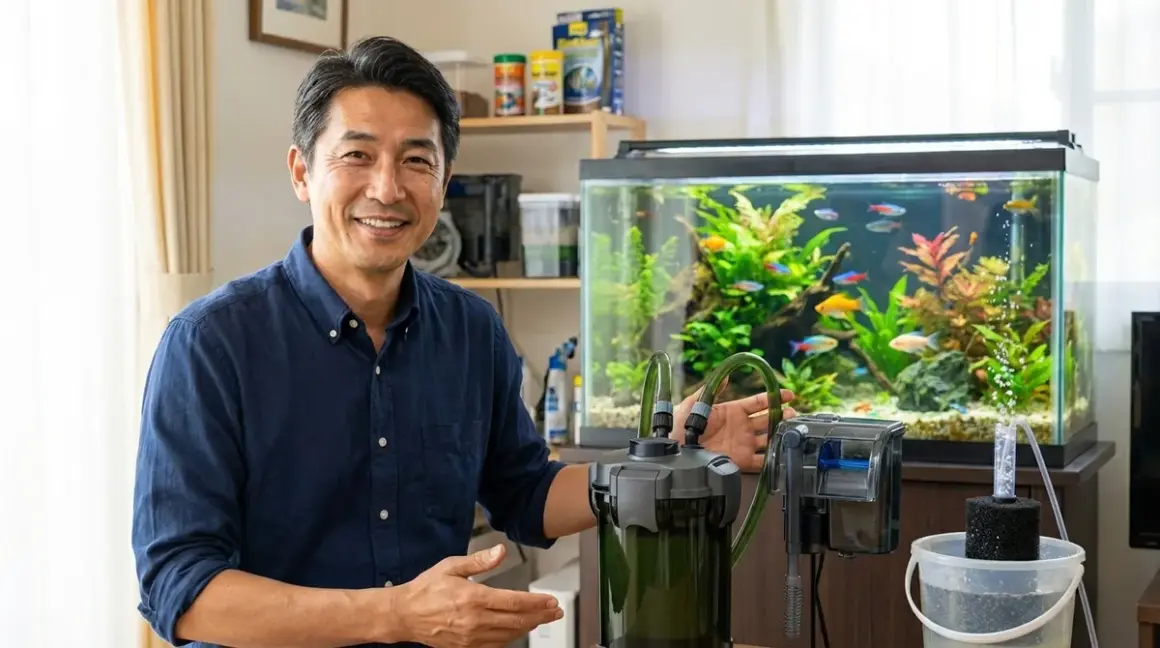

I remember standing in the fish store back in 2011, staring at a wall of filters like they were written in a foreign language. I'd just inherited that first 20-gallon tank, and the sales guy kept throwing around terms like "GPH" and "mechanical versus biological filtration" while I nodded along pretending I understood. I ended up buying the biggest hang-on-back filter they had—figured more power was always better, right?—and spent the next week watching my poor fish get blown around like leaves in a hurricane. That expensive mistake taught me what I wish someone had explained from the start: understanding aquarium filter types isn't about buying the most powerful option, it's about matching the right filtration system to your specific tank size, livestock, and maintenance style. After fifteen years of running everything from 5-gallon betta setups to 150-gallon community tanks, I've learned that each filter type has its place, and choosing the wrong one creates way more problems than it solves.
What to Look For in Aquarium Filter Types
Flow Rate and Tank Turnover
In my experience, the single most misunderstood spec on any filter box is the gallons-per-hour (GPH) rating. Here's what actually matters: you want your filter to turn over the total water volume of your tank 4-6 times per hour for most freshwater setups, and 6-10 times for heavily stocked or saltwater tanks. When I upgraded to my first complete aquarium setup, I thought a 200 GPH filter was overkill for my 40-gallon tank—turns out it was barely adequate once I factored in the flow reduction from media resistance and aging impellers.

But here's the tricky part: you need to balance turnover with current strength. My 10-gallon betta tank taught me this lesson the hard way—bettas with their long, flowing fins can't handle strong current, so even though the math said I needed 40-60 GPH, I had to dial it down to around 30 GPH and compensate with extra media capacity. Species matter. A tank full of tetras and corydoras can handle—and actually benefits from—stronger flow that oxygenates the water and keeps debris in suspension so the filter can catch it. A tank with fancy goldfish or fighting fish? You need adjustable flow or a filter type that naturally produces gentler circulation.
The other thing nobody tells beginners: the advertised GPH is measured with an empty, brand-new filter. Once you load it with media and it accumulates some biological growth (which is good!), you're looking at maybe 70-80% of that rated flow. I always buy one size up from what the math technically requires, just to account for this reality.
Media Capacity and Filtration Stages
This is where the real work happens, and where I see the biggest difference between cheap filters and ones worth investing in. You want three stages of filtration working together: mechanical (removing visible particles), biological (housing the beneficial bacteria that convert ammonia to nitrite to nitrate), and chemical (usually activated carbon removing dissolved organics, medications, or odors).
Sponge filters? They're basically all biological with some mechanical thrown in—the sponge's surface area hosts bacteria while trapping larger particles. Hang-on-back filters typically have cartridges that try to do all three at once, which sounds efficient but means you're throwing away expensive cartridges full of beneficial bacteria every time you do "maintenance" according to the manufacturer's instructions. (I stopped following those instructions years ago—more on that in a minute.)
Canister filters are where you really get to customize your media stack. My 75-gallon planted tank runs with a Fluval 407, and I've got it layered with coarse sponge at the bottom, then finer mechanical media, then a tray of ceramic rings for biological filtration, and finally a bag of Purigen (a premium chemical media) at the top. That's probably overkill for most people, but the point is: more media capacity means longer time between cleanings and more stable water parameters.
When I was cycling my first tank—before I really understood the nitrogen cycle—I kept "cleaning" my filter cartridge under tap water because it looked gross. Killed off all my beneficial bacteria every single time and wondered why my ammonia levels kept spiking. Chlorinated tap water is poison to those bacteria colonies. Now I only rinse filter media in old tank water during water changes, and only when flow noticeably decreases.
Maintenance Requirements and Accessibility
Let me be honest: if you won't actually maintain it, the "best" filter is worthless. I've learned to match filter types to my realistic maintenance schedule, not my aspirational one.
Sponge filters are almost comically easy—squeeze them out in a bucket of old tank water every couple weeks, done. Takes maybe two minutes. Hang-on-backs vary wildly: some have quick-access media chambers you can service in under five minutes, while others (looking at you, certain AquaClear models from my early days) require partial disassembly that inevitably leads to spilling dirty filter water down the back of the stand.
Canister filters are the most work, but only every 2-3 months for most setups. The downside? When you do service them, it's a 20-30 minute project involving disconnecting hoses, hauling the canister to a sink or tub, cleaning multiple media trays, checking o-rings and impellers, and priming the whole system before restart. I've had canisters that primed beautifully every time, and I've had ones that required ten minutes of frustrated shaking and burping to get water flowing again. This matters more than people realize—if your filter is a hassle, you'll delay maintenance, water quality suffers, and suddenly you're dealing with algae blooms or sick fish.
Accessibility also means parts availability. I once bought an off-brand canister filter that worked great for eight months until the ceramic shaft in the impeller cracked. Couldn't find replacement parts anywhere, and the whole unit became a $120 paperweight. Now I stick with established brands like Fluval, Aqueon, Penn-Plax, or Marineland where I know I can get seals, impellers, and media baskets five years from now.
Noise Level and Aquarium Placement
This probably should've been my first consideration for the 20-gallon tank in my bedroom, but I learned about filter noise the hard way—specifically at 2 AM when the water level dropped half an inch and my hang-on-back started making this rhythmic slurping sound that haunts me to this day.
Canister filters are generally the quietest because everything happens inside a sealed container under the stand. The only sound should be a gentle hum from the motor—if you hear rattling, clicking, or gurgling, something's wrong (usually trapped air or a worn impeller). My Eheim 2217 is so quiet I sometimes put my hand near the outlet to check it's actually running.
Hang-on-back filters vary from pleasantly quiet to legitimately annoying. The water-return design matters a lot here. Filters that dump water directly onto the surface can sound like a tiny waterfall—which some people find soothing and others (like my partner) want to throw out the window. The fix is usually lowering the water level slightly or adding a pre-filter sponge that diffuses the flow, but that's one more thing to fuss with.
Sponge filters driven by air pumps are only as quiet as the pump itself. I run Tetra Whisper pumps (ironically not that whisper-quiet) for my smaller tanks, and I've learned to put them on foam pads to dampen vibration noise. The air bubbling through the sponge creates a soft aquarium ambiance that I actually like, but it's definitely audible. If your tank is in a bedroom or office where you need silence, factor this in.
Our Top Picks
Penn-Plax Cascade 700 Canister Filter
The Penn-Plax Cascade 700 Canister Filter🛒 Amazon is my go-to recommendation for 65-gallon tanks and anything up to about 70 gallons, offering exceptional media capacity without the premium price tag of German-engineered canisters. This filter taught me that you don't need to spend $300 to get reliable canister performance—though you do give up some of the refined engineering details that expensive models provide.
Pros:
- Five media baskets let you customize your filtration layers extensively (I run sponge, ceramic rings, and carbon in mine)
- 350 GPH flow rate provides solid turnover for most community tank setups
- Self-priming function works reliably about 80% of the time without fussing
- Spray bar and directional outlet give you flow customization options
- Media baskets are large enough to fit standard filter products without custom cutting
Cons:
- The valve assembly sometimes seeps during the first few months—not a full leak, but enough to leave water marks on the cabinet floor if you don't check regularly
- The impeller can be noisy if you don't clean it thoroughly every few months; debris gets stuck in the magnetic assembly more easily than on my Eheim units
Aqueon QuietFlow 50 Hang-On-Back Filter
The Aqueon QuietFlow 50 Power Filter🛒 Amazon handles tanks up to 50 gallons with a design that actually delivers on the "quiet" part of its name—something I appreciated after years of dealing with rattling filter housings. This is the filter I recommend when someone wants effective filtration without the complexity or price of a canister system.
Pros:
- Internal pump design eliminates the exposed impeller noise that plagues cheaper hang-on-back models
- Self-priming pump restarts reliably after power outages or water changes (this matters more than people realize)
- Five-stage filtration includes biological grids you don't have to replace monthly, just rinse
- Adjustable flow control lets you dial down current for delicate fish
- Cartridges are standard size, making generic replacements easy to find and affordable
Cons:
- The bio-grid holder can be awkward to seat properly during reassembly—if it's not clicked in just right, you'll get bypass flow that reduces filtration efficiency
- Filter cartridge design still encourages monthly replacement when you really only need to swap the carbon portion; feels like engineered obsolescence
Fluval 407 Canister Filter
The Fluval 407 Performance Canister Filter🛒 Amazon represents what I consider the sweet spot between performance and practicality for serious hobbyists running 100-gallon tanks or heavily stocked 75-gallon setups. After struggling with cheaper canisters that leaked or lost prime, investing in this Fluval taught me what "German-engineered reliability" actually means in practical terms (even though Fluval is Canadian).
Pros:
- 383 GPH rated flow maintains strong circulation even when fully loaded with media
- Seven-liter media capacity gives you room for custom filtration stages I actually use—coarse sponge, Seachem Matrix, Purigen, and polishing pad
- AquaStop valves make disconnecting for maintenance genuinely tool-free and drip-free
- Pump head design makes impeller access simple for quarterly cleaning
- Priming button works consistently without the frustrating air-lock issues that plagued my old Penn-Plax unit
Cons:
- At close to three times the price of budget canisters, the cost is genuinely prohibitive for beginners or anyone running multiple tanks on a budget
- The media baskets, while well-designed, are proprietary sizes that don't accommodate standard bulk filter media without some creative packing
Hikari Bacto-Surge Sponge Filter
The Hikari Bacto-Surge High Density Foam Filter🛒 Amazon is my standard choice for hospital tanks, breeding setups, and any aquarium under 20 gallons where you need gentle filtration that won't suck up fry or stress delicate fish. I keep three of these on hand because they're that useful for specialized situations—and because they're nearly impossible to break.
Pros:
- High-density foam provides exceptional biological filtration surface area while creating almost zero current
- Weighted base actually stays put without floating up or tipping over (a problem I've had with cheaper sponge filters)
- Multiple connection options work with standard airline tubing from any air pump
- Foam is easily removable for cleaning and genuinely reusable for years—I'm still using one from 2018
- Perfect for betta tanks, shrimp colonies, and fry-rearing where intake suction would be dangerous
Cons:
- At around $25-30 for a single sponge filter, it's significantly more expensive than basic foam filters that cost $8, though the durability justifies it long-term
- Requires a separate air pump and airline tubing, which adds to the total system cost and component count for beginners
Marineland Penguin 350 Power Filter
The Marineland Penguin 350 Power Filter🛒 Amazon handles up to 75-gallon tanks with a traditional hang-on-back design that's been refined over decades—this is basically the same filter design I started with fifteen years ago, just with minor improvements. Sometimes tried-and-true beats innovative but finicky.
Pros:
- Dual Bio-Wheel system provides rotating biological filtration that truly works—I've measured notably lower nitrite levels compared to cartridge-only filters on comparable tanks
- 350 GPH flow rate gives you solid turnover for most community setups up to 70 gallons
- Bio-Wheels are permanent and never need replacement, just occasional rinsing when they get gunky
- Adjustable mid-level intake strainer keeps debris from clogging the impeller
- Widely available replacement cartridges at every pet store make emergency media swaps easy
Cons:
- Bio-Wheels can stop rotating if they get coated with biofilm buildup or if water level drops even slightly—when they stop, you lose the primary benefit of this design
- Filter housing is bulky and extends several inches behind the tank rim, which can interfere with lids or light fixtures on rimless setups
Aqua Clear 70 Power Filter
The AquaClear 70 Power Filter🛒 Amazon suits tanks up to 70 gallons with a modular media approach that lets you ditch proprietary cartridges entirely—something I wish I'd discovered years earlier before I spent hundreds on disposable filter pads. This filter changed how I think about hang-on-back maintenance economics.
Pros:
- Customizable media basket accommodates sponges, ceramic rings, carbon bags, or any combination you want without forcing you into brand-specific cartridges
- 300 GPH pump with adjustable flow control handles everything from gentle betta current to strong circulation for African cichlids
- Refiltration grid ensures water passes through media thoroughly rather than channeling around it
- Media stacking system makes partial maintenance possible—clean the sponge this week, check the carbon next month
- Long-term cost savings are significant when you're just rinsing reusable sponges instead of buying cartridges
Cons:
- The media basket requires complete removal to access anything, which inevitably leads to spillage and is messier than filters with side-access doors
- Impeller assembly can be finicky to reassemble correctly after cleaning—if the magnetic coupling isn't seated perfectly, you'll hear grinding or the motor won't start
Frequently Asked Questions
What size filter do I need for my aquarium?
Your filter should turn over your tank's total water volume 4-6 times per hour for standard community tanks, or 6-10 times per hour for heavily stocked or messy fish like goldfish and cichlids. Calculate this by multiplying your tank gallons by your target turnover rate—a 40-gallon community tank needs a filter rated for 160-240 GPH at minimum. In my experience, you should actually size up one level from this calculation because filters lose flow efficiency as media loads up and ages, so I'd run a 250-300 GPH filter on that same 40-gallon tank to maintain proper circulation long-term. Species requirements matter too—bettas, gouramis, and other labyrinth fish need much gentler flow regardless of tank size, so you might choose a lower-flow filter with adjustable output or add baffles to reduce current strength even if the math suggests more power.
Can I use a canister filter on a small tank?
You absolutely can use a canister filter on tanks as small as 20 gallons, though whether you should depends on your budget, available space, and maintenance preferences rather than any technical limitation. I run a small Eheim 2213 on my 29-gallon planted tank specifically because the external design eliminates in-tank equipment clutter and the large media capacity means I can go 8-10 weeks between maintenance sessions instead of weekly cartridge checks with a hang-on-back. The main considerations are cost—you're spending $100-150 on a canister versus $30-50 for a comparable hang-on-back—and whether you have cabinet space under the tank to house the canister unit. For nano tanks under 10 gallons, canisters become impractical simply because even the smallest models produce too much flow, and you'd need to baffle or restrict the output so much that you lose the benefits of having that powerful pump in the first place.
How often should I clean my aquarium filter?
The honest answer is when flow noticeably decreases or every 4-6 weeks, whichever comes first—though this varies dramatically based on filter type and how heavily stocked your tank is. My sponge filters get squeezed out in old tank water every two weeks during routine water changes because they clog faster with visible debris, while my canister filters on lightly stocked planted tanks might go 10-12 weeks before flow drops enough to warrant servicing. The critical thing I learned after killing off beneficial bacteria colonies repeatedly as a beginner: never clean filter media under tap water, only rinse mechanical components like sponges and pads in a bucket of old aquarium water you've siphoned out during water changes, and never replace biological media (ceramic rings, bio-balls) unless it's literally falling apart. You want that brownish, slightly slimy buildup on your biological media—that's where your nitrogen cycle bacteria live, and scrubbing it away means restarting the cycle from scratch.
Are sponge filters good enough for a full aquarium setup?
Sponge filters work beautifully as primary filtration for smaller tanks up to about 20 gallons, breeding setups, shrimp colonies, and any situation where you need gentle flow and maximum biological filtration, but they have real limitations for larger or heavily stocked tanks. I run sponge filters as my only filtration on my 10-gallon betta tank and 15-gallon cherry shrimp colony with excellent results—water parameters stay stable, maintenance takes minutes, and the gentle flow is perfect for these species. However, my 75-gallon community tank with 40+ fish would overwhelm a sponge filter's capacity because they lack strong mechanical filtration to clear suspended particles and don't move enough water volume to maintain adequate oxygenation in larger spaces. Sponge filters also provide zero chemical filtration unless you add a separate carbon bag somewhere in the tank, and the air pump bubbles create surface agitation that can be excessive for planted tanks where you're trying to maintain dissolved CO2 levels for plant growth.
What's the difference between mechanical and biological filtration?
Mechanical filtration physically removes solid waste particles like uneaten food, fish waste, plant debris, and free-floating particles from the water by trapping them in sponges, filter floss, or other porous materials—it's basically straining your aquarium water through progressively finer meshes to catch visible debris. Biological filtration, on the other hand, uses beneficial bacteria colonies growing on media surfaces to chemically convert toxic ammonia into less harmful compounds through the nitrogen cycle—first converting ammonia (from fish waste and decaying matter) into nitrite, then converting nitrite into nitrate, which is far less toxic and removed through regular water changes. In practical terms from my years of maintaining various aquarium equipment, mechanical filtration makes your water look clear and prevents debris buildup, while biological filtration is what actually keeps your fish alive by eliminating the invisible toxins that would otherwise poison them within days. Every filter performs both functions to some degree, but the ratio matters—sponge filters are primarily biological with light mechanical capability, while certain cartridge systems focus heavily on mechanical filtration and risk disrupting biological colonies when you replace the cartridge too frequently.
The Verdict
After fifteen years of running tanks from 5 to 150 gallons, I've settled into a pretty clear philosophy: canister filters for my display tanks over 40 gallons where I want maximum media capacity and minimal visible equipment, hang-on-backs for mid-sized tanks where convenience trumps customization, and sponge filters for specialized applications where gentle flow matters more than raw power. The "best" filter type really does depend on your specific situation—your tank size, fish species, budget, and honest assessment of how much maintenance effort you'll actually sustain long-term.
What I wish someone had told me back when I was staring at that wall of filters in 2011: you can't really choose wrong as long as you match flow rate to your tank volume and species needs, but you can definitely make your life harder by picking a filter that doesn't fit your maintenance style. Start with what makes sense for your first tank, and as you gain experience reading your water parameters and understanding your own habits, you'll naturally figure out which aquarium filter types work best for your specific version of this addictive hobby.