
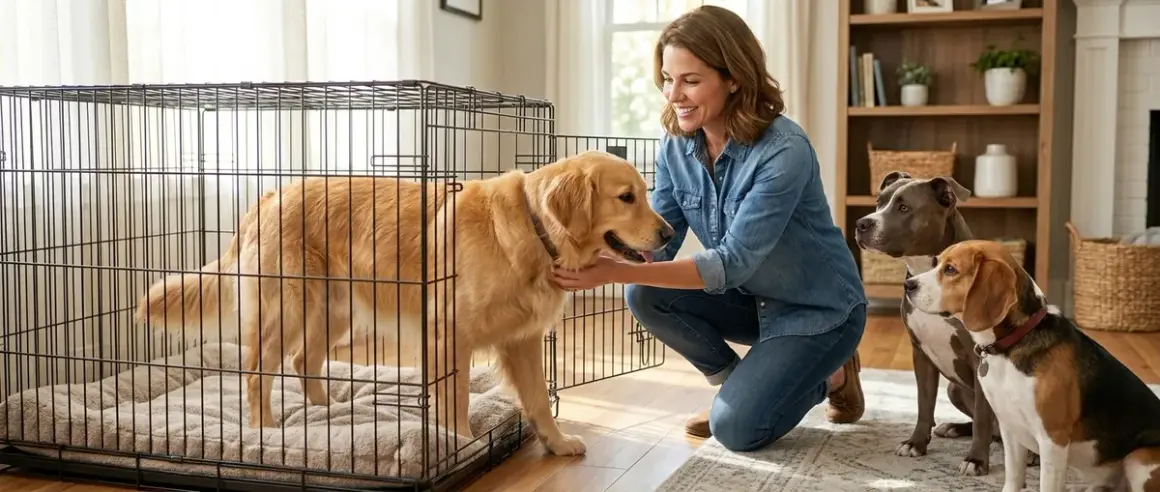

I've been grooming dogs for nearly a decade, and I can tell you that the ones who come in relaxed and confident almost always have one thing in common: they're comfortable in a crate. When Tractor Supply and the AKC present tips for crate training, they're drawing on behavioral science that I've watched play out on the grooming table hundreds of times. A dog who sees their crate as a safe space handles stress better—whether that's a trip to the groomer, a thunderstorm, or recovery from surgery.
This guide walks you through the complete crate training process for dogs of all ages, from puppies to adults to seniors. You'll learn how to choose the right crate size, introduce it without triggering anxiety, and troubleshoot the most common roadblocks. Expect to spend 1-2 weeks on basic acceptance and 4-6 weeks to build solid crate habits, though timelines vary wildly depending on your dog's history and temperament. This is a foundational skill that pays dividends across every aspect of dog ownership.
What You'll Need
Before you start applying the advice that Tractor Supply and the AKC present tips for crate training emphasize, gather these supplies:
- Wire or plastic dog crate sized appropriately for your dog's adult weight (should allow standing, turning, and lying down comfortably—no more than 4-6 inches of extra space for puppies to prevent elimination in one corner)
- Crate mat or washable bedding made from durable materials like polyester fleece or orthopedic foam (avoid stuffing-filled beds for destructive chewers)
- High-value training treats with single-source protein and minimal fillers (freeze-dried liver, chicken, or salmon work well for most dogs)
- Interactive puzzle toy or Kong made from durable rubber for mental stimulation during crate time
- Enzymatic cleaner specifically formulated for pet accidents (non-ammonia based)
- Baby gate or exercise pen (optional, for gradual room confinement before full crate training)
- White noise machine or calming music (optional, for noise-sensitive dogs)
- Patience and consistency—this isn't a quick fix, and your energy directly affects your dog's perception of the crate
Step 1: Choose The Right Crate Size And Placement
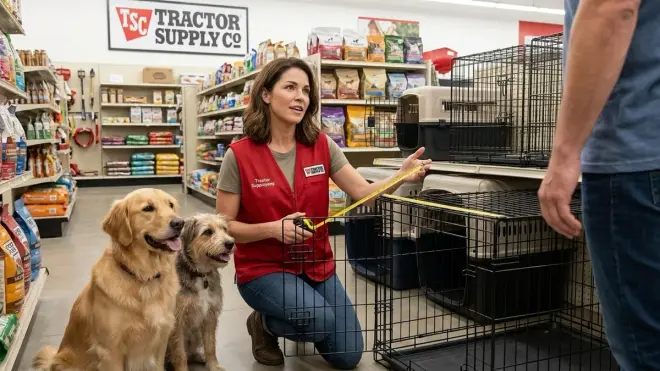
The foundation of everything Tractor Supply and the AKC present tips for crate training recommend starts with proper equipment. I've seen too many people buy a crate based on guesswork or what was on sale, then wonder why their dog refuses to settle.
Measure your dog from nose to tail base, then add 4 inches—that's your minimum crate length. Measure from floor to the top of their head while standing, add 4 inches—that's your minimum height. For puppies, you'll need to base this on their projected adult size for the breed, which you can estimate with your veterinarian or by researching breed standards from the American Kennel Club. Many wire crates come with divider panels that let you adjust the interior space as your puppy grows, preventing them from using one end as a bathroom.
I use wire crates in my own home because they offer better airflow and visibility, which helps anxious dogs feel less isolated. Plastic airline-style crates create more of a den feeling, which some dogs prefer—my senior shepherd mix absolutely will not settle in a wire crate but sleeps peacefully in her plastic one. The choice depends on your individual dog's personality.
Place the crate in a quiet area of your home where your family spends time—not a basement or isolated room. Dogs are social animals, and isolation increases anxiety. I keep one crate in my living room and another in my bedroom for nighttime. Avoid placing crates in direct sunlight or near heating vents, as temperature regulation matters more than people realize, especially for brachycephalic breeds like Bulldogs or Pugs.
Step 2: Create Positive Associations Before Closing The Door
This is where most people rush things and create problems that take weeks to undo. Your dog needs to believe the crate is the best spot in the house before you ever ask them to stay in it with the door closed.
Start by leaving the crate door open or removing it entirely. Toss a few high-value treats just inside the entrance. Don't force your dog to investigate—let curiosity do the work. When one of my rescues came home with severe kennel anxiety from her shelter experience, I spent three full days just feeding her meals near the open crate, gradually moving the bowl closer until she was eating half-inside.
Once your dog willingly steps in to grab treats, start tossing them deeper into the crate. Use a cheerful, casual tone—"Go to your spot!"—and mark the behavior with a "yes!" when they enter. I like to hide small treats in the bedding so my dogs do a little sniffing treasure hunt, which builds positive emotional associations.
Feed all meals inside the crate with the door still open. Place the bowl at the back so your dog has to fully commit to being inside. This takes advantage of a natural positive experience (eating) and links it to the space. For food-motivated dogs, this step works quickly. For anxious or aloof dogs, it may take a week or more. Don't skip ahead.
Step 3: Introduce Door Closure In Tiny Increments
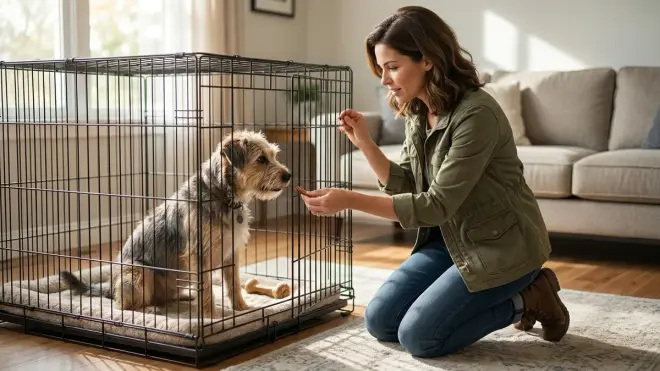
The moment you close that door, you're asking your dog to accept confinement. This is a huge psychological shift, and the techniques that Tractor Supply and the AKC present tips for crate training outline rely on making this transition so gradual your dog barely notices.
Wait until your dog is happily eating a meal or chewing a stuffed KONG Classic Dog Toy inside the crate. Gently swing the door closed—don't latch it—then immediately open it again before they finish. Repeat this during several meals until your dog doesn't react to the door movement.
Next, close and latch the door for just 5 seconds while your dog eats, then open it before they finish. You're teaching them that the door closes, but it also opens—there's no need to panic. I stay right next to the crate during these early sessions, sitting on the floor with a book or my phone, acting completely calm and disinterested. Your body language communicates safety.
Inch up the closed-door duration to 30 seconds, then one minute, then two minutes. If your dog whines, barks, or paws at the door, you've moved too fast. Don't open the door while they're vocalizing—that teaches them that noise gets them released. Instead, wait for even a 2-second pause in the protest, then open the door during that quiet moment. This is hard, especially at 2 a.m. with a whining puppy, but consistency here prevents weeks of backsliding.
Step 4: Build Duration And Distance Systematically
Once your dog accepts 5-10 minutes of closed-door crate time while you're right there, it's time to add distance and distraction. This is where the process mirrors the principles behind stopping problem behaviors like nighttime barking—you're teaching calm behavior through incremental challenges.
Close your dog in the crate with a long-lasting chew or puzzle toy. Stand up and take two steps away. Count to ten, return, open the door, and release them with a quiet "okay" (not an excited celebration that makes leaving the crate more rewarding than being in it). Repeat this several times, extending your distance until you can leave the room for 30 seconds.
I do these sessions 3-4 times a day in 10-15 minute blocks. Training happens faster with multiple short sessions than one exhausting marathon. Your dog's brain needs time to process and form new neural pathways, especially for anxiety-related learning.
Start leaving the room entirely for one minute, then two, then five. Vary the duration randomly so your dog doesn't learn to anticipate exact timing—sometimes you'll come back after 30 seconds, sometimes after six minutes. This unpredictability actually reduces anxiety because the dog stops obsessing over when you'll return.
Once your dog handles 20-30 minutes of alone time in the crate, you can start using it for real-life situations: while you shower, during meal prep, when guests arrive. Always provide a safe chew item and make sure your dog has eliminated beforehand.
Step 5: Address Age-Specific Needs And Limitations
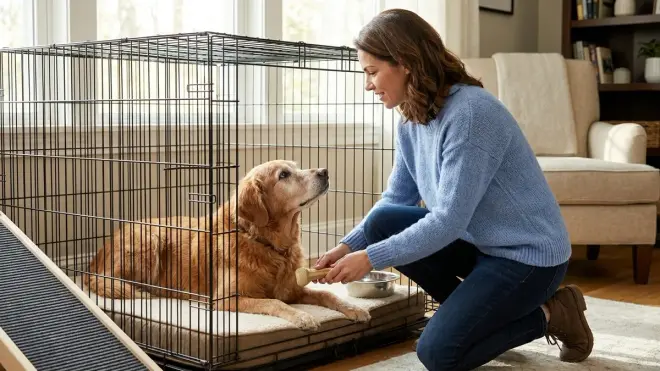
The same crate training framework applies to puppies, adults, and seniors, but the timeline and expectations shift dramatically. When Tractor Supply and the AKC present tips for crate training for different life stages, they emphasize adjusting for physical and cognitive capacity.
Puppies (8 weeks to 6 months) have underdeveloped bladder control. The general rule is they can hold it for one hour per month of age, plus one—so a 3-month-old puppy maxes out around four hours, and that's pushing it. I never crate a young puppy longer than their age allows, even overnight. If you work full-time, you need a mid-day break or a dog walker, or you'll be cleaning accidents and undoing your housetraining progress. Puppies also have higher energy needs, so a tired puppy crates better than a bouncing one—factor in play sessions before crate time.
Adult dogs (1-7 years for most breeds) can typically handle 6-8 hours in a crate if they're conditioned properly, though I think that's the absolute maximum and prefer 4-6 hours. Just because a dog can hold it doesn't mean they're comfortable or mentally stimulated. An adult dog new to crate training needs the same gradual introduction as a puppy—don't assume they'll just accept it because they're grown. Some of the worst crate anxiety I've seen has been in adult rescues who were crated punitively or for excessive durations in previous homes.
Senior dogs (7+ years, though this varies by breed size) may have mobility issues that make getting in and out of a crate difficult, plus incontinence concerns from cognitive decline or medical conditions. My 11-year-old shepherd has arthritis, so her crate has a thick orthopedic mat and I've built a small ramp to the entrance. She also gets bathroom breaks every 3-4 hours because her control isn't what it used to be. For seniors, the crate serves more as a safe sleeping space than a confinement tool, and I'm much more flexible about leaving the door open unless there's a specific medical reason (post-surgery rest, for example).
Step 6: Handle Separation Anxiety And Panic Separately
True separation anxiety is a clinical behavioral disorder, not just mild protest whining. If your dog drools excessively, self-harms trying to escape, or shows signs of panic (dilated pupils, panting, trembling) within seconds of crate confinement, standard crate training won't work—you need a veterinary behaviorist and possibly medication.
I learned this the hard way with one of my terrier mixes. I thought I was following all the right steps, but he would bloody his nose trying to push through the wire bars. Turns out he had severe confinement panic from being trapped in a drainage pipe as a stray puppy. We worked with a certified dog behavior consultant who specialized in anxiety cases, used desensitization protocols that took months (not weeks), and ultimately decided he'd never be safely crated. He now stays in a gated bedroom section when I'm gone, which he tolerates fine.
Most dogs don't have true separation anxiety—they have protest behavior or under-exercise issues. Protest whining sounds annoying but rhythmic. Panic vocalizations are frantic, escalating, and accompanied by physical stress signals. If you're unsure, video your dog during a crate session and show it to your vet.
For mild protest, the solution is simply outlasting the noise without reinforcing it. I use white noise or a fan to buffer the sound, which also helps my sanity. Some dogs settle faster with a cover over the crate to create a darker den environment—I drape a blanket over three sides of the crate for my youngest dog, who's easily visually overstimulated.
Step 7: Establish A Consistent Routine And Exit Protocol
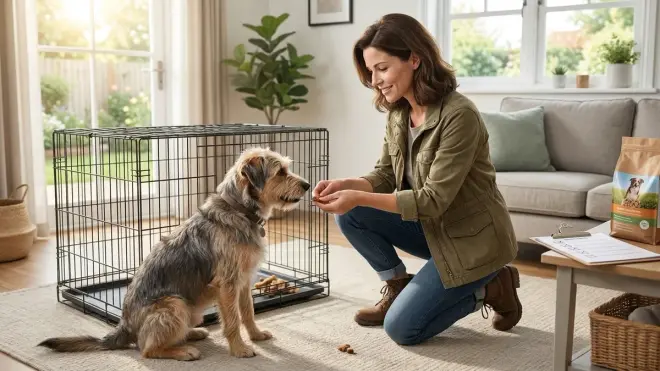
Dogs thrive on predictable patterns. The more consistent your crate routine, the faster your dog will settle into it as normal life. I crate my dogs at the same times every day: when I leave for work, during dinner prep (because four dogs underfoot while I'm holding hot pans is a disaster), and overnight.
Create a pre-crate ritual that signals it's time to settle. For my crew, it's a quick bathroom trip, then "kennel up" in an upbeat voice, then a filled Kong goes into each crate. They race to their crates because they know the good stuff happens inside. This ritual takes about three minutes and eliminates resistance.
Your exit protocol matters just as much as the entry. When you return home, don't make a big fuss or immediately release your dog. I walk in, set down my bags, take off my shoes, and only then calmly open the crate doors. If I release them the second I walk in, I'm teaching them that my arrival is the most exciting event of the day, which amps up separation stress when I leave. Boring arrivals and departures reduce the emotional charge around your comings and goings.
Never use the crate as punishment. If your dog has an accident or chews something they shouldn't, sending them to the crate with an angry tone teaches them the crate is where bad things happen. The crate should only ever be associated with rest, safety, and good things like food and chew toys.
Step 8: Transition To Household Freedom Gradually
The end goal for most people isn't lifelong crate confinement—it's a dog who can be trusted loose in the house. But that freedom needs to be earned through demonstrated reliability, not just given because your dog hit a certain age.
Start with very short periods of freedom in a single puppy-proofed room while you're home and can supervise. A gated kitchen or bedroom works well. If your dog handles 30 minutes without getting into trouble (chewing furniture, eliminating, etc.), extend it to an hour. If they mess up, go back to the crate for another week, then try again.
Once your dog is solid in one room for several hours, expand to two rooms, then the whole house over time. This process can take months, especially for high-energy breeds or teenage dogs (roughly 6-18 months, depending on breed) who are in their destructive phases. My terrier mix earned full house freedom at 14 months old. My Cattle Dog mix wasn't trustworthy until almost two years. Every dog is different.
Some dogs will always do better in a crate when left alone, and that's okay. My shepherd, even at 11, prefers her crate when I'm gone—she settles faster and sleeps deeper. I leave the door open, but she goes in voluntarily. The crate isn't a cage if your dog chooses it as their safe space.
Pro Tips & Common Mistakes
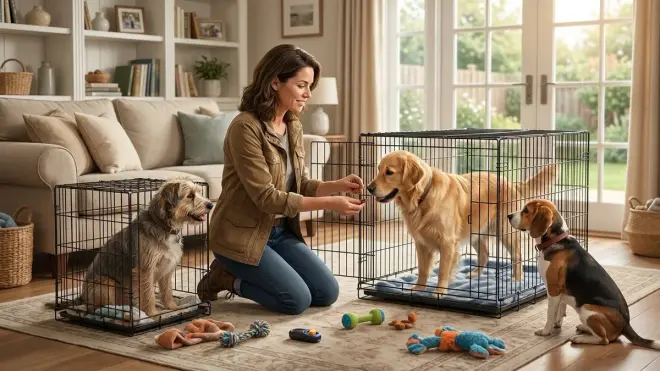
Biggest mistake: using the crate as a substitute for exercise and mental stimulation. A bored, under-exercised dog will see the crate as a prison no matter how perfectly you execute the training. Before every crate session, I make sure my dogs have had appropriate physical activity for their age and breed—a 20-minute walk for my senior, a 45-minute run for my high-energy terrier. A tired dog is a cooperative dog.
Pro tip: if you're crate training a puppy and working full-time, consider a dog walker or neighbor who can let your puppy out mid-day. The math doesn't lie—an 8-week-old puppy can't hold it for eight hours. Trying to force it creates accidents, stress, and regression in housetraining. I've groomed plenty of six-month-old dogs who still aren't housetrained because their owners expected physically impossible bladder control.
Common mistake: opening the crate door while your dog is whining, barking, or pawing. I know it's hard, especially in an apartment with thin walls, but every time you release under protest, you're teaching your dog that noise works. Wait for a pause—even two seconds of quiet—then open the door. The timing here is everything.
Pro tip: rotate the toys and chews you give during crate time. If your dog gets the same Kong every single session, it loses its appeal. I have five different food puzzle toys that I cycle through, plus different fillings—sometimes peanut butter, sometimes mashed sweet potato, sometimes frozen kibble mixed with broth. Novelty keeps crate time interesting.
Common mistake: skipping crate training entirely because "my dog will never need it." Then an emergency happens—injury, surgery, evacuation—and your dog is terrified by confinement during an already stressful event. The crate is a life skill, not optional. I've held too many panicking dogs on the grooming table who were never taught to accept restraint, and it's traumatic for everyone involved.
Frequently Asked Questions
How long does it take to fully crate train a dog?
Most dogs reach basic crate acceptance within 2-4 weeks if you're consistent with gradual training sessions, but building up to 6-8 hours of comfortable alone time typically takes 6-10 weeks for puppies and 4-8 weeks for adult dogs without prior trauma. Dogs with previous negative crate experiences, high anxiety, or separation issues may need 3-6 months of systematic desensitization work with a professional trainer. I've seen puppies master it in two weeks and rescue dogs take four months—your timeline depends entirely on your individual dog's history and temperament.
Should I put food and water in the crate?
For crate sessions under 2-3 hours, skip the water bowl—dogs don't need constant water access and a full bladder creates discomfort and accidents, especially for puppies. For longer sessions, attach a no-spill water bottle designed for crates to provide access without the mess of a bowl that gets tipped over. Never leave full food bowls in a crate—scheduled meals happen either right before crating or immediately after release. The exception is high-value stuffed toys like Kongs filled with a small amount of food, which serve as mental stimulation rather than a meal.
Can I crate train an older dog who's never been crated?
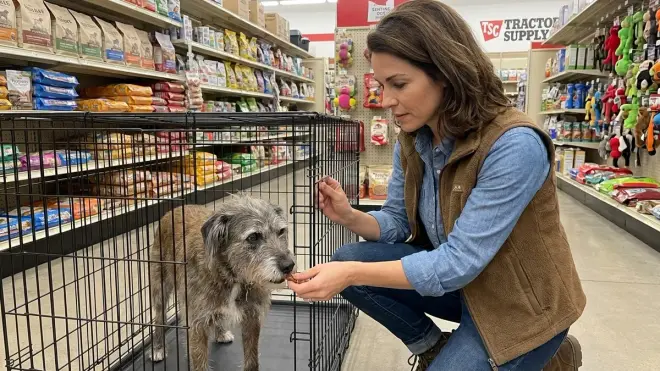
Yes, but expect the process to take longer than with a puppy because adult dogs have established routines and may have formed negative associations with confinement from shelter experiences or previous homes. I successfully crate-trained my seven-year-old rescue using the exact same gradual introduction process—starting with meals near an open crate, building positive associations over weeks, and never rushing the door closure. The key is patience and adjusting expectations; where a puppy might accept overnight crating in two weeks, an anxious adult might need two months just to relax with the door closed for ten minutes.
What's the maximum time a dog can stay in a crate?
Adult dogs (1-7 years) should never be crated longer than 6-8 hours maximum, and I personally consider anything over six hours to be pushing acceptable limits except for overnight sleep when their bodies are naturally resting. Puppies follow the one-hour-per-month-of-age rule—a four-month-old puppy maxes out around five hours, and that includes overnight. Senior dogs often need bathroom breaks every 3-4 hours due to weakening bladder control and age-related health issues. If your schedule regularly requires longer confinement, you need a dog walker, pet sitter, or alternative arrangement like a gated room with puppy pads—chronic over-crating leads to physical discomfort, behavioral problems, and deteriorating trust.
Summary
The principles that Tractor Supply and the AKC present tips for crate training build from work because they respect canine learning theory and natural den instincts. You're not forcing your dog into a cage—you're creating a safe space that serves you both. I've watched this transform anxious shelter dogs into confident family members, and I use these exact techniques in my own home with four very different dogs.
Start with proper sizing and placement, build positive associations before closing any doors, increase duration and distance in tiny increments, and adjust for your dog's age and individual needs. The timeline varies wildly—two weeks for some dogs, three months for others—but the framework stays the same. Your consistency determines success more than your dog's breed or background.
The grooming table taught me that handling and restraint are learned skills, not natural acceptances. Every dog who walks into my shop calm in their carrier or relaxed during a bath got there through patient training that looked a lot like this. Your dog won't love the crate on day one, but with the right approach, they'll choose it on day ninety.