


Verdict: Separate feeding stations win for most multi-species households, especially when you're dealing with size differences, food aggression potential, or species-specific dietary needs between dogs and cats.
I've lived with four dogs for years, and even within a single species, feeding time can turn chaotic without clear boundaries. When you add cats to the mix—with their grazing habits, slower eating pace, and completely different nutritional requirements—feeding multiple pets separately becomes less about preference and more about safety and health.

This comparison breaks down the practical realities of both approaches: the space requirements, behavioral considerations, cost differences, and daily workflow of managing meals in a multi-pet home where dogs and cats share the same roof. I'm pulling from my grooming clients' experiences (I hear everything at the shop), veterinary feeding guidelines, and the trial-and-error of my own household to give you a realistic picture of what actually works.
Quick Comparison
| Criterion | Separate Feeding Stations | Shared Bowl Area |
|---|---|---|
| Species-specific nutrition | Each pet gets appropriate food (crucial for cats vs dogs) | High risk of dietary cross-contamination |
| Food aggression management | Eliminates most resource guarding triggers | Can escalate tension, especially dog-to-cat |
| Space requirements | Needs multiple locations (rooms, counters, crate areas) | Minimal footprint, single feeding zone |
| Setup cost | Higher initial investment in bowls, mats, barriers | Lower—one set of bowls may suffice |
| Daily time investment | 5-10 minutes per meal for setup/supervision | 2-3 minutes, but requires constant monitoring |
| Long-term health outcomes | Better portion control, reduced obesity risk | Difficult to track individual intake |
Species-Specific Nutritional Control
Here's the thing that surprised me most when I first started working with clients who had both cats and dogs: cats eating dog food isn't just suboptimal—it's legitimately dangerous over time. Cats are obligate carnivores requiring taurine, arachidonic acid, and higher protein levels that dog food simply doesn't provide. Meanwhile, dogs scarfing down calorie-dense cat food pack on weight fast.
With separate feeding stations, you control exactly what goes into each animal. My client Maria sets up her cat's bowls on a kitchen counter (cats jump, most dogs don't), while her Labrador eats in a gated corner of the mudroom. The physical separation means her cat gets the high-protein formula he needs without the dog hoovering it down in thirty seconds.
The workflow looks like this: prep both meals simultaneously, place the cat's food in the elevated or isolated location first, then serve the dog in his designated spot. Most cats take 15-30 minutes to finish a meal through grazing, while dogs typically demolish their portions in under five minutes. That timing mismatch is exactly why shared bowls fail—the dog finishes and immediately targets the cat's food.
I use the Neater Feeder Express Elevated Dog and Cat Bowls🛒 Amazon for my senior shepherd because the height helps her neck positioning, but I'd never put a cat bowl next to it. The spatial separation isn't negotiable in my house. One design quirk: the tray catches spills nicely but slides on tile, so I use a rubber mat underneath.
For complete details on matching food types to your specific pets, the fundamentals of how to choose dog food and appropriate feline nutrition apply differently depending on age and health status.
Behavioral Safety and Food Aggression Prevention
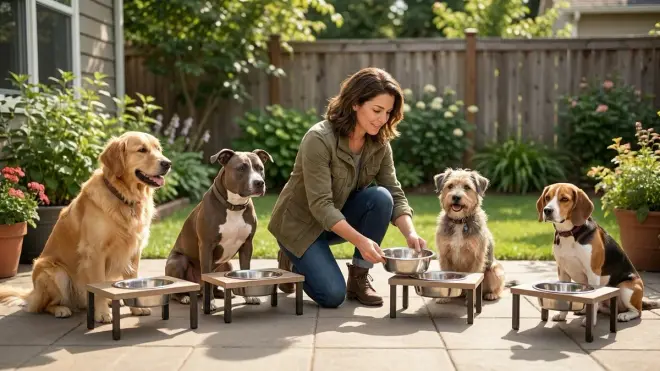
I've seen resource guarding escalate from a low growl to a veterinary emergency faster than most people realize. Dogs, even friendly ones, can view a cat approaching their food as a challenge. Cats, smaller and more vulnerable, often eat in a state of stress when dogs are nearby—which affects digestion and creates negative associations with mealtime.
Separate stations eliminate the trigger entirely. There's no competition, no posturing, no need for the cat to bolt mid-meal because the dog wandered over. In my grooming work, I handle anxious dogs all the time, and I see the same stress signals around food: stiff body language, eating too fast, guarding the bowl even when it's empty. That anxiety doesn't magically disappear just because you want your pets to share nicely.
The spatial setup matters as much as the concept. Effective separation means:
- Physical barriers (closed doors, baby gates, crate feeding for dogs)
- Vertical separation (cat feeding on counters, cat trees, or wall-mounted shelves)
- Timing separation (feeding pets in shifts if space is limited)
My terrier mix has zero food aggression toward my other dogs, but he's obsessed with cat food. If a client's cat were in the equation, I'd feed him in his crate with the door closed for twenty minutes, then release him only after the cat finished and I'd removed the bowls. That's not punitive—it's management that prevents the behavioral spiral that leads to the issues covered in why pets fight over food and resources.
Shared bowl arrangements require constant supervision, which sounds manageable until you're juggling it twice a day, every day, for years. I'm realistic about my own attention span—I'll forget to watch closely, I'll get distracted by my phone, and that's when problems happen.
Space and Setup Requirements
Separate feeding stations demand more real estate, and in small apartments or homes with open floor plans, that's a genuine constraint. You need:
- Dedicated feeding spots for each pet (or each species if you have multiples)
- Storage for separate food containers (dogs and cats need airtight, pest-proof options)
- Traffic flow that doesn't force pets to cross paths during meals
I converted a corner of my laundry room into a cat feeding station for a client whose golden retriever couldn't resist counter-surfing. We installed a wall-mounted shelf at five feet—high enough the dog couldn't reach, sturdy enough for a confident cat to land on. Cost was maybe thirty dollars in materials, but it solved a daily battle.
If you're already using automatic feeders for multiple pets, you've got a head start on the infrastructure. Microchip-activated feeders create instant separation even in shared spaces, though they work best for cats (many large dogs just bulldoze through the barriers).
Shared bowl setups need almost no space—one corner, one mat, done. But you trade that convenience for the supervision burden and the risk of one pet monopolizing all the food. I've seen it play out too many times: the dog eats his portion, the cat's portion, and then the cat goes hungry or learns to sneak-eat at 3 a.m. when the dog's asleep.
Daily Management and Time Investment
Let me be honest about the time reality. Separate feeding stations add 5-10 minutes to each meal when you account for:
- Preparing species-appropriate portions
- Placing food in multiple locations
- Supervising until the fast eater (usually the dog) finishes
- Removing bowls and cleaning up
In my four-dog household, I already stagger meals slightly because my senior girl eats slower and needs space. Adding a cat would mean another station, another timing consideration, another cleanup zone.
But here's what I've learned: that upfront time investment pays back in reduced behavioral issues and better health monitoring. When each pet has a designated spot, you immediately notice if someone's appetite drops, if they're eating too fast, or if they're leaving food behind—all early warning signs of health problems. At the grooming shop, I can't count how many clients discovered their dog's dental pain or their cat's kidney issues because separate feeding made appetite changes obvious.
Shared bowl feeding takes less active time upfront (2-3 minutes to set out food), but you're trading that for passive monitoring time and the mental load of constant vigilance. You're watching for bullying, food stealing, stress signals, and making sure the timid cat actually gets to eat. That's exhausting in a different way.
The broader strategies for managing multiple animals under one roof, including feeding logistics, fall under multi-pet household management, which covers everything from introduction protocols to long-term cohabitation success.
Cost Comparison
Separate feeding requires more equipment upfront:
- Multiple bowl sets: Stainless steel or ceramic (avoid plastic—it harbors bacteria and some pets develop contact dermatitis). Figure $15-40 per set depending on size and quality.
- Elevated feeders or specialty stations: $20-80 for basic models; microchip feeders run $100-180.
- Feeding mats: Silicone mats that contain spills and protect floors, around $10-25 each.
- Storage containers: Airtight bins for dry food, $15-30 per container.
My total investment for four dogs ran about $200 once I factored in durable bowls, mats, and the elevated feeder for my senior. Adding cat feeding infrastructure would tack on another $50-100 depending on whether I went with simple counter bowls or a microchip feeder.
Shared bowl setups minimize equipment costs—you might get away with $30-50 for a couple of decent bowls and a single mat. But the hidden costs show up in wasted food (dogs eating cat food that doesn't meet their needs, cats not eating enough because they're stressed), potential veterinary bills from nutritional imbalances or injuries from food fights, and the replacement cost if resource guarding damages your setup.
I'd rather pay more upfront for a system that prevents problems than save fifty dollars now and deal with a $300 emergency vet visit later because my dog bit the cat over a food dispute.
Who Should Choose Separate Feeding Stations
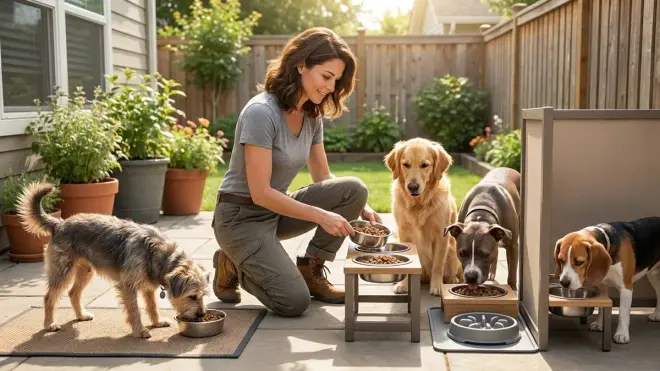
You need separate stations if:
You have both dogs and cats—the nutritional requirements alone make this non-negotiable for responsible feeding. Cats grazing on dog food long-term develop taurine deficiency, which causes heart disease and vision problems. Dogs eating cat food regularly become overweight and may develop pancreatitis from the higher fat content.
You've observed any resource guarding behavior, even mild. A hard stare, a stiff posture, a growl when another pet approaches the bowl—these don't improve on their own. Separate feeding removes the rehearsal opportunity for those behaviors to escalate.
You want accurate portion control and health monitoring. If you're managing weight, tracking food intake for medical reasons, or feeding prescription diets, you need to know exactly who ate what.
You have the space and can commit to the routine. I won't sugarcoat it: separate feeding is more work. But if you've got the square footage and can build it into your daily rhythm, it's the gold standard.
Who Should Choose Shared Bowl Areas
Shared bowls might work if:
You have multiple pets of the same species who are perfectly matched in size, eating speed, and food type—like two adult cats with identical dietary needs who've lived together since kittenhood and show zero food-related tension. Even then, I'd watch closely.
You're in an extremely space-constrained situation (think studio apartment) and your pets are small, calm, and have proven over months that they respect each other's food. This is rare. Most shared-bowl success stories I hear are either temporary (people eventually switch to separate stations after a conflict) or involve significant supervision that owners don't always acknowledge.
You're feeding raw or wet food that must be consumed immediately and can supervise the entire meal. Some raw feeders prefer communal feeding because it mimics pack eating dynamics, but this only works with dogs who've established a stable hierarchy and show no guarding. Never attempt this with cats present.
Honestly, I don't recommend shared bowls for dog-cat households under any circumstances. The risks outweigh the minor convenience gains.
Frequently Asked Questions
Can I feed my dog and cat in the same room if I use separate bowls?
Yes, same-room feeding works if you establish clear spatial separation—at least six to eight feet between feeding stations for most dog-cat pairs, with the cat's bowl elevated or in a corner where the dog can't approach. Watch for stress signals in the cat (eating rapidly, interrupted eating, looking over their shoulder) and food-focused behavior in the dog. If you see either, increase distance or move to separate rooms entirely. My senior shepherd and a hypothetical cat could share my kitchen because she's low-energy and disinterested in cat food, but my terrier would need a closed door between them.
How do I transition from shared bowls to separate feeding stations without stressing my pets?

Start by introducing the new feeding locations with high-value treats first, building positive associations before moving actual meals. For dogs, practice "place" or "stay" commands at the new station with rewards. For cats, make the elevated or isolated spot appealing with treats and catnip before expecting them to eat there. Transition gradually over 5-7 days: first meal at the old location, second at the new spot, until both pets accept the change. Maintain consistent meal times throughout—the routine provides security even as the location shifts. My dogs adapted to location changes within three days because the timing and ritual stayed identical.
What's the safest way to feed a large dog and a small cat in a multi-pet home?
Vertical separation is your best friend. Feed the cat on a counter, cat tree platform, or wall-mounted shelf that the dog physically cannot reach—minimum height of four feet for most large breeds. Install a baby gate with a cat door to create a dog-free feeding room if you have the space. Microchip-activated feeders like the SureFeed Microchip Pet Feeder🛒 Amazon work well for cats because they keep dog noses out, though determined large dogs sometimes paw them open (that's the main design weakness—the lid mechanism isn't built for canine persistence). Never rely on the dog's "good behavior" alone; management through physical barriers prevents the kind of incidents that require immediate attention from the protocols outlined in multi-pet home safety.
Bottom Line
Feeding multiple pets separately isn't the easiest option, but it's the right one for the vast majority of dog-cat households. The time investment is real, the space requirements aren't trivial, and you'll spend more on equipment upfront. But you'll sleep better knowing your cat isn't developing nutritional deficiencies from eating dog food, your dog isn't guarding resources and creating a tense environment, and you can actually track who's eating what.
I've built my entire multi-dog household around separate feeding stations because I've seen too many preventable problems stem from shared bowls—both in my grooming clients' homes and in conversations with veterinary professionals. The extra five minutes twice a day buys you peace of mind, better health outcomes, and a household where mealtime doesn't trigger anxiety or conflict. That's worth every minute and every dollar.