


I've been grooming dogs for nearly a decade, and I'll tell you what: the chaos level difference between a single-pet home and a multi pet household isn't just doubled—it's exponential. At my own place, managing four rescue dogs taught me that everything you thought you knew about pet care gets rewritten when you add a second, third, or fourth animal to the mix. The feeding routines that worked perfectly for one dog collapse when another resource-guarder enters the picture. The peaceful evening walks turn into a logistical puzzle. But here's the thing—multi-pet homes aren't just more work. They're entirely different ecosystems that require specific strategies, not just "more of the same."
If you're living with multiple dogs, cats, or a combination of species, this guide will walk you through the practical realities of making it work. Not the idealized Instagram version—the real, fur-covered, occasionally frustrated version that most of us actually live.

What Is a Multi-Pet Household?
A multi pet household is any home environment where two or more pets live together, whether they're the same species or different ones. The American Veterinary Medical Association tracks these numbers closely, and the data shows that most pet-owning homes actually fall into this category. Dog households average 1.7 dogs, while cat households typically have 2.3 cats. Cross-species homes—dogs with cats, small animals with either, or more complex combinations—add another layer of behavioral and care considerations.
The definition matters because a multi-pet household operates under different rules than a single-pet home. You're not just caring for individual animals anymore; you're managing a social structure with hierarchies, territorial boundaries, resource competition, and interspecies communication challenges. In my grooming salon, I can usually tell within the first five minutes whether a dog comes from a single-pet or multi-pet home. The way they react to other dogs in the waiting area, their resource guarding tendencies around treats, even their coat condition (sometimes the submissive dog in a household gets less human attention and grooming time)—it all tells a story.
The household might include dogs of different ages, sizes, and energy levels. It might be cats who've established territories across different vertical spaces. It could be a dog-cat combination where predator-prey instincts need careful management, or small animals like rabbits, guinea pigs, or birds who require complete physical separation from larger pets. Each configuration brings unique management requirements.
How Multi-Pet Household Dynamics Work
The mechanics of a functioning multi-pet household rest on three interconnected systems: social hierarchy, resource management, and spatial organization. I learned this the hard way when I brought my third rescue home—a terrier mix with zero concept of personal space—and watched my carefully balanced two-dog household descend into three weeks of chaos.
Social Structure and Pack Dynamics

Dogs establish hierarchies, though they're more fluid than the old "alpha dog" theories suggested. Modern behavioral science recognizes that dogs form cooperative social groups where roles shift based on context. The dog who controls the favorite sleeping spot might defer to another dog at feeding time. Cats, despite their reputation as solitary hunters, also form complex social structures in multi-cat homes, often organizing themselves into bonded pairs or coalitions.
What matters from a management perspective is recognizing that your pets will work out a social order, and your job isn't to dictate it—it's to prevent conflict during the negotiation process. That means understanding the subtle body language: the hard stare that precedes a food-bowl confrontation, the stiff posture when a new dog approaches a favorite toy, the ear position that signals a cat's tolerance is wearing thin. Understanding why pets fight over food and resources helps you read these early warning signs before small tensions escalate into genuine aggression.
Cross-species households add translation challenges. Dogs use play bows and direct eye contact; cats interpret direct eye contact as a threat and communicate readiness to interact through slow blinks and sideways approaches. A dog's enthusiastic greeting can terrify a cat who reads it as predatory pursuit. The practical approach to introducing cat to dog relationships requires systematic desensitization that respects these different communication styles.
Resource Distribution Systems
Every conflict I've seen between household pets—and I mean every single one—traces back to resources. Food, water, sleeping spots, human attention, toys, access to doors or windows, even sunny patches on the floor. Animals perceive these as finite goods worth defending.
The solution isn't to provide identical resources (that often makes competition worse, because now there's no clear ownership). Instead, you need sufficient quantity with intentional differentiation. My four dogs each have distinct feeding locations, different sleeping areas they've claimed as "theirs," and toys that match their play styles so they're not constantly stealing from each other.
Feeding stations deserve particular attention in multi-pet households. The decision between separate feeding stations versus shared bowls fundamentally shapes daily peace or conflict. I'm firmly in the separate-stations camp, especially for dogs with any hint of food motivation. I've seen too many dogs gulp their food dangerously fast because they're anxious about a housemate approaching, or refuse to eat entirely because they feel vulnerable at a shared location.
For households mixing dogs and cats, vertical space becomes the most valuable resource. Cats need high perches where dogs can't reach them—not just for escape, but for comfortable observation and rest. I installed wall-mounted shelves in my home that my dogs ignore but give cats a completely separate spatial layer. The multi-pet home safety framework covers these environmental modifications in detail.
Temporal Management and Routine Architecture
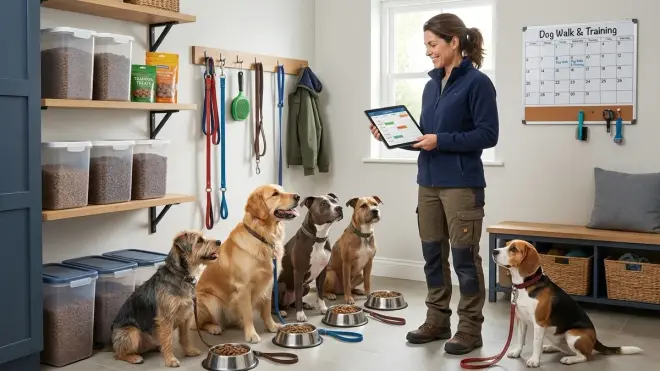
Here's something most multi-pet advice skips: when you do things matters as much as how you do them. In a single-pet household, you can be spontaneous. In a multi-pet household, inconsistent timing creates anxiety and competition.
I feed my four dogs in the same order, in the same locations, at the same times every day. Not because I'm rigid, but because predictable routines reduce pre-feeding arousal and competition. The high-energy terrier gets walked first in the morning because exercising her before breakfast reduces her anxiety around food. The senior shepherd eats last because she's slow and methodical, and she'd panic if she had to rush.
The same principle applies to grooming, playtime, and training sessions. I rotate one-on-one time with each dog on a schedule they've learned to anticipate. The dog who's not getting attention at the moment knows their turn is coming, which drastically reduces pushy demand behaviors.
For households with multiple dogs of different ages, this temporal structure needs to account for life-stage requirements. Puppies need more frequent meals, senior dogs might need middle-of-the-night bathroom breaks, adults typically handle longer intervals between activities. Juggling these overlapping schedules is genuinely one of the hardest parts of multi-pet household management—harder than any single care task.
Why Multi-Pet Household Management Matters
The practical significance hits your daily life in three measurable ways: time efficiency, financial sustainability, and animal welfare outcomes. Get the systems right, and a multi-pet household runs smoothly enough that the benefits—companionship for your pets, entertainment and emotional support for you—outweigh the logistics. Get them wrong, and you're trapped in an exhausting cycle of behavioral interventions, veterinary crises, and constant stress.
Health and Safety Implications
Poor multi-pet management creates genuine health risks. Food competition leads to bloat in dogs who eat too fast, or malnutrition in submissive animals who don't eat enough. Chronic stress from territorial conflicts suppresses immune function and exacerbates conditions like feline idiopathic cystitis in cats or inflammatory bowel disease in dogs. Fights cause injuries—I've treated grooming clients with torn ears, puncture wounds, and worse from household disputes that escalated.
The preventive angle matters too. Managing multiple pet veterinary care requires organization that most single-pet owners never develop. You need systems for tracking which animals are due for which vaccines, who needs annual dental cleanings, whose prescription runs out when. I use a color-coded calendar and individual health binders for each dog because I learned the hard way that "I'll remember" doesn't work when you're juggling four different medication schedules.
Automated systems help—quality automatic feeders for multiple pets with microchip recognition or portion control features can solve feeding conflicts while ensuring each animal gets their specific diet. This becomes critical when one pet needs prescription food for kidney disease while another needs high-protein food for muscle maintenance.
Behavioral Health and Quality of Life

Animals in chaotic, poorly managed multi-pet homes develop anxiety disorders, compulsive behaviors, and aggression issues that they wouldn't display in better-structured environments. I can think of half a dozen dogs I've groomed over the years whose "difficult" temperaments improved dramatically when their owners implemented better household management—or worsened when a new pet was added without proper integration.
The flip side is that well-managed multi-pet households provide species-appropriate socialization that single-pet homes can't match. Dogs are social animals; having a stable canine companion often reduces separation anxiety and provides play opportunities that humans can't replicate. Cats benefit from compatible feline companionship despite their independent reputation. Even the observation and occasional low-key interaction between species (a dog and cat who peacefully coexist without being best friends) provides environmental enrichment.
Your own quality of life depends on this too. A multi-pet household in constant conflict is exhausting. You're breaking up fights, managing feeding aggression, dealing with stress-related health issues, and never quite relaxing in your own home. A well-managed one, though? That's watching your senior dog gently mentor a younger rescue, or seeing your anxious cat gain confidence through interaction with a calm dog. Those moments are why most of us have multiple pets in the first place.
Types of Multi-Pet Household Configurations
Same-Species Households
Multi-dog households are the most common configuration, and they range from remarkably easy to incredibly complex depending on breed characteristics, age distributions, and sex combinations. I've lived the reality of four dogs for years now, and the practical difference between managing two dogs versus four isn't linear—it's more like a complexity curve that steepens after the third animal.
Size variation within the household creates specific concerns. My senior shepherd weighs 75 pounds; my terrier mix is 18 pounds. They need different door heights for safe access, different crate sizes for rest spaces, dramatically different portion sizes, and careful supervision during play since the shepherd could accidentally injure the terrier despite having zero aggressive intent. Breed-specific traits matter too—herding dogs might try to manage other household dogs, terriers often have higher prey drive that affects their behavior around smaller pets, brachycephalic breeds overheat faster during group play sessions.
Multi-cat households function very differently from dog groups. Cats are more territorial and less hierarchical. They typically organize space vertically and temporally rather than through direct social hierarchy. A peaceful six-cat household usually means those cats have worked out time-sharing systems for prime locations and established clear territorial boundaries that humans might not even notice. Litter box mathematics becomes critical—the standard recommendation is one box per cat plus one extra, placed in different locations to prevent territorial blocking.
Cross-Species Households
Dog-cat combinations are the most common cross-species setup, and success depends heavily on individual temperaments and proper introduction protocols. High-prey-drive breeds (many terriers, sighthounds, some herding breeds) require more careful management and might never be fully trustworthy around cats. Conversely, I've seen gentle giant breeds like Newfoundlands and Saint Bernards who treat cats with remarkable care.
The key is providing escape routes and safe zones that cats can access but dogs can't. Baby gates with cat doors, wall-mounted perches, closed rooms designated as cat-only spaces—these aren't optional in dog-cat homes, they're foundational infrastructure.
Small animal integration (rabbits, guinea pigs, birds, hamsters, reptiles) requires complete physical separation from both dogs and cats in most cases. Even a gentle, well-meaning dog can injure a rabbit through overly enthusiastic interaction. Cats have strong predatory responses to bird movements and small rodent behaviors. These animals can coexist in the same household, but typically not in the same spaces without barriers.
I've had clients with incredibly complex households—dogs, cats, and aquariums or terrariums housing reptiles or fish. The complete aquarium setup guide becomes relevant here because aquarium management in a multi-pet home requires securing lids against curious paws and positioning tanks where they won't be knocked over during play sessions.
Age-Distributed Households

Managing puppies or kittens with adult or senior pets might be the single most challenging multi-pet configuration. Juvenile animals have energy levels and play styles that can genuinely harass older animals. My senior shepherd has arthritis and limited patience for my terrier's boundless enthusiasm. I manage this through strategic separation—the terrier gets exercise and playtime that exhausts her before the shepherd's active hours, and the shepherd has a quiet room she can retreat to when she needs peace.
The feeding considerations get complex too. Puppies need multiple meals daily with higher protein content than many adult dog foods provide. Senior dogs often need specialized diets for kidney support, joint health, or weight management. You can't just put down one bowl and call it done. Understanding how to choose dog food for different life stages helps, but implementation requires those separate feeding stations I keep emphasizing.
The training timeline adds another layer. Puppies need intensive socialization and basic obedience work. Adult dogs might need behavior modification for established issues. Senior dogs benefit from cognitive enrichment but can't handle the physical demands of advanced training. You're running three different training programs simultaneously, and they can't all happen in the same space at the same time without chaos.
Multi-Pet Care Systems That Actually Work
Feeding Protocols for Multiple Animals
I'll be direct: feeding time is the highest-risk period in most multi-pet households. Resource competition triggers aggressive responses even in otherwise gentle animals. My system is non-negotiable in its structure but flexible in its details based on your specific household.
Spatial separation during feeding is baseline requirement number one. Each animal needs a designated feeding location far enough from others that they can't see each other eat. For my four dogs, that means one in the kitchen, one in the laundry room, one in a bedroom, and one in a bathroom with the door closed. Yes, it's a production. Yes, it's worth it to prevent the food gulping and anxiety that shared feeding spaces create.
Feeding order and timing should follow a consistent pattern your pets can predict. I feed in order of who's most food-motivated to least, because the highly motivated dogs settle faster once they've eaten and aren't as anxious watching others eat. For dog-cat households, feeding cats in elevated locations or separate rooms prevents dogs from stealing cat food (which is too rich for canine digestive systems and creates nutritional imbalances).
Diet differentiation is standard in multi-pet homes because animals of different ages, sizes, and health statuses need different nutrition. Puppy food supports growth with higher protein and fat. Senior formulas support joint health and kidney function with modified protein levels and added supplements. Some pets need prescription diets for allergies, digestive issues, or medical conditions. The comparison between dry dog food and wet dog food affects this too—older dogs with dental issues might need wet food while younger dogs handle kibble fine.
This is where microchip-activated automatic feeders earn their cost. They read your pet's implanted microchip or RFID collar tag and only open for that specific animal, allowing free-feeding schedules for cats or portion-controlled meals for dogs without cross-contamination. For households where you can't physically supervise every meal, this technology solves problems that manual management can't.
Post-feeding protocols matter too. Don't immediately let all animals back into shared spaces while some are still eating. The dog who finishes first will make a beeline for the slower eater's bowl, guaranteed. I wait until all four dogs have finished, then pick up any remaining food before opening doors and gates.
Training in Multi-Pet Environments

Training multiple pets simultaneously is inefficient and frustrating for everyone involved. Training them individually during dedicated sessions, then generalizing those behaviors to group contexts, actually works.
Individual training sessions should happen in spaces away from other pets to minimize distraction and competition. I rotate my dogs through training time—one dog gets focused attention for 10-15 minutes while the others are in separate areas with enrichment toys or resting. The dog in training gets my complete attention, higher-value treats, and a chance to learn without competing for my focus.
Crate training becomes more valuable in multi-pet households than single-pet ones because crates provide safe, individualized spaces for training, feeding, rest, and separation when needed. Each of my dogs has their own crate with the door removed (they're fully crate-trained so I don't need containment, just defined personal space). They retreat to their crates voluntarily when they want solitude, and I use crates with doors closed during individual training sessions to keep other dogs out of the picture.
Group behavior training comes after individual skills are solid. Teaching all dogs to sit simultaneously before going through a door, or to settle on individual beds during dinner, requires that each dog already knows the individual behavior. I build this by first rewarding one dog for the behavior while others observe, then gradually raising criteria until all dogs perform together. This takes weeks or months depending on your starting point, and backsliding is normal when you add a new pet to the household.
The same principle applies to leash walking. I train each dog individually to walk on a loose leash, then gradually work up to walking two together, then three, and finally all four. Even now, I sometimes split them into smaller groups because walking four dogs of different sizes and energy levels together requires more management than I want on a casual morning walk.
Grooming and Health Maintenance Logistics
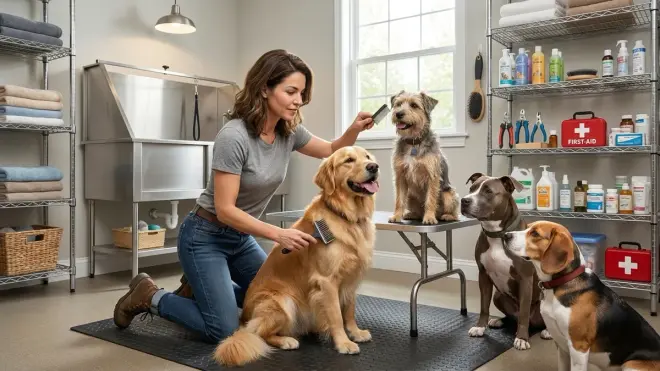
As a professional groomer, I can tell you that grooming gets complicated fast in multi-pet households because each animal has different coat types, grooming frequencies, and handling requirements. My terrier needs professional grooming every 6-8 weeks for coat stripping. My shepherd needs weekly brushing at minimum to manage shedding. The other two fall somewhere in between.
I maintain a grooming rotation schedule posted where I can see it, because "I'll do it when they need it" doesn't work when you're tracking four different grooming timelines. One dog gets a full brush-out on Monday, another on Wednesday, and so on. Nail trims happen on a different rotation based on individual growth rates and activity levels (dogs who walk on pavement daily wear nails down faster than those who mostly walk on grass).
Health maintenance tracking requires actual systems, not just good intentions. I use individual binders with vaccination records, medication lists, weight tracking, and vet visit notes for each dog. When one dog shows symptoms of illness, I can quickly cross-reference whether others are current on preventive medications or might need monitoring for contagion.
Parasite prevention in multi-pet households is all-or-nothing. You can't treat three dogs for fleas and skip the fourth because "he doesn't go outside much"—they're all sharing the same environment. Same with intestinal parasites, heartworm prevention, and tick protection. Consistent, household-wide prevention is simpler and cheaper than treating outbreaks.
Space Planning and Environmental Design
Physical environment design prevents more conflicts than any amount of training or behavioral intervention. Your house layout either supports multi-pet harmony or constantly undermines it.
Multiple resource stations distributed throughout the home reduce competition. That means water bowls in several rooms (not just one bowl everyone shares), multiple sleeping areas with different characteristics (cool tile floor, warm bed, elevated perch, enclosed crate), and enough litter boxes in cat households that no one has to wait or cross through another cat's territory to access one.
Vertical space for cats in dog-cat households is non-negotiable. Cat trees, wall-mounted shelves, tops of furniture—cats need a three-dimensional environment that dogs can't access. This gives cats escape routes when they're overwhelmed and observation posts where they can monitor household activity from safety.
Barrier management using baby gates or closed doors lets you control which animals interact when. I have gates that section my house into zones, allowing me to separate dogs when I'm introducing a new one, feeding, giving one dog a rest break from group play, or managing any situation where not all dogs should be together. These gates stay up permanently because I use them daily, not just during crises.
Individual retreat spaces that each pet can claim as exclusively theirs reduce territorial stress. My senior shepherd's crate is in the quietest room; no other dog goes in there. My terrier has claimed a specific corner of the couch. These aren't formal assignments I made—they're preferences the dogs established that I reinforce by keeping other dogs out of those specific spots.
Frequently Asked Questions
How many pets is too many for one household?

The right number depends on your time, space, financial resources, and experience level, not an arbitrary count. I manage four dogs successfully because I work from home, have a fenced yard, budget for their care, and have professional pet-handling experience. Someone working 60-hour weeks in a small apartment might struggle with two. The practical test is whether you can provide each animal with adequate veterinary care, daily exercise and enrichment, individual attention, proper nutrition, and a stress-free environment—when any of those consistently fails, you've exceeded your household capacity regardless of the specific number.
What's the best way to introduce a new pet to existing household animals?
The best approach is slow, structured, and species-specific, using gradual desensitization rather than immediate full contact. For dogs, that typically means initial introductions in neutral territory (not your home), short supervised interactions that end before anyone gets overstimulated, and gradual increase in time together over days or weeks. For cats, it means scent swapping before visual contact, feeding on opposite sides of a closed door, then visual contact through barriers before any direct interaction. For dog-cat introductions, the dog should be calm and trained in basic obedience before you even begin, and the cat needs vertical escape routes throughout the home. Rushing this process creates problems that take months to fix, while patient introduction builds positive associations from the start.
Should I get two pets at the same time or add them separately?
Adding pets separately is almost always easier for both humans and animals, with one major exception: very young puppies or kittens from the same litter often bond deeply and adjust well when adopted together. For adult or adolescent animals, sequential addition gives you time to train and bond with the first pet, establish household routines, and then integrate the second pet into an existing stable structure. Simultaneous addition of two untrained animals means you're managing two adjustment periods, two training programs, and the relationship between the animals all at once, which is genuinely overwhelming for most people. That said, some rescue organizations prefer adopting bonded pairs together because separating them causes significant stress—if you're adopting animals who are already bonded to each other, keeping them together makes sense despite the added complexity.
How do I stop my pets from fighting over food and toys?
You prevent resource competition through environmental management, not corrections after conflicts start. Every pet needs their own feeding location that's spatially separated from others, ideally far enough apart that they can't see each other eating. Meals should happen simultaneously so no one finishes first and approaches another pet's bowl. For toys, provide enough variety that pets can self-select different items rather than competing for one prized object, and pick up highly valued items between play sessions if they trigger guarding behaviors. If fights are already happening, you'll need systematic desensitization—feeding pets progressively closer together over weeks while rewarding calm behavior, or trading behaviors where pets learn to voluntarily release toys in exchange for treats. Punishing the aggression itself usually makes it worse because the pet associates the other animal with negative experiences, intensifying the competition.
Do multi-pet households need different veterinary care approaches?

Yes, multi-pet households benefit from consolidated care strategies that single-pet owners don't need. Find a veterinarian who can see multiple pets in one appointment block when appropriate (like for annual wellness checks), which saves you multiple trips. Establish clear record-keeping systems at home because you're tracking several medication schedules, vaccine due dates, and health histories that can blur together. Budget for the reality that veterinary costs scale linearly—two pets cost roughly twice as much as one, three cost three times as much. Consider pet insurance for multi-pet households because a single emergency can cost thousands, and having multiple pets increases the statistical likelihood you'll face expensive health crises. Ask your vet about household protocols for contagious conditions—if one pet contracts kennel cough or intestinal parasites, what's the prevention or treatment approach for housemates?
Creating a Multi-Pet Household That Works
The difference between a chaotic multi-pet household and a peaceful one comes down to systems, not sacrifice. You don't need to spend every waking hour managing your pets, but you do need thoughtful infrastructure: separate feeding stations that respect each animal's need for security, predictable routines that reduce anxiety and competition, individual training and attention that prevents behavioral deterioration, and environmental design that provides enough resources to go around.
I won't pretend it's always easy. This morning my terrier stole the shepherd's breakfast while I was trimming someone's nails in the other room, and I spent 20 minutes managing the aftermath. Last week I completely forgot my youngest dog's heartworm medication and had to set three phone alarms so it wouldn't happen again. Multi-pet household management is a practice, not a destination.
But when I watch my four dogs settled on various furniture around the living room, each in their claimed spot, comfortable enough with each other to sleep in the same space but secure enough in their resources that they're not anxious—that's what good multi-pet household management creates. Not a Pinterest-perfect matching-collar fantasy, but a functional, relatively peaceful home where multiple animals coexist with minimal stress and maximum enrichment for everyone involved.
The work you put into proper management structures pays dividends in reduced veterinary costs from stress-related illness, fewer behavioral problems requiring intervention, and genuinely better quality of life for both you and your pets. That's not theory from a textbook—it's what I've seen work in my own home and in hundreds of grooming clients' households over nearly a decade of professional pet care.
Your multi-pet household can absolutely thrive. It just requires different strategies than the ones you'd use for a single pet, and the willingness to admit when something isn't working and adjust your approach. The pets are worth it.